Plus, receive recommendations and exclusive offers on all of your favorite books and authors from Simon & Schuster.
0:00 /
Table of Contents
About The Book
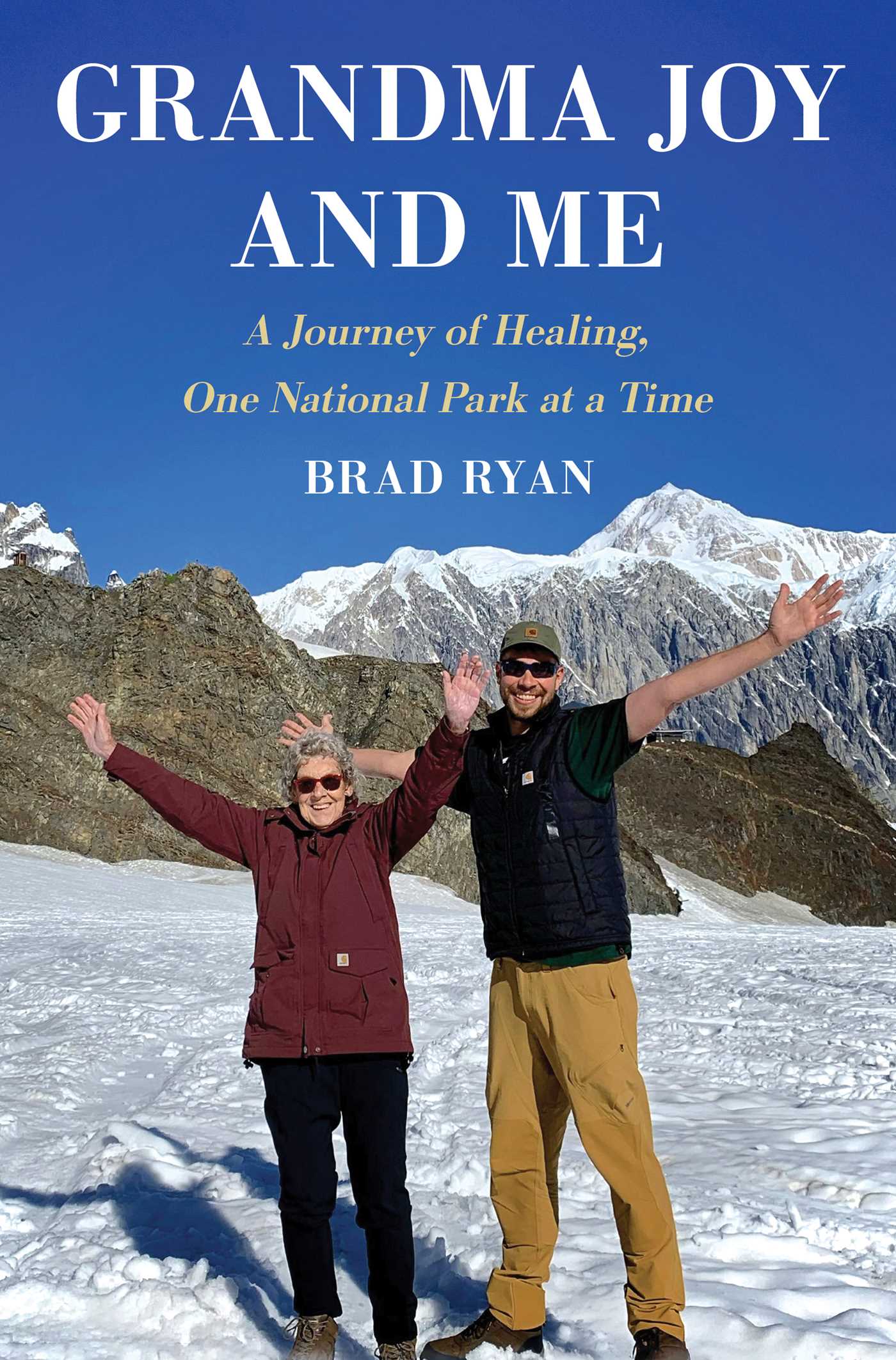
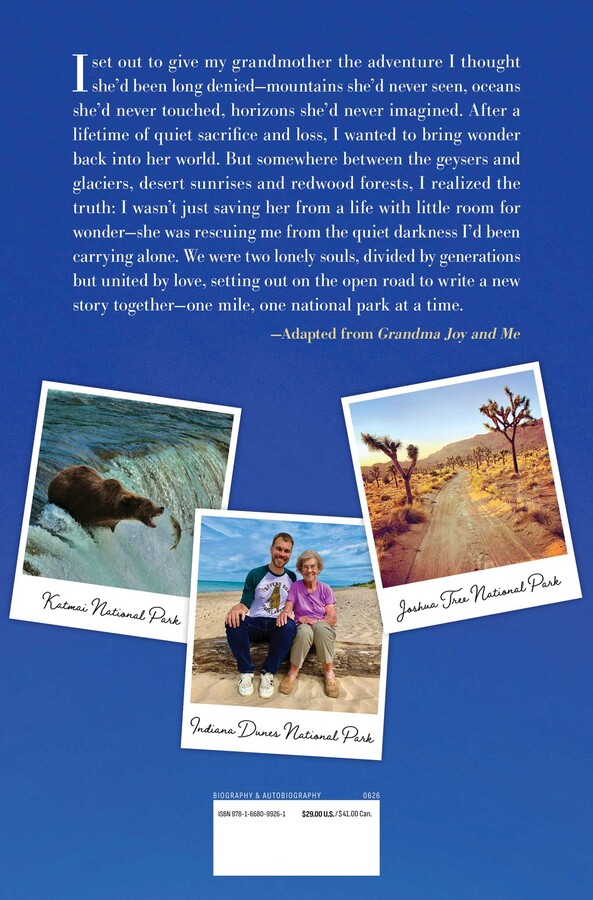
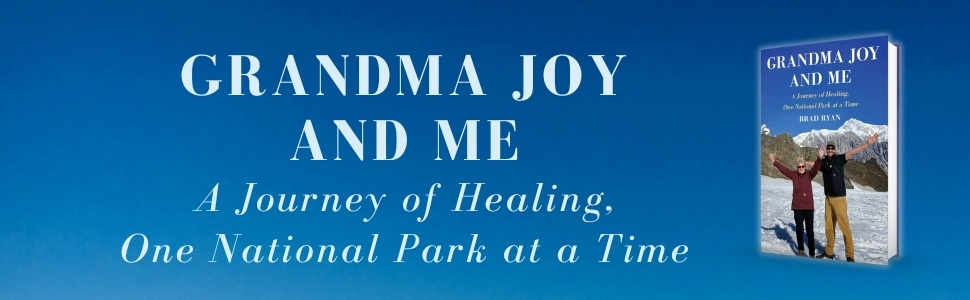
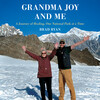
A heartrending, transformative true story following Brad Ryan and his grandmother Joy Ryan as they embark on a seven-year journey to visit every US National Park.
Raised in Appalachia, Grandma Joy lived a life shaped by constraints and hardships, while Brad grappled with the weight of family rifts and unresolved pain. Together, they embarked on a quest not only to witness the majesty of America’s wild landscapes but also to heal generations of struggles and misunderstandings. Over seven years, they sought to visit all sixty-three US National Parks. From the towering peaks of Denali to the otherworldly beauty of the Everglades, each park became a classroom, teaching them profound lessons about nature, resilience, and each other.
Grandma Joy and Me follows a seven-year adventure of intergenerational healing, wherein a grandmother and grandson find themselves released from the injustices—real and imagined—that had long held them hostage. An emotionally charged exploration of love, forgiveness, and resilience, this unique bond between a young man and his ninety-three-year-old grandmother—the oldest person to visit every US National Park—is more than just any travel tale; it is a testament to what makes us deeply human.
Raised in Appalachia, Grandma Joy lived a life shaped by constraints and hardships, while Brad grappled with the weight of family rifts and unresolved pain. Together, they embarked on a quest not only to witness the majesty of America’s wild landscapes but also to heal generations of struggles and misunderstandings. Over seven years, they sought to visit all sixty-three US National Parks. From the towering peaks of Denali to the otherworldly beauty of the Everglades, each park became a classroom, teaching them profound lessons about nature, resilience, and each other.
Grandma Joy and Me follows a seven-year adventure of intergenerational healing, wherein a grandmother and grandson find themselves released from the injustices—real and imagined—that had long held them hostage. An emotionally charged exploration of love, forgiveness, and resilience, this unique bond between a young man and his ninety-three-year-old grandmother—the oldest person to visit every US National Park—is more than just any travel tale; it is a testament to what makes us deeply human.
Excerpt
Chapter 1: The First Mountain 1. THE FIRST MOUNTAIN
September 25, 2015
I piloted my Ford Escape south on Interstate 71 toward Cincinnati as Grandma Joy gazed out the window through her wire-rimmed trifocals at a vast expanse of harvest-shorn cornstalks flattened to the earth. I glanced at her wizened hands folded neatly in her lap. We were just one hour into our seven-hour drive, having sprung her from our Mayberry-like hometown of Duncan Falls, Ohio. With each mile, I carried her farther from our two–traffic light town, population under a thousand—where I’d been raised and she’d spent most of her life—on her first ever camping trip to see her first mountain.
But now I worried. How would those hands fare assembling our tent once we arrived at the Elkmont Campground in Great Smoky Mountains National Park? The forecast had turned dour, rainstorms expected. Would she still be smiling tomorrow morning after sleeping on an air mattress, possibly in a downpour? What had I been thinking?
Despite my worries, her enthusiasm remained contagious.
“Lookie there!” She pointed to a tall grain silo towering above the tawny horizon. “My word. That thing’s humongous!”
“It sure is,” I answered, doing my best to sound steady while my thoughts circled nervously—trying to convince myself this wasn’t an ill-fated adventure.
“Good heavens, there’s a ladder goin’ up it. How’d you like to climb that?”
“No way!” I laughed. “Falling to my death is my worst fear. I’ll let you climb it.”
“Oh, sugar.” She chuckled.
It was around six on a Friday evening. The trees around the white farmhouse we passed were just beginning to fade to yellow. I was thirty-four and in the throes of my final year of veterinary school, which had been an all-consuming pressure cooker, a prison. But now I’d been given a few days away, the first weekend I’d truly had “off” in months. Nature was where I always recharged, but I hadn’t been able to break away since starting vet school. I hoped we might witness bugling elk during their annual rut, or, if we were lucky, a black bear foraging in the valley at Cades Cove under a gray-blue veil of Smoky Mountain mist. I wished that for my grandmother even more than for myself.
I’d met up with Grandma Joy at the end of my shift. My stepfather had driven her to The Ohio State University College of Veterinary Medicine, and together we hightailed it out of Columbus, me still wearing ceil-blue scrubs. I drove steadfastly into the night, bound for the mountains she had waited a lifetime to behold.
Five years earlier, I had reached out to Grandma Joy after nearly a decade of estrangement stemming from my parents’ bitter divorce. With my heart pounding, I showed up unannounced and knocked on her front door. She didn’t smile when she saw me, but she didn’t slam the door either—that felt like a win. I invited her to join me on a hike in Blue Rock State Park—a nostalgic place where fond memories were made in my childhood, and where we could begin to fill in the details from our season of silence.
We followed the Muskingum River south before turning onto Cutler Lake Road. In the still-barren woods, we walked a high bank above a swollen stream. A sudden, clamorous splash broke the quiet. Below us, a thick-bodied shape arrowed through the water, its long black paddle tail clearly visible.
“Oh, my God,” I whispered. “It’s a beaver.”
She turned to me with a surprised smile I hadn’t seen since before our fallout. We stood in close communion, watching it glide downstream until it slipped from view. Something in us settled, like silt in clear water. Nature was the thread that stitched us back together.
As we moved on, I told her I’d been hiking in Blue Rock daily since returning from the Appalachian Trail (A.T.)—my six-month trek on a 2,200-mile footpath through the wilderness from Georgia to Maine. She studied me with admiring disbelief, trying to reconcile how her unathletic grandson had managed such a feat.
I recounted to Grandma Joy the story of a spring morning when I watched the sun rise over the balds in Virginia’s Grayson Highlands. Wild ponies nibbled the grasses against a wash of spring rhododendrons and dogwoods in bloom. In Pennsylvania, the trail was notoriously rocky but rimmed with wild blueberries. I threw my pack down and ate until my stomach ached. I described the clusters of pink, cup-shaped mountain laurel painting the hillside where I lay curled in the fetal position to nurse my sick belly. And when I described the view from Mount Katahdin, Maine’s highest peak, the final stop on my trek, her eyes softened.
“That must be something,” she’d said tenderly. “I regret not seeing more of the great outdoors in my life. I never even got to see a mountain.”
Her words bothered me then and even more as the weeks and years passed. The love of nature she instilled in me had taken me around the world to conserve cheetahs in Namibia and study hyenas in South Africa’s Kruger National Park. Grandma Joy, though, had rarely left her Northern Appalachian home, aside from a handful of fishing trips with Grandpa Bob to Canada and their winter circuits to Lake Okeechobee in Florida.
I’d been fortunate, seeing far more of the world than the average Duncan Falls native. Through my travels, I’d found peace and a deep sense of self; meeting people from elsewhere widened what I thought possible for my life. It seemed unjust that Grandma Joy had lived eight decades without experiencing so many of the wonders that fed my soul. When I realized how small her lens on the world was, I vowed to widen it.
At least that’s what I told myself five years later, when I finally invited her, on the spur of the moment, to join me for a weekend in the Smokies.
The other impetus for our road trip was deeper—and darker—a private burden I needed to share.
Earlier that morning, I’d been perched on a hard stool in a dark reading room scanning a lateral abdominal radiograph of a cat with acute GI distress. I stared blankly at the tangled loops of small intestine on the imaging screen, searching for any sign of a blockage, though my thoughts kept circling back to David Hilton, the second-year student who hadn’t shown up for his urinary system exam earlier that week. No one could reach him, and an investigation was underway. By Thursday, a palpable unease had taken hold on campus. I worried vet school had drained every ounce of joy from David’s life—the same way it had drained mine.
Before vet school, I’d always thrived in academia. It was the one arena where I could make my father proud. Though he bemoaned my lack of sports acumen, he proudly handed me crisp twenties for my straight-A report cards.
That was back when we were still speaking—before I came out as gay and refused to hide my truth, and before a violent argument drove me from the paternal side of my family, Grandma Joy included.
I’d lived under the cloud of his disapproval my whole life, never tough enough or man enough for him. But I could always redeem myself academically—until now.
Though I locked myself in a study room for every waking hour, my exam scores had never been worse. For the first time in my life, I developed test anxiety, which spiraled into chronic depression and suicidal ideation. The only comforting thought, any guise of control, was the fantasy that I could make it all go away in an instant.
Driving down Lane Avenue at 3 a.m. during my third year, I closed my eyes, floored the accelerator, and pictured my body hitting a brick wall at eighty. The mental footage of my lifeless body swaddled me in a perverse calm. Though I’d dreamed my whole life of going to vet school—to be the first in my family to earn a college degree and become a doctor—now that I was here, my imposter syndrome had curdled into raw self-hatred. I was sure my acceptance to vet school had been an administrative blunder.
I tried to channel the man I’d become when I thru-hiked the Appalachian Trail—clear-eyed, boundless, known to my fellow thru-hikers only by my trail name, Hellbender. But that man no longer existed.
I moved on to the next radiograph, holding space for David Hilton, wherever he was, looking for some light in the darkness.
Hours before I set off with Grandma Joy, I entered the teaching hospital and passed the new dean deep in conversation with our associate dean of student affairs. Their faces looked dire. A knot formed in my stomach. When I arrived in the radiology suite, a rotation mate informed me that David Hilton’s body had been discovered; he’d taken his own life.
During rounds, I had trouble hearing any words. David’s name was the newest addition to a long list of vet students and veterinarians lost to suicide. I snuck into the bathroom and stared at myself in the mirror, terrified by how close I’d come to making the same decision.
Five months had passed since I’d had a weekend off, and even longer since I’d breathed in earthy moss and sweet pines. That’s when I hatched my plan. The Smokies were only seven hours away. I would grab my tent and go.
In the mountains, with duff under my feet and the music of brooks drowning out the screed in my head, maybe I’d find myself again. But being in nature wasn’t enough to comfort me. I needed to be with someone who loved me. I needed her, but this was also the perfect chance to check a long overdue dream off Grandma Joy’s bucket list.
I dialed her number. “What are you up to this weekend?”
“Nothing much, punkin. Just sitting here crocheting.”
“How would you feel about seeing your first mountain?”
“Mountain?”
“I need to get away. I want to go down to the Smokies, and I’d love for you to join me. I could really use the company. What do you say?”
“What time are you picking me up?” she asked without missing a beat.
By five that evening, I placed her suitcase in the backseat and opened my passenger door. I rolled down the windows, turned on some bluegrass, and headed south.
“Okay my way!” Grandma Joy shouted as she peered out the passenger window—signaling there were no vehicles coming from her direction and it was safe to turn left. Her catchphrase took me back to truck rides through the southeastern Ohio countryside with my grandparents when I was young—like no time had passed at all.
“I’m glad you’re here,” I said. “Can you believe you’re going to sleep in a tent tonight?”
Her eyes widened. “Might as well give ’er a whirl. You reckon it’ll be raining when we get down there?”
The forecast looked dicey, but after living in the Appalachian wilderness for six months, I knew a 50 percent chance of rain also meant a 50 percent chance of no rain, so I never let the weatherman rattle me.
“It looks good up here,” I said. “But it’s hard to say what we’re driving into.”
“Oh, well. We won’t melt, will we?” She scrunched up her face, lowering her forehead as she raised her nose. A woman of few words, her gestures often said more, and right now her face said it’s no big deal. She pointed to the large pink golf umbrella she’d brought along just in case.
The rain began to fall softly as we proceeded down Interstate 75 South through the Daniel Boone National Forest. I cranked up Dolly Parton to drown out the hypnotic rhythm of the drops. My eyelids were getting heavy, and we still had hours of night driving ahead.
“I really like her.” Grandma Joy gestured at the radio.
“Did you know Dolly grew up with eleven brothers and sisters in a two-room cabin in the Smokies?”
“Heavens, no! Boy, that’d be crowded. But you know my three boys shared one bedroom, and we got along just fine. Kids these days spend too much time cooped up inside if you ask me.”
“Dolly didn’t have running water or electricity,” I said. “She’d catch fireflies in a mason jar to make a night-light.”
“I hope she poked holes in the lid so they could breathe. God love ’em!”
I must have watched 9 to 5 a hundred times growing up. Of all the artists on the radio, no one made me happier than Dolly. My sister, Lindsay, was a national clogging champion, so we vacationed in Gatlinburg and Pigeon Forge every year for her competitions. I begged my parents to take me to Dollywood, and they obliged.
When I was nine, I even persuaded my mom to buy me a blond wig, a red-and-white polka-dot dress, and balloons to fashion a busty Dolly Parton costume for Halloween. I considered every detail, down to the beauty mark beneath her lower lip, which I drew on with mascara. My father glared across the room like a man witnessing the slow death of his last good hope as my mother stuffed my bra. He looked terrified as I sashayed out the front door in high heels to go trick-or-treating with my sister, undoubtedly wishing I had chosen to be G.I. Joe or He-Man, but instead he got a pint-size Dolly—and honey, I was fully committed.
The rain was merciless by the time we crossed the Tennessee border, and it continued until we pulled into Elkmont Campground at one in the morning. We followed the numbered signs along the Little River to our reserved campsite complete with a gravel tent pad, picnic table, and fire ring. We only needed to assemble our tent without getting soaked.
I shined my headlights on the tent pad and reached for the tent. Grandma Joy opened her umbrella. As I assembled the poles, she held the umbrella over my head with one hand and aimed a flashlight on my hands with the other. A gust of wind blew her backward a few steps, and cold water cascaded off the umbrella’s ribs onto my back while she found her footing.
“You okay?” I asked.
“Fine and dandy,” she shot back, shielding me once again as the rain forced a torrent of leaves to spiral down around us.
I moved quickly to stake the tent corners and secure the rainfly, then wiped the tent floor dry before taking the umbrella from Grandma Joy. She sat on the ground at the tent door, slipped off her wet shoes beneath the vestibule, then crawled inside.
Guided by my headlamp, I blew up the mattress while she unfurled our sleeping bags. Once we were situated, I let out a sigh.
“That wind’s still blowing like a son of a gun,” she said.
“If the rain stops tomorrow, let’s drive over to Cades Cove and find a black bear.”
“Alrighty. I’d get a kick out of that.”
“Have a good night, Grandma Joy.”
I turned off my headlamp, closed my eyes, and relished the water careening down the Little River over sandstone cobbles. It was the familiar peace I’d felt on the Appalachian Trail.
I was anxious to see her reaction when the haze cleared and she scanned the horizon for the first time. With the specter of David Hilton’s suicide hanging over me and the rain pouring down, I took in a deep breath of Smoky Mountain air and sighed again. I didn’t know how long it would last, but I was thankful to feel content in my own skin, even for a fleeting moment.
Grandma Joy began to snore—like a lawn mower with a faulty spark plug, the timbre reverberating off the tent at six-second intervals. In her haste to pack, she’d forgotten to bring a cup and Efferdent tabs for her dentures. I worried they might dislodge and cause her to choke. Eventually my exhaustion overrode her log-sawing rumble, and I drifted off.
At some ungodly hour, the air mattress shifted beneath me, and I heard a booming thump. I fumbled for my headlamp and discovered Grandma Joy was no longer beside me. I lurched forward to see her feet peeking out from beneath the mattress like the Wicked Witch of the East pinned beneath Dorothy Gale’s farmhouse.
“Are you hurt?” I asked, panicked.
Grandma Joy chuckled. “Good gravy! This is like one of those Laurel and Hardy movies.” She rolled toward the wall of the tent and her head popped up with a sheepish grin. We fussed around to right the situation.
“I think the darned plug came out,” she said. “Good thing I didn’t zip myself in that sleeping bag or else I might never get out from under here.”
“I’m just glad you didn’t break a hip.”
“Oh, fiddlesticks! I’d have to fall more than a few inches for that to happen.”
Soon, we were sleeping again.
But when I awoke within the hour, Grandma Joy was eerily silent. I listened for the faintest trace of a snore, anything to contradict my growing fear I might be lying next to a corpse. I heard nothing but the cacophony of raindrops pummeling our tent.
“Grandma!” I hollered and poked her hard between the shoulders.
She gasped and the mattress swayed. “What in the dickens is wrong with you?”
I paused, then confessed. “I thought you were dead.”
“Dead? Well, you almost saw to it, with the fright you just gave me.”
“I’m sorry.” I laughed. “Let’s try to sleep, but I need a favor.”
“What’s that, punkin?”
“Keep snoring, so I know you’re still alive.”
The rain continued to fall the next morning. Thick fog swallowed the mountains, so we scrapped our bear-viewing plans and headed to Gatlinburg to grab breakfast and wait for the skies to clear. We traded the park’s quietude for a bustling tourist trap lined with saltwater taffy shops, Old Tyme portrait studios, and miniature golf courses. Even in the drizzle, hordes of tourists pressed along the cramped sidewalks.
“Oh, brother!” Grandma Joy frowned. “This is a madhouse. You couldn’t pay me to come here on vacation. I’ll be glad to get outta this mess!”
“Let’s skip the pancakes and head over to the Cherokee, North Carolina, side to see some elk. It’s rut season—hopefully they’ll put on a show for us.”
“I’d love to see that!”
We grabbed some Macintosh apples from our cooler and ate them for breakfast as we climbed toward Newfound Gap. A half hour later, the fog began to lift as we approached the Oconaluftee Visitor Center, just outside Cherokee.
“I’m going to run in and ask the rangers for the forecast for the rest of the day,” I said.
“Oh, good!” she replied. “I have to go pee diddle.”
We were barely back on the road, when we noticed a long line of vehicles parked along both sides of Newfound Gap Road. Scores of people stared across the grassy field. We parked along the brim, then joined a small group gathered around a park ranger who pointed to the expansive antlers of a bull elk nestled within a small herd of cows grazing about a hundred yards from the road.
“That’s the dominant bull,” the ranger said. “He spends most of the day warding off challenges and rounding up any cows who try to escape. His behavior is driven by a surge in testosterone and his instinct to pass on his genes. By the time the rut is over, the dominant bull typically loses two hundred pounds—about twenty percent of his body weight.”
“Not much time to eat I suppose,” Grandma Joy said. “Oh, lookie there!” She pointed to a slightly smaller bull lying in a muddy ditch. Huge clumps of mud and grass dangled from his rack. He extended his long neck and swept his antlers in a powerful arc, slinging mud into the air.
“He’s throwing a conniption fit down there,” Grandma Joy said, hands over her heart, grinning. “By golly, he really wants a girlfriend. God love him.”
Off in the distance, the dominant bull raised his head to the sky and emitted a high-pitched bugle. At the rival’s call, a younger, displaced bull standing near the far edge of the field flared his nostrils, let out a low growl, then a shrill scream for five seconds. The dominant bull lowered his head and grunted as another clump of mud fell from his antlers. Just then, another bull bugled across the valley, but our attention remained fixed on the dominant bull before us.
“Keeping all his ladies corralled in this field is a full-time job,” the ranger said.
“Good heavens, yes! How’s he gonna keep up with all those gals?” Grandma Joy shook her head as three cows came to a screeching halt beside the harem. The bull held his ground.
We got back into the Escape and drove on, stopping to observe several bachelor herds along the way. Grandma Joy sized up each bull and pondered which had the best prospect to usurp the dominant one before the rut concluded in October.
“I never thought I’d see something like that in all my born days.” She grinned.
It was close to noon when the sun finally penetrated the clouds, though the fog had crept back in. We headed back to explore a short section of the A.T. at Newfound Gap.
The road snaked through a mixed hardwood stand of hemlocks, sugar maples, and yellow birches. The canopy was mostly green with a spattering of early autumn yellow from the basswoods and tulip trees. As we gained elevation, the forest opened to reveal exposed, rocky slopes where the forest composition shifted to pine and oak.
Grandma Joy pointed to a jagged ridgeline shaped by the contorted branches of pitch pines. “There sure are a lot more Christmas trees up here.”
I stopped at each overlook, hoping to show her a clear view, but the fog hijacked every vista.
“Do you see why they call them the Smoky Mountains?” I asked.
“Indeed, I do.”
When we reached the top of Thomas Divide, the blue haze finally lifted and revealed our first panorama. We stared down at the Oconaluftee Valley and breathed in the fragrance of red spruce and Fraser firs along the North Carolina–Tennessee border. A blistering series of tsee-tsee-tsee notes emanated from a golden-crowned kinglet as Grandma Joy set eyes on the Smokies for the first time. The corners of her mouth upturned slightly. Layers of evergreen softened to gray on the horizon beneath a sea of amber and Chantilly-pink clouds.
“We could stand here for the rest of our lives and never absorb all of this beauty,” I said. “It’s as impossible as taking in every pixel of a painting.”
Grandma Joy stood still and scanned the horizon. I placed my hands on her shoulders and asked, “Was it worth the wait?”
“You better believe it,” she said, her breath escaping softly, as if she’d forgotten she’d been holding it.
“Do you see the white rectangle on this tree?” I asked. “That blaze marks the A.T. You can follow the white blazes all the way south to Georgia or all the way north to Maine.”
“Oh, my word!”
We pulled into the Newfound Gap lot and walked to the brown sign at the trailhead.
“?‘Katahdin, Maine, one thousand nine hundred and seventy-two miles,’?” Grandma Joy read aloud. “I still don’t know how you did the whole thing!”
“One step at a time.” I smiled. “That’s the only way to do it.”
After our short jaunt on the A.T., we drove to the Alum Cave Bluffs trailhead. “Arch Rock is one point four miles up ahead. It’s a moderate climb,” I said.
“That doesn’t seem too bad.”
“If we keep going, we can reach the Alum Cave Bluffs, but that’s a pretty strenuous climb. That’s two point three miles from here.”
“We could always turn around if it gets too bad.” She shrugged.
We took off from the trailhead bound for the Alum Cave Bluffs, armed with four large bottles of Gatorade, a box of granola bars, and a spontaneous plan to climb our first mountain together.
Shortly into our hike, we crossed the first stream on an austere log bridge. Grandma Joy stopped halfway to peek over the rail and admire the water below. We followed the dirt path into an old-growth forest and drew in a deep, invigorating breath of petrichor rising from mosses in every shade of green, while we stared up into the dense beech-birch canopy. She giggled when a stubby, red-breasted nuthatch landed upside down on a hemlock trunk beside us.
“You’re a little show-off, aren’t you?” she said, smiling gleefully.
We crossed a second log bridge above Alum Cave Creek. Each time a group of hikers approached her from behind, Grandma Joy picked up her pace.
“Hey, we’re in no hurry.” I touched her shoulder. “The tortoise wins the race.”
“Oh, honey, I hate that you have to wait on me,” she said in an exaggerated, sullen tone. “You’d have been up there by now.”
“Let’s count the number of folks your age we’ve seen climbing this mountain, shall we?”
At a more treacherous log bridge—one side with a handrail, the other exposed—I led her across.
“Man alive! This is quite an adventure,” she exclaimed. “Now I know what it’s like to walk the plank!”
We stopped to rest, and two women emerged around the bend.
“Beautiful morning, isn’t it?” Grandma Joy called, her cheer ringing out.
“It certainly is,” the taller woman replied.
“I see you made it across the plank back there,” Grandma Joy said.
“We did. And apparently, so did you! I’m so impressed.”
“My grandson here decided to take me on a little adventure,” she said.
“Not too shabby for an eighty-five-year-old,” I boasted.
“You’re eighty-five?” the shorter woman said, eyes bugged. “I hope I have a grandson who’ll take me hiking when I’m your age. We’ll see you at the top!”
We were halfway up the steepest section when we stopped to rest. “It’s nice and cool in here, isn’t it?” she said, winded.
“Just take your time and let me know if you feel dizzy.”
As we climbed higher, the mist cooled our red faces. I followed behind her with arms outstretched, ready to catch her if she slipped on a wet root. We always let the faster hikers pass, but I couldn’t resist gloating to each passerby.
“Not bad for eighty-five, right?” I called out, pointing at my grandmother.
Each hiker raised their hand to give her a high five.
“You’re one badass, granny!” a thick-bearded man in a blue bandanna said.
Her forehead wrinkles collapsed as her eyebrows lifted. “What’s that all about?” she asked, peevish.
“Think about all the grandmas your age locked away in their houses and nursing homes,” I said. “You are climbing a mountain!”
Her playful scowl softened. “I guess I’m one of the lucky ones.”
We stopped for a Gatorade break along a rock outcropping and peered across at the Little Duck Hawk Range. Clouds obscured the distant mountains, but the near slope remained visible—verdant and splashed with burgundy, mustard, and coral.
“Autumn’s coming,” Grandma Joy said. “This sure is pretty country. My, oh my.”
Though we continued, I worried I might be pushing her too hard. “You won’t let me down if we need to turn back,” I reassured.
“We’re only gonna be here once,” she pronounced defiantly. “I’m getting to the top of this mountain if it kills me!”
We followed the ridgeline to a long series of steps that crept up the mountainside as far as we could see.
“My word!” she said. “It’ll be a miracle if we ever get there.”
“It can’t be too much farther.” I feigned optimism.
“You said that twenty times already. I’m gonna smack you for fibbing,” she snapped, still grinning, though exhausted.
We veered into the final steps, and from that vantage point I saw at least fifty hikers sitting beneath an eighty-foot wall of orange rock. We were finally there!
As we made our final approach, the hikers gathered beneath the Alum Cave Bluffs began to clap. I held firm to Grandma Joy’s arm. Everyone who’d passed us welcomed us with a standing ovation.
When the applause died, Grandma Joy raised her hand to her forehead and peered up at the bluff with fifty pairs of eyes on her. She squinted, then turned to me and shouted, “You mean you dragged me all the way up here for this little dip in the rock?”
Every onlooker burst out laughing in unison. Sure, it wasn’t the Grand Canyon, but I thought it was beautiful in its own right. Even though Grandma Joy was unimpressed, I was still proud of her willpower.
We stared at the skyline, hoping to catch a glimpse of a peregrine falcon when a group of college-age men approached. “Do you mind if we take a photo with you?”
“Who, me?” she shot back. “Why in the world do you want a picture with me?”
“We want to be like you when we grow up,” a tall blond guy said and handed me his camera. He helped Grandma Joy up. The others gathered, and she set humility aside, hamming it up in a series of poses beneath the mighty dip in the rock.
Later that night, we made a campfire and relived the day. She’d not only seen her first mountain, but also climbed one.
“I’m proud of you, Grandma,” I said.
“Oh, it wasn’t nothing,” she replied, brushing it off. Her hands fidgeted with the paper plate in her lap. She stared into the fire as I continued.
“It means so much to be here with you,” I told her.
“I was happy to do it, punkin. I’m glad you called.”
My thoughts billowed into the crisp night air. I wondered what it would take to feel whole—if life would feel lighter when I returned to campus.
Looking at her across the fire, I thought about the resilience it took to face the world after losing her husband and two of her three sons. This little old lady with a high school education was a trove of wisdom. I’d learned more about myself in one weekend in the wilderness with her than in thirteen years of higher learning. I was in awe of Grandma Joy’s spirit. Because her blood ran through me, I hoped I could channel her grit when I needed it.
It was late, and we were growing drowsy, hypnotized by the glowing, red-hot embers. Suddenly Grandma Joy’s voice broke through the night chorus of crickets and katydids.
Without preface or provocation, she announced, “Your Grandpa Bob and I always knew you were gay.”
My fight-flight-freeze response kicked in, and I froze. A million questions flooded my brain, but I wasn’t sure I wanted to hear her answers. Then I felt sick. Though I accepted myself, I still wasn’t prepared to discuss my sexual orientation with my grandmother. I had always been content living a double life without creating any unnecessary awkwardness between us. Yet her words had been years in the making—and so very needed. Her voice was warm and reassuring, so why was I rattled?
“I didn’t think you knew,” I said finally.
Her eyes widened beneath the reflection of dying embers on her glasses. “I may be old, Brad, but I’m not senile,” she said. “If I accepted you when you were two, then I accept you now. That’s all there is to it.”
She walked over and tapped my shoulder. “God love ya,” she said, then disappeared into the tent. I tossed another log on the fire and closed my eyes. The crickets kept me company a little while longer as the gravity of her words settled—that my lifetime of hiding had been for naught. Nothing was ever what it seemed.
We packed up the following morning. Before driving back to Ohio, we detoured to Clingmans Dome, the highest point in the park. We drove the winding road to the lot, then walked the paved half-mile trail to the observation tower.
The inspirational panoramic view of the Smokies reminded me what had been missing in my life since vet school commenced: connection with family, the joy of exploration, sharing nature with someone I loved. I’d lost nearly a decade with Grandma Joy after my parents’ divorce, but maybe it wasn’t too late. I hoped we could plan more road trips once vet school was behind me.
Grandma Joy hiked ahead on our descent, her yellow fleece bright as a canary winging through the clouds that settled around us. I snapped a photo and hurried after her into the fog.
After a full day’s drive, we arrived back in Duncan Falls. I helped her up the porch steps and stood behind her while she fumbled with the key. She opened the door and turned to grab her duffel. She was crying.
“Thank you, Brad. Most grandsons wouldn’t have done a thing like that. I really appreciate it.” She wrapped her arms around me.
I pulled out of her driveway and headed back to Columbus. Tomorrow I’d be back in my scrubs reading radiographs, but in this moment, I was free. Our weekend in the Smokies had mended something in me I thought was beyond repair. But as I drove farther from Duncan Falls, guilt edged in. Tomorrow she would return to her daily walks around the cemetery. I couldn’t let that happen, not after offering her this taste of a new world.
My foot pressed the accelerator, my hometown in the rearview mirror. “I can’t let it end here.”
September 25, 2015
I piloted my Ford Escape south on Interstate 71 toward Cincinnati as Grandma Joy gazed out the window through her wire-rimmed trifocals at a vast expanse of harvest-shorn cornstalks flattened to the earth. I glanced at her wizened hands folded neatly in her lap. We were just one hour into our seven-hour drive, having sprung her from our Mayberry-like hometown of Duncan Falls, Ohio. With each mile, I carried her farther from our two–traffic light town, population under a thousand—where I’d been raised and she’d spent most of her life—on her first ever camping trip to see her first mountain.
But now I worried. How would those hands fare assembling our tent once we arrived at the Elkmont Campground in Great Smoky Mountains National Park? The forecast had turned dour, rainstorms expected. Would she still be smiling tomorrow morning after sleeping on an air mattress, possibly in a downpour? What had I been thinking?
Despite my worries, her enthusiasm remained contagious.
“Lookie there!” She pointed to a tall grain silo towering above the tawny horizon. “My word. That thing’s humongous!”
“It sure is,” I answered, doing my best to sound steady while my thoughts circled nervously—trying to convince myself this wasn’t an ill-fated adventure.
“Good heavens, there’s a ladder goin’ up it. How’d you like to climb that?”
“No way!” I laughed. “Falling to my death is my worst fear. I’ll let you climb it.”
“Oh, sugar.” She chuckled.
It was around six on a Friday evening. The trees around the white farmhouse we passed were just beginning to fade to yellow. I was thirty-four and in the throes of my final year of veterinary school, which had been an all-consuming pressure cooker, a prison. But now I’d been given a few days away, the first weekend I’d truly had “off” in months. Nature was where I always recharged, but I hadn’t been able to break away since starting vet school. I hoped we might witness bugling elk during their annual rut, or, if we were lucky, a black bear foraging in the valley at Cades Cove under a gray-blue veil of Smoky Mountain mist. I wished that for my grandmother even more than for myself.
I’d met up with Grandma Joy at the end of my shift. My stepfather had driven her to The Ohio State University College of Veterinary Medicine, and together we hightailed it out of Columbus, me still wearing ceil-blue scrubs. I drove steadfastly into the night, bound for the mountains she had waited a lifetime to behold.
Five years earlier, I had reached out to Grandma Joy after nearly a decade of estrangement stemming from my parents’ bitter divorce. With my heart pounding, I showed up unannounced and knocked on her front door. She didn’t smile when she saw me, but she didn’t slam the door either—that felt like a win. I invited her to join me on a hike in Blue Rock State Park—a nostalgic place where fond memories were made in my childhood, and where we could begin to fill in the details from our season of silence.
We followed the Muskingum River south before turning onto Cutler Lake Road. In the still-barren woods, we walked a high bank above a swollen stream. A sudden, clamorous splash broke the quiet. Below us, a thick-bodied shape arrowed through the water, its long black paddle tail clearly visible.
“Oh, my God,” I whispered. “It’s a beaver.”
She turned to me with a surprised smile I hadn’t seen since before our fallout. We stood in close communion, watching it glide downstream until it slipped from view. Something in us settled, like silt in clear water. Nature was the thread that stitched us back together.
As we moved on, I told her I’d been hiking in Blue Rock daily since returning from the Appalachian Trail (A.T.)—my six-month trek on a 2,200-mile footpath through the wilderness from Georgia to Maine. She studied me with admiring disbelief, trying to reconcile how her unathletic grandson had managed such a feat.
I recounted to Grandma Joy the story of a spring morning when I watched the sun rise over the balds in Virginia’s Grayson Highlands. Wild ponies nibbled the grasses against a wash of spring rhododendrons and dogwoods in bloom. In Pennsylvania, the trail was notoriously rocky but rimmed with wild blueberries. I threw my pack down and ate until my stomach ached. I described the clusters of pink, cup-shaped mountain laurel painting the hillside where I lay curled in the fetal position to nurse my sick belly. And when I described the view from Mount Katahdin, Maine’s highest peak, the final stop on my trek, her eyes softened.
“That must be something,” she’d said tenderly. “I regret not seeing more of the great outdoors in my life. I never even got to see a mountain.”
Her words bothered me then and even more as the weeks and years passed. The love of nature she instilled in me had taken me around the world to conserve cheetahs in Namibia and study hyenas in South Africa’s Kruger National Park. Grandma Joy, though, had rarely left her Northern Appalachian home, aside from a handful of fishing trips with Grandpa Bob to Canada and their winter circuits to Lake Okeechobee in Florida.
I’d been fortunate, seeing far more of the world than the average Duncan Falls native. Through my travels, I’d found peace and a deep sense of self; meeting people from elsewhere widened what I thought possible for my life. It seemed unjust that Grandma Joy had lived eight decades without experiencing so many of the wonders that fed my soul. When I realized how small her lens on the world was, I vowed to widen it.
At least that’s what I told myself five years later, when I finally invited her, on the spur of the moment, to join me for a weekend in the Smokies.
The other impetus for our road trip was deeper—and darker—a private burden I needed to share.
Earlier that morning, I’d been perched on a hard stool in a dark reading room scanning a lateral abdominal radiograph of a cat with acute GI distress. I stared blankly at the tangled loops of small intestine on the imaging screen, searching for any sign of a blockage, though my thoughts kept circling back to David Hilton, the second-year student who hadn’t shown up for his urinary system exam earlier that week. No one could reach him, and an investigation was underway. By Thursday, a palpable unease had taken hold on campus. I worried vet school had drained every ounce of joy from David’s life—the same way it had drained mine.
Before vet school, I’d always thrived in academia. It was the one arena where I could make my father proud. Though he bemoaned my lack of sports acumen, he proudly handed me crisp twenties for my straight-A report cards.
That was back when we were still speaking—before I came out as gay and refused to hide my truth, and before a violent argument drove me from the paternal side of my family, Grandma Joy included.
I’d lived under the cloud of his disapproval my whole life, never tough enough or man enough for him. But I could always redeem myself academically—until now.
Though I locked myself in a study room for every waking hour, my exam scores had never been worse. For the first time in my life, I developed test anxiety, which spiraled into chronic depression and suicidal ideation. The only comforting thought, any guise of control, was the fantasy that I could make it all go away in an instant.
Driving down Lane Avenue at 3 a.m. during my third year, I closed my eyes, floored the accelerator, and pictured my body hitting a brick wall at eighty. The mental footage of my lifeless body swaddled me in a perverse calm. Though I’d dreamed my whole life of going to vet school—to be the first in my family to earn a college degree and become a doctor—now that I was here, my imposter syndrome had curdled into raw self-hatred. I was sure my acceptance to vet school had been an administrative blunder.
I tried to channel the man I’d become when I thru-hiked the Appalachian Trail—clear-eyed, boundless, known to my fellow thru-hikers only by my trail name, Hellbender. But that man no longer existed.
I moved on to the next radiograph, holding space for David Hilton, wherever he was, looking for some light in the darkness.
Hours before I set off with Grandma Joy, I entered the teaching hospital and passed the new dean deep in conversation with our associate dean of student affairs. Their faces looked dire. A knot formed in my stomach. When I arrived in the radiology suite, a rotation mate informed me that David Hilton’s body had been discovered; he’d taken his own life.
During rounds, I had trouble hearing any words. David’s name was the newest addition to a long list of vet students and veterinarians lost to suicide. I snuck into the bathroom and stared at myself in the mirror, terrified by how close I’d come to making the same decision.
Five months had passed since I’d had a weekend off, and even longer since I’d breathed in earthy moss and sweet pines. That’s when I hatched my plan. The Smokies were only seven hours away. I would grab my tent and go.
In the mountains, with duff under my feet and the music of brooks drowning out the screed in my head, maybe I’d find myself again. But being in nature wasn’t enough to comfort me. I needed to be with someone who loved me. I needed her, but this was also the perfect chance to check a long overdue dream off Grandma Joy’s bucket list.
I dialed her number. “What are you up to this weekend?”
“Nothing much, punkin. Just sitting here crocheting.”
“How would you feel about seeing your first mountain?”
“Mountain?”
“I need to get away. I want to go down to the Smokies, and I’d love for you to join me. I could really use the company. What do you say?”
“What time are you picking me up?” she asked without missing a beat.
By five that evening, I placed her suitcase in the backseat and opened my passenger door. I rolled down the windows, turned on some bluegrass, and headed south.
“Okay my way!” Grandma Joy shouted as she peered out the passenger window—signaling there were no vehicles coming from her direction and it was safe to turn left. Her catchphrase took me back to truck rides through the southeastern Ohio countryside with my grandparents when I was young—like no time had passed at all.
“I’m glad you’re here,” I said. “Can you believe you’re going to sleep in a tent tonight?”
Her eyes widened. “Might as well give ’er a whirl. You reckon it’ll be raining when we get down there?”
The forecast looked dicey, but after living in the Appalachian wilderness for six months, I knew a 50 percent chance of rain also meant a 50 percent chance of no rain, so I never let the weatherman rattle me.
“It looks good up here,” I said. “But it’s hard to say what we’re driving into.”
“Oh, well. We won’t melt, will we?” She scrunched up her face, lowering her forehead as she raised her nose. A woman of few words, her gestures often said more, and right now her face said it’s no big deal. She pointed to the large pink golf umbrella she’d brought along just in case.
The rain began to fall softly as we proceeded down Interstate 75 South through the Daniel Boone National Forest. I cranked up Dolly Parton to drown out the hypnotic rhythm of the drops. My eyelids were getting heavy, and we still had hours of night driving ahead.
“I really like her.” Grandma Joy gestured at the radio.
“Did you know Dolly grew up with eleven brothers and sisters in a two-room cabin in the Smokies?”
“Heavens, no! Boy, that’d be crowded. But you know my three boys shared one bedroom, and we got along just fine. Kids these days spend too much time cooped up inside if you ask me.”
“Dolly didn’t have running water or electricity,” I said. “She’d catch fireflies in a mason jar to make a night-light.”
“I hope she poked holes in the lid so they could breathe. God love ’em!”
I must have watched 9 to 5 a hundred times growing up. Of all the artists on the radio, no one made me happier than Dolly. My sister, Lindsay, was a national clogging champion, so we vacationed in Gatlinburg and Pigeon Forge every year for her competitions. I begged my parents to take me to Dollywood, and they obliged.
When I was nine, I even persuaded my mom to buy me a blond wig, a red-and-white polka-dot dress, and balloons to fashion a busty Dolly Parton costume for Halloween. I considered every detail, down to the beauty mark beneath her lower lip, which I drew on with mascara. My father glared across the room like a man witnessing the slow death of his last good hope as my mother stuffed my bra. He looked terrified as I sashayed out the front door in high heels to go trick-or-treating with my sister, undoubtedly wishing I had chosen to be G.I. Joe or He-Man, but instead he got a pint-size Dolly—and honey, I was fully committed.
The rain was merciless by the time we crossed the Tennessee border, and it continued until we pulled into Elkmont Campground at one in the morning. We followed the numbered signs along the Little River to our reserved campsite complete with a gravel tent pad, picnic table, and fire ring. We only needed to assemble our tent without getting soaked.
I shined my headlights on the tent pad and reached for the tent. Grandma Joy opened her umbrella. As I assembled the poles, she held the umbrella over my head with one hand and aimed a flashlight on my hands with the other. A gust of wind blew her backward a few steps, and cold water cascaded off the umbrella’s ribs onto my back while she found her footing.
“You okay?” I asked.
“Fine and dandy,” she shot back, shielding me once again as the rain forced a torrent of leaves to spiral down around us.
I moved quickly to stake the tent corners and secure the rainfly, then wiped the tent floor dry before taking the umbrella from Grandma Joy. She sat on the ground at the tent door, slipped off her wet shoes beneath the vestibule, then crawled inside.
Guided by my headlamp, I blew up the mattress while she unfurled our sleeping bags. Once we were situated, I let out a sigh.
“That wind’s still blowing like a son of a gun,” she said.
“If the rain stops tomorrow, let’s drive over to Cades Cove and find a black bear.”
“Alrighty. I’d get a kick out of that.”
“Have a good night, Grandma Joy.”
I turned off my headlamp, closed my eyes, and relished the water careening down the Little River over sandstone cobbles. It was the familiar peace I’d felt on the Appalachian Trail.
I was anxious to see her reaction when the haze cleared and she scanned the horizon for the first time. With the specter of David Hilton’s suicide hanging over me and the rain pouring down, I took in a deep breath of Smoky Mountain air and sighed again. I didn’t know how long it would last, but I was thankful to feel content in my own skin, even for a fleeting moment.
Grandma Joy began to snore—like a lawn mower with a faulty spark plug, the timbre reverberating off the tent at six-second intervals. In her haste to pack, she’d forgotten to bring a cup and Efferdent tabs for her dentures. I worried they might dislodge and cause her to choke. Eventually my exhaustion overrode her log-sawing rumble, and I drifted off.
At some ungodly hour, the air mattress shifted beneath me, and I heard a booming thump. I fumbled for my headlamp and discovered Grandma Joy was no longer beside me. I lurched forward to see her feet peeking out from beneath the mattress like the Wicked Witch of the East pinned beneath Dorothy Gale’s farmhouse.
“Are you hurt?” I asked, panicked.
Grandma Joy chuckled. “Good gravy! This is like one of those Laurel and Hardy movies.” She rolled toward the wall of the tent and her head popped up with a sheepish grin. We fussed around to right the situation.
“I think the darned plug came out,” she said. “Good thing I didn’t zip myself in that sleeping bag or else I might never get out from under here.”
“I’m just glad you didn’t break a hip.”
“Oh, fiddlesticks! I’d have to fall more than a few inches for that to happen.”
Soon, we were sleeping again.
But when I awoke within the hour, Grandma Joy was eerily silent. I listened for the faintest trace of a snore, anything to contradict my growing fear I might be lying next to a corpse. I heard nothing but the cacophony of raindrops pummeling our tent.
“Grandma!” I hollered and poked her hard between the shoulders.
She gasped and the mattress swayed. “What in the dickens is wrong with you?”
I paused, then confessed. “I thought you were dead.”
“Dead? Well, you almost saw to it, with the fright you just gave me.”
“I’m sorry.” I laughed. “Let’s try to sleep, but I need a favor.”
“What’s that, punkin?”
“Keep snoring, so I know you’re still alive.”
The rain continued to fall the next morning. Thick fog swallowed the mountains, so we scrapped our bear-viewing plans and headed to Gatlinburg to grab breakfast and wait for the skies to clear. We traded the park’s quietude for a bustling tourist trap lined with saltwater taffy shops, Old Tyme portrait studios, and miniature golf courses. Even in the drizzle, hordes of tourists pressed along the cramped sidewalks.
“Oh, brother!” Grandma Joy frowned. “This is a madhouse. You couldn’t pay me to come here on vacation. I’ll be glad to get outta this mess!”
“Let’s skip the pancakes and head over to the Cherokee, North Carolina, side to see some elk. It’s rut season—hopefully they’ll put on a show for us.”
“I’d love to see that!”
We grabbed some Macintosh apples from our cooler and ate them for breakfast as we climbed toward Newfound Gap. A half hour later, the fog began to lift as we approached the Oconaluftee Visitor Center, just outside Cherokee.
“I’m going to run in and ask the rangers for the forecast for the rest of the day,” I said.
“Oh, good!” she replied. “I have to go pee diddle.”
We were barely back on the road, when we noticed a long line of vehicles parked along both sides of Newfound Gap Road. Scores of people stared across the grassy field. We parked along the brim, then joined a small group gathered around a park ranger who pointed to the expansive antlers of a bull elk nestled within a small herd of cows grazing about a hundred yards from the road.
“That’s the dominant bull,” the ranger said. “He spends most of the day warding off challenges and rounding up any cows who try to escape. His behavior is driven by a surge in testosterone and his instinct to pass on his genes. By the time the rut is over, the dominant bull typically loses two hundred pounds—about twenty percent of his body weight.”
“Not much time to eat I suppose,” Grandma Joy said. “Oh, lookie there!” She pointed to a slightly smaller bull lying in a muddy ditch. Huge clumps of mud and grass dangled from his rack. He extended his long neck and swept his antlers in a powerful arc, slinging mud into the air.
“He’s throwing a conniption fit down there,” Grandma Joy said, hands over her heart, grinning. “By golly, he really wants a girlfriend. God love him.”
Off in the distance, the dominant bull raised his head to the sky and emitted a high-pitched bugle. At the rival’s call, a younger, displaced bull standing near the far edge of the field flared his nostrils, let out a low growl, then a shrill scream for five seconds. The dominant bull lowered his head and grunted as another clump of mud fell from his antlers. Just then, another bull bugled across the valley, but our attention remained fixed on the dominant bull before us.
“Keeping all his ladies corralled in this field is a full-time job,” the ranger said.
“Good heavens, yes! How’s he gonna keep up with all those gals?” Grandma Joy shook her head as three cows came to a screeching halt beside the harem. The bull held his ground.
We got back into the Escape and drove on, stopping to observe several bachelor herds along the way. Grandma Joy sized up each bull and pondered which had the best prospect to usurp the dominant one before the rut concluded in October.
“I never thought I’d see something like that in all my born days.” She grinned.
It was close to noon when the sun finally penetrated the clouds, though the fog had crept back in. We headed back to explore a short section of the A.T. at Newfound Gap.
The road snaked through a mixed hardwood stand of hemlocks, sugar maples, and yellow birches. The canopy was mostly green with a spattering of early autumn yellow from the basswoods and tulip trees. As we gained elevation, the forest opened to reveal exposed, rocky slopes where the forest composition shifted to pine and oak.
Grandma Joy pointed to a jagged ridgeline shaped by the contorted branches of pitch pines. “There sure are a lot more Christmas trees up here.”
I stopped at each overlook, hoping to show her a clear view, but the fog hijacked every vista.
“Do you see why they call them the Smoky Mountains?” I asked.
“Indeed, I do.”
When we reached the top of Thomas Divide, the blue haze finally lifted and revealed our first panorama. We stared down at the Oconaluftee Valley and breathed in the fragrance of red spruce and Fraser firs along the North Carolina–Tennessee border. A blistering series of tsee-tsee-tsee notes emanated from a golden-crowned kinglet as Grandma Joy set eyes on the Smokies for the first time. The corners of her mouth upturned slightly. Layers of evergreen softened to gray on the horizon beneath a sea of amber and Chantilly-pink clouds.
“We could stand here for the rest of our lives and never absorb all of this beauty,” I said. “It’s as impossible as taking in every pixel of a painting.”
Grandma Joy stood still and scanned the horizon. I placed my hands on her shoulders and asked, “Was it worth the wait?”
“You better believe it,” she said, her breath escaping softly, as if she’d forgotten she’d been holding it.
“Do you see the white rectangle on this tree?” I asked. “That blaze marks the A.T. You can follow the white blazes all the way south to Georgia or all the way north to Maine.”
“Oh, my word!”
We pulled into the Newfound Gap lot and walked to the brown sign at the trailhead.
“?‘Katahdin, Maine, one thousand nine hundred and seventy-two miles,’?” Grandma Joy read aloud. “I still don’t know how you did the whole thing!”
“One step at a time.” I smiled. “That’s the only way to do it.”
After our short jaunt on the A.T., we drove to the Alum Cave Bluffs trailhead. “Arch Rock is one point four miles up ahead. It’s a moderate climb,” I said.
“That doesn’t seem too bad.”
“If we keep going, we can reach the Alum Cave Bluffs, but that’s a pretty strenuous climb. That’s two point three miles from here.”
“We could always turn around if it gets too bad.” She shrugged.
We took off from the trailhead bound for the Alum Cave Bluffs, armed with four large bottles of Gatorade, a box of granola bars, and a spontaneous plan to climb our first mountain together.
Shortly into our hike, we crossed the first stream on an austere log bridge. Grandma Joy stopped halfway to peek over the rail and admire the water below. We followed the dirt path into an old-growth forest and drew in a deep, invigorating breath of petrichor rising from mosses in every shade of green, while we stared up into the dense beech-birch canopy. She giggled when a stubby, red-breasted nuthatch landed upside down on a hemlock trunk beside us.
“You’re a little show-off, aren’t you?” she said, smiling gleefully.
We crossed a second log bridge above Alum Cave Creek. Each time a group of hikers approached her from behind, Grandma Joy picked up her pace.
“Hey, we’re in no hurry.” I touched her shoulder. “The tortoise wins the race.”
“Oh, honey, I hate that you have to wait on me,” she said in an exaggerated, sullen tone. “You’d have been up there by now.”
“Let’s count the number of folks your age we’ve seen climbing this mountain, shall we?”
At a more treacherous log bridge—one side with a handrail, the other exposed—I led her across.
“Man alive! This is quite an adventure,” she exclaimed. “Now I know what it’s like to walk the plank!”
We stopped to rest, and two women emerged around the bend.
“Beautiful morning, isn’t it?” Grandma Joy called, her cheer ringing out.
“It certainly is,” the taller woman replied.
“I see you made it across the plank back there,” Grandma Joy said.
“We did. And apparently, so did you! I’m so impressed.”
“My grandson here decided to take me on a little adventure,” she said.
“Not too shabby for an eighty-five-year-old,” I boasted.
“You’re eighty-five?” the shorter woman said, eyes bugged. “I hope I have a grandson who’ll take me hiking when I’m your age. We’ll see you at the top!”
We were halfway up the steepest section when we stopped to rest. “It’s nice and cool in here, isn’t it?” she said, winded.
“Just take your time and let me know if you feel dizzy.”
As we climbed higher, the mist cooled our red faces. I followed behind her with arms outstretched, ready to catch her if she slipped on a wet root. We always let the faster hikers pass, but I couldn’t resist gloating to each passerby.
“Not bad for eighty-five, right?” I called out, pointing at my grandmother.
Each hiker raised their hand to give her a high five.
“You’re one badass, granny!” a thick-bearded man in a blue bandanna said.
Her forehead wrinkles collapsed as her eyebrows lifted. “What’s that all about?” she asked, peevish.
“Think about all the grandmas your age locked away in their houses and nursing homes,” I said. “You are climbing a mountain!”
Her playful scowl softened. “I guess I’m one of the lucky ones.”
We stopped for a Gatorade break along a rock outcropping and peered across at the Little Duck Hawk Range. Clouds obscured the distant mountains, but the near slope remained visible—verdant and splashed with burgundy, mustard, and coral.
“Autumn’s coming,” Grandma Joy said. “This sure is pretty country. My, oh my.”
Though we continued, I worried I might be pushing her too hard. “You won’t let me down if we need to turn back,” I reassured.
“We’re only gonna be here once,” she pronounced defiantly. “I’m getting to the top of this mountain if it kills me!”
We followed the ridgeline to a long series of steps that crept up the mountainside as far as we could see.
“My word!” she said. “It’ll be a miracle if we ever get there.”
“It can’t be too much farther.” I feigned optimism.
“You said that twenty times already. I’m gonna smack you for fibbing,” she snapped, still grinning, though exhausted.
We veered into the final steps, and from that vantage point I saw at least fifty hikers sitting beneath an eighty-foot wall of orange rock. We were finally there!
As we made our final approach, the hikers gathered beneath the Alum Cave Bluffs began to clap. I held firm to Grandma Joy’s arm. Everyone who’d passed us welcomed us with a standing ovation.
When the applause died, Grandma Joy raised her hand to her forehead and peered up at the bluff with fifty pairs of eyes on her. She squinted, then turned to me and shouted, “You mean you dragged me all the way up here for this little dip in the rock?”
Every onlooker burst out laughing in unison. Sure, it wasn’t the Grand Canyon, but I thought it was beautiful in its own right. Even though Grandma Joy was unimpressed, I was still proud of her willpower.
We stared at the skyline, hoping to catch a glimpse of a peregrine falcon when a group of college-age men approached. “Do you mind if we take a photo with you?”
“Who, me?” she shot back. “Why in the world do you want a picture with me?”
“We want to be like you when we grow up,” a tall blond guy said and handed me his camera. He helped Grandma Joy up. The others gathered, and she set humility aside, hamming it up in a series of poses beneath the mighty dip in the rock.
Later that night, we made a campfire and relived the day. She’d not only seen her first mountain, but also climbed one.
“I’m proud of you, Grandma,” I said.
“Oh, it wasn’t nothing,” she replied, brushing it off. Her hands fidgeted with the paper plate in her lap. She stared into the fire as I continued.
“It means so much to be here with you,” I told her.
“I was happy to do it, punkin. I’m glad you called.”
My thoughts billowed into the crisp night air. I wondered what it would take to feel whole—if life would feel lighter when I returned to campus.
Looking at her across the fire, I thought about the resilience it took to face the world after losing her husband and two of her three sons. This little old lady with a high school education was a trove of wisdom. I’d learned more about myself in one weekend in the wilderness with her than in thirteen years of higher learning. I was in awe of Grandma Joy’s spirit. Because her blood ran through me, I hoped I could channel her grit when I needed it.
It was late, and we were growing drowsy, hypnotized by the glowing, red-hot embers. Suddenly Grandma Joy’s voice broke through the night chorus of crickets and katydids.
Without preface or provocation, she announced, “Your Grandpa Bob and I always knew you were gay.”
My fight-flight-freeze response kicked in, and I froze. A million questions flooded my brain, but I wasn’t sure I wanted to hear her answers. Then I felt sick. Though I accepted myself, I still wasn’t prepared to discuss my sexual orientation with my grandmother. I had always been content living a double life without creating any unnecessary awkwardness between us. Yet her words had been years in the making—and so very needed. Her voice was warm and reassuring, so why was I rattled?
“I didn’t think you knew,” I said finally.
Her eyes widened beneath the reflection of dying embers on her glasses. “I may be old, Brad, but I’m not senile,” she said. “If I accepted you when you were two, then I accept you now. That’s all there is to it.”
She walked over and tapped my shoulder. “God love ya,” she said, then disappeared into the tent. I tossed another log on the fire and closed my eyes. The crickets kept me company a little while longer as the gravity of her words settled—that my lifetime of hiding had been for naught. Nothing was ever what it seemed.
We packed up the following morning. Before driving back to Ohio, we detoured to Clingmans Dome, the highest point in the park. We drove the winding road to the lot, then walked the paved half-mile trail to the observation tower.
The inspirational panoramic view of the Smokies reminded me what had been missing in my life since vet school commenced: connection with family, the joy of exploration, sharing nature with someone I loved. I’d lost nearly a decade with Grandma Joy after my parents’ divorce, but maybe it wasn’t too late. I hoped we could plan more road trips once vet school was behind me.
Grandma Joy hiked ahead on our descent, her yellow fleece bright as a canary winging through the clouds that settled around us. I snapped a photo and hurried after her into the fog.
After a full day’s drive, we arrived back in Duncan Falls. I helped her up the porch steps and stood behind her while she fumbled with the key. She opened the door and turned to grab her duffel. She was crying.
“Thank you, Brad. Most grandsons wouldn’t have done a thing like that. I really appreciate it.” She wrapped her arms around me.
I pulled out of her driveway and headed back to Columbus. Tomorrow I’d be back in my scrubs reading radiographs, but in this moment, I was free. Our weekend in the Smokies had mended something in me I thought was beyond repair. But as I drove farther from Duncan Falls, guilt edged in. Tomorrow she would return to her daily walks around the cemetery. I couldn’t let that happen, not after offering her this taste of a new world.
My foot pressed the accelerator, my hometown in the rearview mirror. “I can’t let it end here.”
About The Author
Brad Ryan
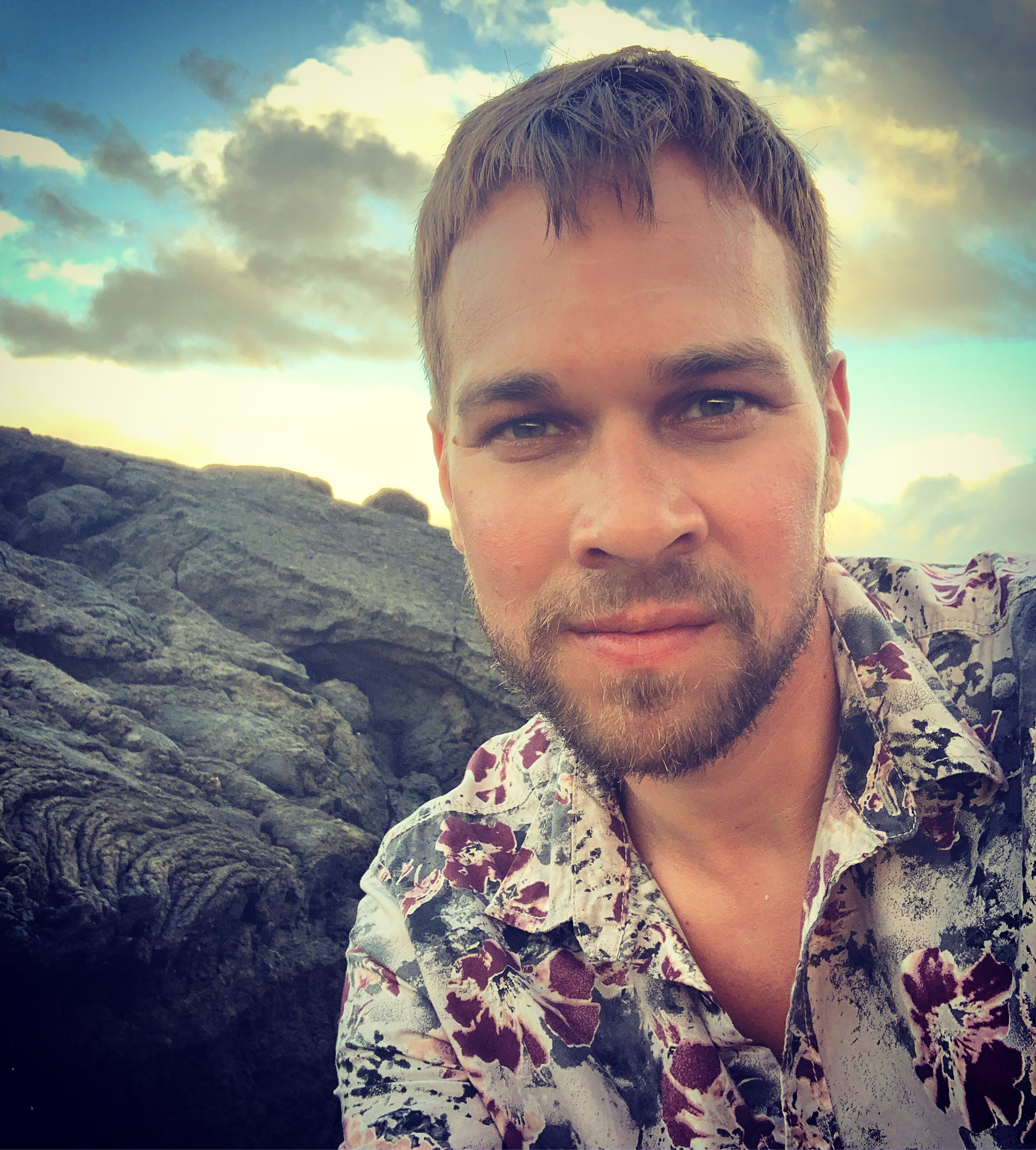
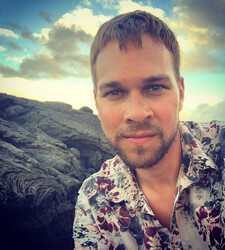
Brad Ryan is a veterinarian, wildlife conservationist, social media influencer, and writer from southeastern Ohio. He earned his BA from Miami University in Ohio, an MSc in mammalian biology from the University of Pretoria in South Africa, and a DVM/MPH combined degree from The Ohio State University, specializing in wildlife medicine and veterinary public health. For Brad, storytelling is a vehicle for healing—rooted in empathy, inspired by nature, and driven by a desire to help others feel seen and connected. As a keynote speaker, he champions LGBTQ+ inclusion in the outdoors, eliminating stigma around mental health, and the protection of wildlife and public lands. Follow him on Instagram @GrandmaJoysRoadTrip and @DoctorBradRyan.
Product Details
- Publisher: Simon & Schuster (June 16, 2026)
- Length: 336 pages
- ISBN13: 9781668099261
Browse Related Books
Raves and Reviews
“A heartfelt memoir… an uplifting tribute to nature and intergenerational healing.”
—Publishers Weekly
"Unfold[s] with the rawness and poignancy of an intergenerational family saga."
—The Age
Resources and Downloads
High Resolution Images
-
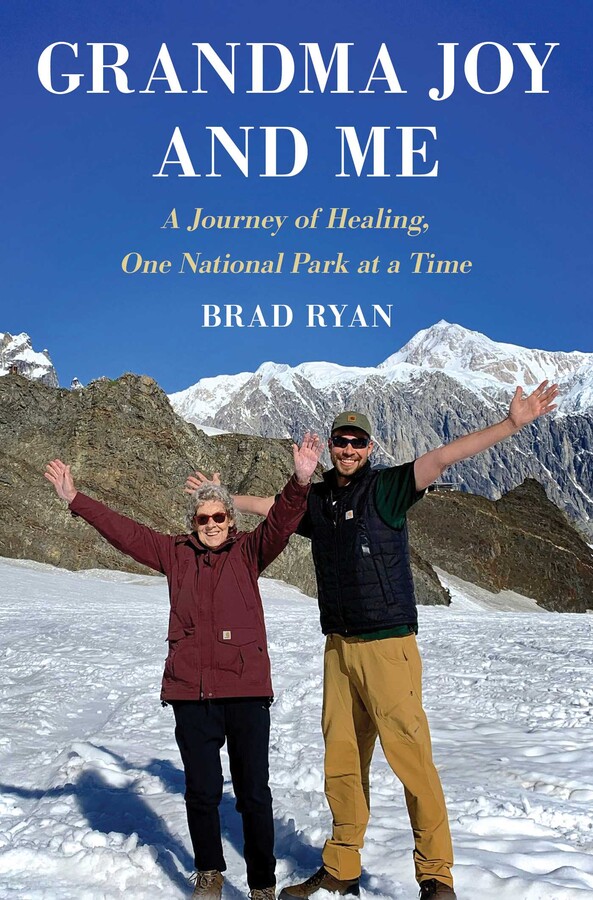
Book Cover Image (jpg): Grandma Joy and Me
Hardcover 9781668099261
-
Author Photo (jpg): Brad Ryan Brad Ryan(0.1 MB)
Any use of an author photo must include its respective photo credit