

Plus, receive recommendations and exclusive offers on all of your favorite books and authors from Simon & Schuster.
0:00 /
Table of Contents
About The Book
A New York Times bestseller!
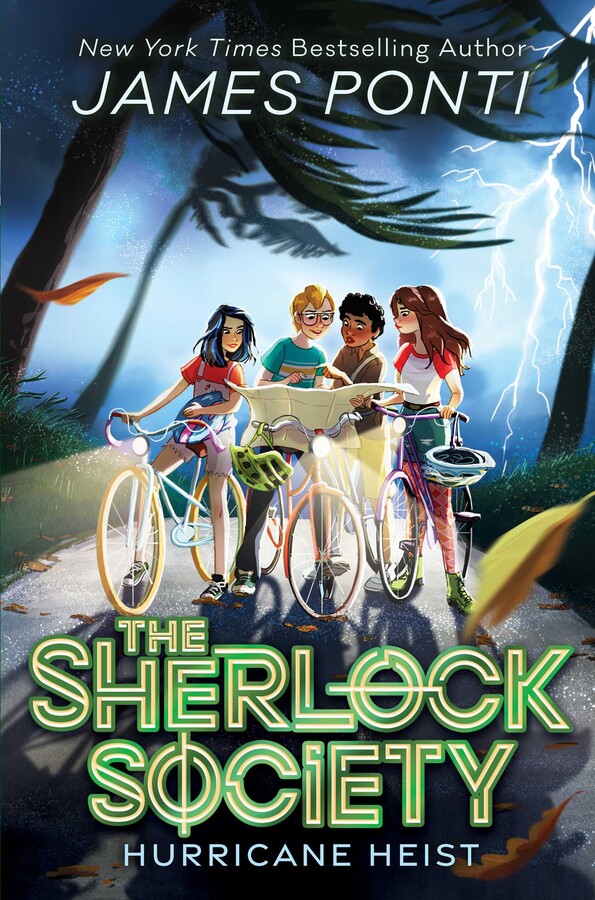
When a hurricane uncovers new information in a cold case, the Sherlock Society investigates a decades-old heist in this “engrossing” (Kirkus Reviews) second book in the hilarious, New York Times bestselling Sherlock Society middle grade series from Edgar Award–winning author James Ponti!
When a category three hurricane hits Miami Beach, it uncovers a body buried at the renowned Moroccan Hotel. The body is identified as the man who served as the hotel’s bell captain sixty years ago…and the presumed culprit of the million-dollar jewel heist that took place just before his disappearance.
Since the bell captain clearly didn’t take off with the goods as had been long believed, the Sherlock Society sets their sights on uncovering the real culprit of the theft with some help from Alex and Zoe’s grandfather, who was friends with the bell captain back in the day, and some retired federal agents from the local old folks’ home.
But when the thief may also be implicated in the bell captain’s murder, even sixty years later, there are people who want the truth to stay buried.
When a hurricane uncovers new information in a cold case, the Sherlock Society investigates a decades-old heist in this “engrossing” (Kirkus Reviews) second book in the hilarious, New York Times bestselling Sherlock Society middle grade series from Edgar Award–winning author James Ponti!
When a category three hurricane hits Miami Beach, it uncovers a body buried at the renowned Moroccan Hotel. The body is identified as the man who served as the hotel’s bell captain sixty years ago…and the presumed culprit of the million-dollar jewel heist that took place just before his disappearance.
Since the bell captain clearly didn’t take off with the goods as had been long believed, the Sherlock Society sets their sights on uncovering the real culprit of the theft with some help from Alex and Zoe’s grandfather, who was friends with the bell captain back in the day, and some retired federal agents from the local old folks’ home.
But when the thief may also be implicated in the bell captain’s murder, even sixty years later, there are people who want the truth to stay buried.
Excerpt
Chapter 1: Celestial Navigation 1 Celestial Navigation
MY LIFE WAS FILLED WITH countless embarrassing athletic failures. Three errors in a single inning of Little League. A particularly bad airball in front of my entire PE class. And a game of hopscotch that landed me in the emergency room. But none were as humiliating as being outrun by my grandfather.
My seventy-three-year-old grandfather.
It was dark and we were sprinting through the woods, but the results would’ve been the same on the track at school. This despite the fact that he had an artificial hip, two heart stents, and a surgically reattached pinky toe that he liked to brag could “still wiggle and everything.”
There were five of us running. My sister, Zoe, was out in front, because she apparently inherited all of the family’s sports genes. Next came my friends, Yadi and Lina, followed by Grandpa, with me in the rear. Which is exactly where I was in danger of getting bitten if we couldn’t stay ahead of the angry security dogs that were chasing us.
“Watch out!” Grandpa warned as he deftly hurdled a fallen tree in our path.
I gave it my best leap, but as I pushed off, my left foot slipped on some pine needles, which severely lowered my midair trajectory. (Can it be called midair if it’s less than twelve inches off the ground?) My right foot caught a branch that was sticking out of the trunk, and before I knew it, I slammed face-first into the ground and was spitting out dirt.
“Are you okay?” Grandpa asked as he helped me up.
My lip was starting to swell and my front tooth felt loose, but I could hear the barking getting closer. “I’m fine,” I mumbled due to the swelling. “Let’s keep moving.”
A few minutes later, we reached a creek about eight feet wide. I was momentarily afraid that everyone else was going to just jump over it, leaving me behind for the dogs.
“Should we follow along the bank or look for a spot to cross?” Zoe asked.
“Neither,” Yadi answered. “We should get in the water and run right down the middle.”
Zoe gave him a confused look. “Why would we do that?”
“Because the dogs won’t be able to track our scent,” he answered.
“He’s right,” Grandpa agreed. “It may be our best chance to lose them.”
“What about snakes and alligators?” Lina asked. “This looks like their kind of neighborhood.”
“They’re a concern, but still theoretical,” Grandpa replied. “The dogs, however, are very real. Besides, we don’t have to go far. Thirty or forty yards should be enough to cover our tracks. Then we can cross to the other side and try to make it back to the fence line.”
My non-participation in the discussion had nothing to do with a lack of interest and everything to do with the fact that I was trying to catch my breath without hyperventilating. When the others turned to me for some input, the best I could offer was a nod and a breathless “I agree.”
The water had a sour stink to it, and my jeans got soaked up to the thighs when my feet squished down into the muck. We didn’t really run so much as tromp, with lots of splashing and significantly more noise than intended. (Bright side: that noise may well have scared away the critters, because we didn’t run into any alligators or water moccasins.)
“Right over there,” Grandpa said, pointing at a cluster of trees and bushes up ahead on the opposite side. “We can hide in that thicket while we figure out how to get off the property and back to Roberta.” (Roberta was the name of Grandpa’s car.)
Finding her wouldn’t be easy, because we were totally lost. All we knew was that we were somewhere in the vast acreage of the Dades Valley Ranch, a very private lodge and very well-hidden retreat where the rich and powerful met to socialize and do business while “roughing it” in the Florida wilderness. Unfortunately, the wilderness came without cell service, which meant we didn’t have GPS. And since we’d all been so focused on eluding the dogs, we were turned around with no sense of direction.
“Does anyone have the faintest idea where we are?” I asked as I climbed up from the water onto some slippery rocks.
“Kind of,” Grandpa said uninspiringly. “Although it would help if the clouds would clear so I could use the moon and stars for celestial navigation.”
“Celestial navigation?” Zoe couldn’t believe it. “This isn’t the Lewis and Clark expedition. Here in the twenty-first century, we can use an app on our phones.”
“You’ve got service?” Yadi asked, surprised.
“No, but the compass works without it,” she replied. “If we follow it east, it will lead us to the fence, which will lead us to the road, which will lead us to the car.”
Grandpa was impressed, if maybe a bit embarrassed.
“Don’t feel bad,” Lina said as she patted him on the shoulder. “Lewis and Clark needed a woman to guide them too.”
“Before we do that, we should rest for a moment and make sure we’ve lost the dogs,” I suggested, trying to make it sound like a strategy rather than another chance for me to recover.
Luckily, there was enough moonlight for us to find an opening in the thicket. That’s where we hid as the barking decreased and eventually stopped.
“Nice,” Zoe said, offering Yadi a fist bump. “You were right about the water.”
“Yeah,” Lina agreed. “Good job.”
“Let’s give them a few minutes to go away, and then we can head east,” Grandpa said.
This wasn’t the first time we’d gotten in over our heads. It was an occupational hazard of solving mysteries. The five of us made up the Sherlock Society, and we’d come to the ranch because we were trying to crack a case more than sixty years old. We didn’t know much about Dades Valley, just that it was so secretive and exclusive it wasn’t marked on any maps. Still, this was where the clues had led us. Just a few hours earlier we’d been excited about what we might discover. Now not so much.
It’s amazing how dramatically things can change in a few hours.
“Does this mean we’re not going to keep looking for the lodge?” Yadi asked.
“For tonight it does,” answered Grandpa. “We’ll have to find it some other way that doesn’t involve sneaking around in the dark.”
“I vote for that,” Lina said.
“Okay, the dogs are gone,” I said. “Are we ready to go?”
“Ready,” answered the others.
Zoe checked the compass on her phone. She was just about to tell us which direction to head when we heard a low, rumbling growl.
She shot me a glare. “Cut it out.”
“It wasn’t me,” I replied.
“Don’t look at me,” said Yadi.
“Shh,” Grandpa said. “Listen.”
There was another growl. This one was lower and lasted longer.
“Is that an alligator?” Lina asked, panicked.
“A gator makes more of a croak than a growl,” Grandpa said. “But it could be something like a bear or a panther.”
Lina flashed a nervous smile. “Suddenly, alligator doesn’t sound so bad.”
When it growled again, we could tell that it was moving closer.
“I think it’s on the other side of these palmettos,” Yadi whispered. “Everyone, stay quiet while I take a look.”
I felt my heart all the way up in my throat as he carefully parted the palmettos and peered through them. When he turned back to us, the color had drained from his face.
“What is it?” Zoe asked.
“You won’t believe me,” he answered.
“So help me, Yadi, if you tell us that it’s a skunk ape…”
“Oh no, it’s way worse than the skunk ape.”
“What could possibly be worse than that?” I asked, not sure I wanted to know the answer.
Just then there was a loud rustling, some extremely heavy footsteps, and an even deeper growl as the animal moved out into the open.
“You’re right, that is worse than a skunk ape,” Lina remarked as we looked into the shimmering moonlight and saw… a rhinoceros.
We stood there for a moment, frozen by fear and confusion. The fear part intensified significantly when the rhino turned and looked directly at us.
“Don’t move,” Grandpa whispered. “Rhinos have terrible eyesight, but they notice sudden motion.”
“This can’t be happening,” Zoe said, stunned. “There are no wild rhinoceroses in Florida.”
“Yeah, we know that,” Yadi replied. “But who wants to tell him?”
The huge animal had a bored expression and lazily chewed on some grass while it kept its gaze in our direction.
“Any thoughts?” I asked.
“Just James and the Giant Peach?” Lina answered.
“What is this?” Zoe said. “Book club?”
“The story begins with a rhinoceros eating James’s parents,” Lina replied.
“Do they do that?” Yadi asked, flustered. “Do rhinos eat people?”
“The one in the book did,” Lina answered.
“Yes, but in that same book, James traveled the world in a magic peach with a talking spider,” I pointed out. “I don’t think we can count on it for scientific accuracy.”
“Rhinos are herbivores, so they do not eat people,” Grandpa reassured us. “But they are still incredibly dangerous.”
“What should we do?” Zoe asked.
“We wait until he looks the other way,” Grandpa replied. “Then we go.”
“In which direction?” whispered Yadi.
“Up,” answered Grandpa.
“Up?!” Lina and I replied at the same moment.
“There’s a pair of oak trees behind us,” he said. “We’ll be safe if we climb up and wait.”
“Wait for what?” Zoe asked.
“For as long as it takes for him to go elsewhere,” he answered.
We’d reached a point where there were no longer any good decisions to be made. Just bad ones that were a little less bad than others.
In the distance, one of the dogs let out a howl, and when the rhino turned its attention toward that, we made our move.
The fear of being trampled or gored did more for my athletic ability than any coach ever had. Not only was I the first to reach one of the trees, but I couldn’t have scaled it quicker if I’d had a ladder. (I guess a few of those athletic genes made it to me after all.) I didn’t stop climbing until I reached a nice thick branch about fifteen feet aboveground. Looking down, I was amazed by how quickly I had accomplished the feat, but also terrified because I had no idea how I was going to get back down without falling and breaking something. Still, that was a worry for later.
Yadi and Lina were in the same tree I was in, while Zoe and Grandpa were in the other. Our flurry of activity had attracted the rhino’s attention, and it moved toward us, but it seemed more curious than angry.
Even though the sun had set, it was still hot and buggy and the branch was super uncomfortable, but it felt good to be up there. We tried our best to blend into the darkness as we waited and watched.
“He can’t really see us,” Grandpa explained. “But he’s got excellent hearing, so we need to keep quiet and stay still.”
“Okay,” we whispered.
I looked over at Lina, who was sitting on a branch near mine, and gave her a reassuring smile. She returned the favor.
I looked back at the rhinoceros and tried to figure out how we’d gotten into this mess. It defied all logic, and I wouldn’t have believed it if I hadn’t been there every step of the way.
It’s funny how things can spin wildly out of control. How one bad decision can snowball into another and then another. Our biggest mistake was when we decided to trespass on private property. But that’s not where this mystery began. It all started more than sixty years ago, when my grandfather was the same age as me, and Hurricane Cleo was about to slam into Miami.
MY LIFE WAS FILLED WITH countless embarrassing athletic failures. Three errors in a single inning of Little League. A particularly bad airball in front of my entire PE class. And a game of hopscotch that landed me in the emergency room. But none were as humiliating as being outrun by my grandfather.
My seventy-three-year-old grandfather.
It was dark and we were sprinting through the woods, but the results would’ve been the same on the track at school. This despite the fact that he had an artificial hip, two heart stents, and a surgically reattached pinky toe that he liked to brag could “still wiggle and everything.”
There were five of us running. My sister, Zoe, was out in front, because she apparently inherited all of the family’s sports genes. Next came my friends, Yadi and Lina, followed by Grandpa, with me in the rear. Which is exactly where I was in danger of getting bitten if we couldn’t stay ahead of the angry security dogs that were chasing us.
“Watch out!” Grandpa warned as he deftly hurdled a fallen tree in our path.
I gave it my best leap, but as I pushed off, my left foot slipped on some pine needles, which severely lowered my midair trajectory. (Can it be called midair if it’s less than twelve inches off the ground?) My right foot caught a branch that was sticking out of the trunk, and before I knew it, I slammed face-first into the ground and was spitting out dirt.
“Are you okay?” Grandpa asked as he helped me up.
My lip was starting to swell and my front tooth felt loose, but I could hear the barking getting closer. “I’m fine,” I mumbled due to the swelling. “Let’s keep moving.”
A few minutes later, we reached a creek about eight feet wide. I was momentarily afraid that everyone else was going to just jump over it, leaving me behind for the dogs.
“Should we follow along the bank or look for a spot to cross?” Zoe asked.
“Neither,” Yadi answered. “We should get in the water and run right down the middle.”
Zoe gave him a confused look. “Why would we do that?”
“Because the dogs won’t be able to track our scent,” he answered.
“He’s right,” Grandpa agreed. “It may be our best chance to lose them.”
“What about snakes and alligators?” Lina asked. “This looks like their kind of neighborhood.”
“They’re a concern, but still theoretical,” Grandpa replied. “The dogs, however, are very real. Besides, we don’t have to go far. Thirty or forty yards should be enough to cover our tracks. Then we can cross to the other side and try to make it back to the fence line.”
My non-participation in the discussion had nothing to do with a lack of interest and everything to do with the fact that I was trying to catch my breath without hyperventilating. When the others turned to me for some input, the best I could offer was a nod and a breathless “I agree.”
The water had a sour stink to it, and my jeans got soaked up to the thighs when my feet squished down into the muck. We didn’t really run so much as tromp, with lots of splashing and significantly more noise than intended. (Bright side: that noise may well have scared away the critters, because we didn’t run into any alligators or water moccasins.)
“Right over there,” Grandpa said, pointing at a cluster of trees and bushes up ahead on the opposite side. “We can hide in that thicket while we figure out how to get off the property and back to Roberta.” (Roberta was the name of Grandpa’s car.)
Finding her wouldn’t be easy, because we were totally lost. All we knew was that we were somewhere in the vast acreage of the Dades Valley Ranch, a very private lodge and very well-hidden retreat where the rich and powerful met to socialize and do business while “roughing it” in the Florida wilderness. Unfortunately, the wilderness came without cell service, which meant we didn’t have GPS. And since we’d all been so focused on eluding the dogs, we were turned around with no sense of direction.
“Does anyone have the faintest idea where we are?” I asked as I climbed up from the water onto some slippery rocks.
“Kind of,” Grandpa said uninspiringly. “Although it would help if the clouds would clear so I could use the moon and stars for celestial navigation.”
“Celestial navigation?” Zoe couldn’t believe it. “This isn’t the Lewis and Clark expedition. Here in the twenty-first century, we can use an app on our phones.”
“You’ve got service?” Yadi asked, surprised.
“No, but the compass works without it,” she replied. “If we follow it east, it will lead us to the fence, which will lead us to the road, which will lead us to the car.”
Grandpa was impressed, if maybe a bit embarrassed.
“Don’t feel bad,” Lina said as she patted him on the shoulder. “Lewis and Clark needed a woman to guide them too.”
“Before we do that, we should rest for a moment and make sure we’ve lost the dogs,” I suggested, trying to make it sound like a strategy rather than another chance for me to recover.
Luckily, there was enough moonlight for us to find an opening in the thicket. That’s where we hid as the barking decreased and eventually stopped.
“Nice,” Zoe said, offering Yadi a fist bump. “You were right about the water.”
“Yeah,” Lina agreed. “Good job.”
“Let’s give them a few minutes to go away, and then we can head east,” Grandpa said.
This wasn’t the first time we’d gotten in over our heads. It was an occupational hazard of solving mysteries. The five of us made up the Sherlock Society, and we’d come to the ranch because we were trying to crack a case more than sixty years old. We didn’t know much about Dades Valley, just that it was so secretive and exclusive it wasn’t marked on any maps. Still, this was where the clues had led us. Just a few hours earlier we’d been excited about what we might discover. Now not so much.
It’s amazing how dramatically things can change in a few hours.
“Does this mean we’re not going to keep looking for the lodge?” Yadi asked.
“For tonight it does,” answered Grandpa. “We’ll have to find it some other way that doesn’t involve sneaking around in the dark.”
“I vote for that,” Lina said.
“Okay, the dogs are gone,” I said. “Are we ready to go?”
“Ready,” answered the others.
Zoe checked the compass on her phone. She was just about to tell us which direction to head when we heard a low, rumbling growl.
She shot me a glare. “Cut it out.”
“It wasn’t me,” I replied.
“Don’t look at me,” said Yadi.
“Shh,” Grandpa said. “Listen.”
There was another growl. This one was lower and lasted longer.
“Is that an alligator?” Lina asked, panicked.
“A gator makes more of a croak than a growl,” Grandpa said. “But it could be something like a bear or a panther.”
Lina flashed a nervous smile. “Suddenly, alligator doesn’t sound so bad.”
When it growled again, we could tell that it was moving closer.
“I think it’s on the other side of these palmettos,” Yadi whispered. “Everyone, stay quiet while I take a look.”
I felt my heart all the way up in my throat as he carefully parted the palmettos and peered through them. When he turned back to us, the color had drained from his face.
“What is it?” Zoe asked.
“You won’t believe me,” he answered.
“So help me, Yadi, if you tell us that it’s a skunk ape…”
“Oh no, it’s way worse than the skunk ape.”
“What could possibly be worse than that?” I asked, not sure I wanted to know the answer.
Just then there was a loud rustling, some extremely heavy footsteps, and an even deeper growl as the animal moved out into the open.
“You’re right, that is worse than a skunk ape,” Lina remarked as we looked into the shimmering moonlight and saw… a rhinoceros.
We stood there for a moment, frozen by fear and confusion. The fear part intensified significantly when the rhino turned and looked directly at us.
“Don’t move,” Grandpa whispered. “Rhinos have terrible eyesight, but they notice sudden motion.”
“This can’t be happening,” Zoe said, stunned. “There are no wild rhinoceroses in Florida.”
“Yeah, we know that,” Yadi replied. “But who wants to tell him?”
The huge animal had a bored expression and lazily chewed on some grass while it kept its gaze in our direction.
“Any thoughts?” I asked.
“Just James and the Giant Peach?” Lina answered.
“What is this?” Zoe said. “Book club?”
“The story begins with a rhinoceros eating James’s parents,” Lina replied.
“Do they do that?” Yadi asked, flustered. “Do rhinos eat people?”
“The one in the book did,” Lina answered.
“Yes, but in that same book, James traveled the world in a magic peach with a talking spider,” I pointed out. “I don’t think we can count on it for scientific accuracy.”
“Rhinos are herbivores, so they do not eat people,” Grandpa reassured us. “But they are still incredibly dangerous.”
“What should we do?” Zoe asked.
“We wait until he looks the other way,” Grandpa replied. “Then we go.”
“In which direction?” whispered Yadi.
“Up,” answered Grandpa.
“Up?!” Lina and I replied at the same moment.
“There’s a pair of oak trees behind us,” he said. “We’ll be safe if we climb up and wait.”
“Wait for what?” Zoe asked.
“For as long as it takes for him to go elsewhere,” he answered.
We’d reached a point where there were no longer any good decisions to be made. Just bad ones that were a little less bad than others.
In the distance, one of the dogs let out a howl, and when the rhino turned its attention toward that, we made our move.
The fear of being trampled or gored did more for my athletic ability than any coach ever had. Not only was I the first to reach one of the trees, but I couldn’t have scaled it quicker if I’d had a ladder. (I guess a few of those athletic genes made it to me after all.) I didn’t stop climbing until I reached a nice thick branch about fifteen feet aboveground. Looking down, I was amazed by how quickly I had accomplished the feat, but also terrified because I had no idea how I was going to get back down without falling and breaking something. Still, that was a worry for later.
Yadi and Lina were in the same tree I was in, while Zoe and Grandpa were in the other. Our flurry of activity had attracted the rhino’s attention, and it moved toward us, but it seemed more curious than angry.
Even though the sun had set, it was still hot and buggy and the branch was super uncomfortable, but it felt good to be up there. We tried our best to blend into the darkness as we waited and watched.
“He can’t really see us,” Grandpa explained. “But he’s got excellent hearing, so we need to keep quiet and stay still.”
“Okay,” we whispered.
I looked over at Lina, who was sitting on a branch near mine, and gave her a reassuring smile. She returned the favor.
I looked back at the rhinoceros and tried to figure out how we’d gotten into this mess. It defied all logic, and I wouldn’t have believed it if I hadn’t been there every step of the way.
It’s funny how things can spin wildly out of control. How one bad decision can snowball into another and then another. Our biggest mistake was when we decided to trespass on private property. But that’s not where this mystery began. It all started more than sixty years ago, when my grandfather was the same age as me, and Hurricane Cleo was about to slam into Miami.
Reading Group Guide
Get a FREE ebook by joining our mailing list today! Plus, receive recommendations for your next Book Club read.
By clicking 'Sign me up', I consent to Simon & Schuster sending me email offers and updates, including offers for a free eBook. I understand I can unsubscribe at any time. Any offer for an eBook may be subject to exclusions, terms, conditions, and registration with our fulfillment partners. We collect and use your information in accordance with our Privacy Policy. Free ebook offer available to NEW CA subscribers only. Offer redeemable at Simon & Schuster's ebook fulfillment partner. Must redeem within 90 days. See the full terms and conditions.
Reading Group Guide
The Sherlock Society Book 2: Hurricane Heist
By James Ponti
About the Book
When a category-three hurricane hits Miami Beach, it uncovers a body buried at the renowned Moroccan Hotel. The body is identified as the man who served as the hotel’s bell captain sixty years ago and the presumed culprit of the million-dollar jewel heist that took place just before his disappearance!
Since the bell captain clearly didn’t take off with the goods as had been long believed, the Sherlock Society sets its sights on uncovering the real culprit of the theft. But when the thief may also be implicated in the bell captain’s murder, even sixty years later there are people who want the truth to stay buried.
Discussion Questions
1. In the very first paragraph, Alex declares, “My life was filled with countless embarrassing athletic failures. . . . But none were as humiliating as being outrun by my grandfather.” Is it surprising to learn that the members of the Sherlock Society are literally trying to outrun harm because of their investigative choices? Based on what you already know about them, why or why not?
2. Alex explains that they were at the Dades Valley Ranch “because we were trying to crack a case more than sixty years old.” (Chapter one) From an investigative perspective, what do you believe will be the biggest challenge for the team working on a case that old?
3. The cold case the team is reopening focuses on a jewel and art heist that occurred at the Moroccan Hotel in Miami Beach during Hurricane Cleo in 1964. An innocent man was wrongly accused of the crime, and the case remained incredibly personal to Grandpa throughout his professional career. As the Sherlock Society begins to examine this sixty-year-old case, how do you think Grandpa’s connection to it will cloud or influence his perspective?
4. During the 1964 investigation of the Moroccan Hotel theft, Ignacio “Doc” Gonzalez was the FBI’s prime suspect in the heist. Young Pete Lassiter defends him to the FBI agents and asserts, “‘Because I know that Doc’s innocent. He’s kind and moral. He has plans for the future. He wouldn’t—I mean he couldn’t—have committed this crime.’” (Chapter nine) Why does Pete feel so strongly that Doc is innocent? Do you think he’s right to do so? Why or why not?
5. While explaining to the FBI why he calls Ignacio “Doc” and why they should call him Ignacio, young Pete states, “‘I call him Doc because we’re friends. But you should call him Ignacio when you interview him because your relationship is professional.’” (Chapter three) What are your thoughts about the friendship between Pete and Doc? Are there any adults with whom you have a special relationship that aren’t family members? If so, what do you like best about it?
6. Consider the shift in the story’s setting between present-day Miami and 1960s Miami. What do you find most appealing about the timeline pivots? In what ways does it help you better understand Alex and Zoe’s grandpa by seeing him as young Pete? Which of his personality traits were already evident as a boy?
7. Describe how the hurricane approaching Miami creates a sense of urgency for the Sherlock Society. How does it affect how they attempt to solve the case, and why?
8. Consider Grandpa’s investigation assignments for each member of the Sherlock Society. How does dividing the research up and allowing each of them to focus on a different aspect of the investigation benefit the team overall?
9. Which character do you most identify with and why? Has that changed any since the first novel?
10. How do Grandpa’s personal connections to this case work to the group’s advantage? Are there any ways that his own experiences might make him less objective to the findings of the case?
11. Does the Sherlock Society operate best as a team, or do you think their individual investigation work is equally effective at resolving the case? Support your argument with textual examples.
12. When discussing his attempt at writing and publishing a book, Grandpa tells them, “‘I’m not a novelist; I’m a journalist. Or, rather, I was one. I miss it, but that doesn’t mean I don’t still have a great life.’” (Chapter fifteen) Based on this comment, what do you believe are the greatest benefits to being a part of the Sherlock Society for him?
13. While watching two firefighters practice their work, Lina remarks, “‘Check out the teamwork. . . . They move in unison, almost like they are dancing.’” (Chapter eleven) Similarly, the Sherlock Society regularly engages in research, analysis, and discussion, often challenging each other’s ideas. How is their teamwork similar to the ways in which the firefighters work together? Why is this so effective?
14. When Lina suggests that the “Ignacio Imposter” would have had to have an ID at the airport to board a plane, Grandpa tells her, “‘You do now, but things were different in 1964 . . . Then you could walk up to an airline counter and purchase tickets without any ID at all.’” (Chapter eleven) What did you find most surprising about Grandpa’s description of air travel in the 1960s? Why do you think it’s so different now?
15. As they visit retired FBI agent Stuart Forrest at the Euro retirement home to share the updates to the Cleo Caper case and the discovery of Ignacio Gonzalez’s remains, Stuart tells Grandpa that he was right about his belief in Ignacio’s innocence all along. Grandpa retorts, “‘I was right about who didn’t do it. Unfortunately, I have no idea who did.’” (Chapter fourteen) Why does he see these former FBI agents as important resources in finally solving the Cleo Caper? What does the chance to return and right this case offer for the retired agents?
16. Consider the way in which the Sherlock Society works on this case: their methods involve reviewing old case files, gathering new information through interviews such as with former FBI agent Forrest, and utilizing modern tools like phone-based searches. They also use symbolic tools like bedpans and poker chips to represent suspects and evidence. Why is this layered approach to the investigation so successful?
17. While discussing Lina’s resistance to interacting with Zoe’s other friends, Lina tells Zoe, “‘You shouldn’t have to know someone to be decent to them. . . . I know they’re your friends. . . . It’s just that I’d rather hang out with Alex and Yadi.’” (Chapter sixteen) Based on what you read, what are some of the specific ways Zoe and Lina’s friendship has developed, despite the bad behavior of Zoe’s other friends?
18. The importance of truth and justice are central to the story as the Sherlock Society seeks to clear Ignacio Gonzalez’s name after decades of wrongful accusation. Why does this become such an important goal for the entire group, not just Grandpa?
19. Considering the conclusion of the novel, what do you predict will happen in the next installment of the Sherlock Society?
Extension Activities
In Hurricane Heist, the Sherlock Society works together to investigate a cold case even the FBI was unable to successfully crack known as the Cleo Caper, a jewel and art heist that occurred at the Moroccan Hotel during Hurricane Cleo in 1964. Begin by having readers use the following Ebsco database resource: https://www.ebsco.com/research-starters/law/cold-cases to learn more about cold cases, specifically to discover the following:
- What is a cold case?
- Why are they significant?
- What types of law enforcement divisions are put in place to work on them and how are they typically staffed?
- What technology is used, and why are modern technological advances important to solving cold cases?
- What are the most common kinds of cold cases?
After the completion of this research, have readers discuss what they learned with one another.
In Hurricane Heist, readers are introduced to and offered a great deal of information about hurricanes. Using library resources and the internet, learn more about what make the following stages of a hurricane unique:
- tropical disturbance
- tropical depression
- tropical storm
- hurricane
After they synthesize that information, have readers dig deeper and work together to learn the difference between a squall and a gust and what the lack of lightning and thunder indicates, as well as other interesting hurricane facts. Finally, have readers find out about the hurricane cycles in the early 1960s that impacted the Miami area to compare those real events to those depicted in the novel, specifically looking for parallels or ways in which author James Ponti was inspired to capture this atmospheric event.
In the novel, Carlos the Cat (Carlos Aguilar), a jewel thief who advised on Hurricane Heist (the movie being filmed at the Moroccan Hotel), is largely eliminated as a heist suspect because of his quick entry into the witness protection program (WPP), which made him unlikely to have had the ability to keep or hide away any stolen goods. Today, the federal witness protection program remains active. Have readers research the WPP to learn the following:
- How is the Witness Protection Program defined?
- Why are individuals and families typically put in this program?
- What are the general statistics of the number of people placed in the WPP?
After completing their research, ask readers to share the most interesting facts they uncovered with others.
Note to Educators: In case researchers come across this, know that the current Federal Witness Protection Program was officially established in 1970, after the events of the flashbacks in the book. However, throughout the sixties, there was a precursor, also known as the Witness Protection Program. Despite some technicalities, they can both be considered part of the same program.
In reading Hurricane Heist, readers learn about the SUSTAIN Lab (SUrge-STructure-Atmosphere INteraction), the largest hurricane simulator in the world, located at the University of Miami. Have readers begin by watching the following news piece: https://www.gulfcoastnewsnow.com/article/university-miami-hurricane-forecasts-simulation-technology/61863579
Then have them learn more about the simulator by visiting the University of Miami’s website: https://sustain.earth.miami.edu/ to better understand the purpose of the SUSTAIN Lab. After investigating both, ask readers to discuss the valuable benefits of such a tool and have them share the five things they found most interesting from their investigation of SUSTAIN and the University of Miami’s hurricane detection and preparation resources.
Edna van Buren is introduced in this novel. She is the famous reporter for the Miami Herald who ultimately inspires young Pete to become one of the paper’s most popular writers. Edna’s character is inspired by real life Pulitzer Prize winner and police and crime reporter Edna Buchanan. Have readers learn more about her by using trusted Internet and library resources, or by reading this coverage of Buchanan (Warning: this article does include mentions of suicide, drugs, and various murders): https://www.pulitzer.org/article/miamis-nonpareil-police-reporter
Then have each reader create a K-W-L chart to capture what they discover from their research, encouraging them to research more about what they wrote in their Want to Know column.
In a flashback sequence, readers learn that “the ‘fun and sun capital of the world’ [Miami] had become a ghost town in preparation for Hurricane Cleo. The streets were empty, and the windows of most buildings had been boarded up. Trash cans, benches, potted plants, and anything else that might become airborne had been moved inside. Even the traffic lights on Biscayne Boulevard had been dismantled to keep them from blowing away.” (Chapter two) In the present, the Sherlock Society and their families are also working on planning for the impending storm heading their way. In anticipation of natural disasters like hurricanes, there is a great deal of preparation that happens in hopes of helping minimize additional damage. Ask readers to research and learn more about hurricane preparedness by utilizing resources offered by the National Oceanic and Atmospheric Administration.
Working in small teams, have readers select one of the following areas to further investigate and prepare to share with the larger group:
- Know your risk: water and wind
- Prepare before hurricane season
- Understand forecast information
- Get moving when a storm threatens
- Stay protected during the storms
- Use caution after the storms
- Take action today
Using a digital tool of choice, have each group take turns sharing their findings.
This guide was created by Dr. Rose Brock. Rose is an associate professor in the Library Science Department in the College of Education at Sam Houston State University and holds a Ph.D. in Library Science, specializing in children’s and young adult literature.
The websites referenced above are provided for informational purposes only and are not intended as an endorsement or promotion of any website. Simon & Schuster is not responsible for the functionality or content of any external website and expressly disclaims all responsibility and liability in connection therewith.
This guide has been provided by Simon & Schuster for classroom, library, and reading group use. It may be reproduced in its entirety or excerpted for these purposes. For more Simon & Schuster guides and classroom materials, please visit simonandschuster.net/m/prek12-teachers-librarians/teaching-resources.
The Sherlock Society Book 2: Hurricane Heist
By James Ponti
About the Book
When a category-three hurricane hits Miami Beach, it uncovers a body buried at the renowned Moroccan Hotel. The body is identified as the man who served as the hotel’s bell captain sixty years ago and the presumed culprit of the million-dollar jewel heist that took place just before his disappearance!
Since the bell captain clearly didn’t take off with the goods as had been long believed, the Sherlock Society sets its sights on uncovering the real culprit of the theft. But when the thief may also be implicated in the bell captain’s murder, even sixty years later there are people who want the truth to stay buried.
Discussion Questions
1. In the very first paragraph, Alex declares, “My life was filled with countless embarrassing athletic failures. . . . But none were as humiliating as being outrun by my grandfather.” Is it surprising to learn that the members of the Sherlock Society are literally trying to outrun harm because of their investigative choices? Based on what you already know about them, why or why not?
2. Alex explains that they were at the Dades Valley Ranch “because we were trying to crack a case more than sixty years old.” (Chapter one) From an investigative perspective, what do you believe will be the biggest challenge for the team working on a case that old?
3. The cold case the team is reopening focuses on a jewel and art heist that occurred at the Moroccan Hotel in Miami Beach during Hurricane Cleo in 1964. An innocent man was wrongly accused of the crime, and the case remained incredibly personal to Grandpa throughout his professional career. As the Sherlock Society begins to examine this sixty-year-old case, how do you think Grandpa’s connection to it will cloud or influence his perspective?
4. During the 1964 investigation of the Moroccan Hotel theft, Ignacio “Doc” Gonzalez was the FBI’s prime suspect in the heist. Young Pete Lassiter defends him to the FBI agents and asserts, “‘Because I know that Doc’s innocent. He’s kind and moral. He has plans for the future. He wouldn’t—I mean he couldn’t—have committed this crime.’” (Chapter nine) Why does Pete feel so strongly that Doc is innocent? Do you think he’s right to do so? Why or why not?
5. While explaining to the FBI why he calls Ignacio “Doc” and why they should call him Ignacio, young Pete states, “‘I call him Doc because we’re friends. But you should call him Ignacio when you interview him because your relationship is professional.’” (Chapter three) What are your thoughts about the friendship between Pete and Doc? Are there any adults with whom you have a special relationship that aren’t family members? If so, what do you like best about it?
6. Consider the shift in the story’s setting between present-day Miami and 1960s Miami. What do you find most appealing about the timeline pivots? In what ways does it help you better understand Alex and Zoe’s grandpa by seeing him as young Pete? Which of his personality traits were already evident as a boy?
7. Describe how the hurricane approaching Miami creates a sense of urgency for the Sherlock Society. How does it affect how they attempt to solve the case, and why?
8. Consider Grandpa’s investigation assignments for each member of the Sherlock Society. How does dividing the research up and allowing each of them to focus on a different aspect of the investigation benefit the team overall?
9. Which character do you most identify with and why? Has that changed any since the first novel?
10. How do Grandpa’s personal connections to this case work to the group’s advantage? Are there any ways that his own experiences might make him less objective to the findings of the case?
11. Does the Sherlock Society operate best as a team, or do you think their individual investigation work is equally effective at resolving the case? Support your argument with textual examples.
12. When discussing his attempt at writing and publishing a book, Grandpa tells them, “‘I’m not a novelist; I’m a journalist. Or, rather, I was one. I miss it, but that doesn’t mean I don’t still have a great life.’” (Chapter fifteen) Based on this comment, what do you believe are the greatest benefits to being a part of the Sherlock Society for him?
13. While watching two firefighters practice their work, Lina remarks, “‘Check out the teamwork. . . . They move in unison, almost like they are dancing.’” (Chapter eleven) Similarly, the Sherlock Society regularly engages in research, analysis, and discussion, often challenging each other’s ideas. How is their teamwork similar to the ways in which the firefighters work together? Why is this so effective?
14. When Lina suggests that the “Ignacio Imposter” would have had to have an ID at the airport to board a plane, Grandpa tells her, “‘You do now, but things were different in 1964 . . . Then you could walk up to an airline counter and purchase tickets without any ID at all.’” (Chapter eleven) What did you find most surprising about Grandpa’s description of air travel in the 1960s? Why do you think it’s so different now?
15. As they visit retired FBI agent Stuart Forrest at the Euro retirement home to share the updates to the Cleo Caper case and the discovery of Ignacio Gonzalez’s remains, Stuart tells Grandpa that he was right about his belief in Ignacio’s innocence all along. Grandpa retorts, “‘I was right about who didn’t do it. Unfortunately, I have no idea who did.’” (Chapter fourteen) Why does he see these former FBI agents as important resources in finally solving the Cleo Caper? What does the chance to return and right this case offer for the retired agents?
16. Consider the way in which the Sherlock Society works on this case: their methods involve reviewing old case files, gathering new information through interviews such as with former FBI agent Forrest, and utilizing modern tools like phone-based searches. They also use symbolic tools like bedpans and poker chips to represent suspects and evidence. Why is this layered approach to the investigation so successful?
17. While discussing Lina’s resistance to interacting with Zoe’s other friends, Lina tells Zoe, “‘You shouldn’t have to know someone to be decent to them. . . . I know they’re your friends. . . . It’s just that I’d rather hang out with Alex and Yadi.’” (Chapter sixteen) Based on what you read, what are some of the specific ways Zoe and Lina’s friendship has developed, despite the bad behavior of Zoe’s other friends?
18. The importance of truth and justice are central to the story as the Sherlock Society seeks to clear Ignacio Gonzalez’s name after decades of wrongful accusation. Why does this become such an important goal for the entire group, not just Grandpa?
19. Considering the conclusion of the novel, what do you predict will happen in the next installment of the Sherlock Society?
Extension Activities
In Hurricane Heist, the Sherlock Society works together to investigate a cold case even the FBI was unable to successfully crack known as the Cleo Caper, a jewel and art heist that occurred at the Moroccan Hotel during Hurricane Cleo in 1964. Begin by having readers use the following Ebsco database resource: https://www.ebsco.com/research-starters/law/cold-cases to learn more about cold cases, specifically to discover the following:
- What is a cold case?
- Why are they significant?
- What types of law enforcement divisions are put in place to work on them and how are they typically staffed?
- What technology is used, and why are modern technological advances important to solving cold cases?
- What are the most common kinds of cold cases?
After the completion of this research, have readers discuss what they learned with one another.
In Hurricane Heist, readers are introduced to and offered a great deal of information about hurricanes. Using library resources and the internet, learn more about what make the following stages of a hurricane unique:
- tropical disturbance
- tropical depression
- tropical storm
- hurricane
After they synthesize that information, have readers dig deeper and work together to learn the difference between a squall and a gust and what the lack of lightning and thunder indicates, as well as other interesting hurricane facts. Finally, have readers find out about the hurricane cycles in the early 1960s that impacted the Miami area to compare those real events to those depicted in the novel, specifically looking for parallels or ways in which author James Ponti was inspired to capture this atmospheric event.
In the novel, Carlos the Cat (Carlos Aguilar), a jewel thief who advised on Hurricane Heist (the movie being filmed at the Moroccan Hotel), is largely eliminated as a heist suspect because of his quick entry into the witness protection program (WPP), which made him unlikely to have had the ability to keep or hide away any stolen goods. Today, the federal witness protection program remains active. Have readers research the WPP to learn the following:
- How is the Witness Protection Program defined?
- Why are individuals and families typically put in this program?
- What are the general statistics of the number of people placed in the WPP?
After completing their research, ask readers to share the most interesting facts they uncovered with others.
Note to Educators: In case researchers come across this, know that the current Federal Witness Protection Program was officially established in 1970, after the events of the flashbacks in the book. However, throughout the sixties, there was a precursor, also known as the Witness Protection Program. Despite some technicalities, they can both be considered part of the same program.
In reading Hurricane Heist, readers learn about the SUSTAIN Lab (SUrge-STructure-Atmosphere INteraction), the largest hurricane simulator in the world, located at the University of Miami. Have readers begin by watching the following news piece: https://www.gulfcoastnewsnow.com/article/university-miami-hurricane-forecasts-simulation-technology/61863579
Then have them learn more about the simulator by visiting the University of Miami’s website: https://sustain.earth.miami.edu/ to better understand the purpose of the SUSTAIN Lab. After investigating both, ask readers to discuss the valuable benefits of such a tool and have them share the five things they found most interesting from their investigation of SUSTAIN and the University of Miami’s hurricane detection and preparation resources.
Edna van Buren is introduced in this novel. She is the famous reporter for the Miami Herald who ultimately inspires young Pete to become one of the paper’s most popular writers. Edna’s character is inspired by real life Pulitzer Prize winner and police and crime reporter Edna Buchanan. Have readers learn more about her by using trusted Internet and library resources, or by reading this coverage of Buchanan (Warning: this article does include mentions of suicide, drugs, and various murders): https://www.pulitzer.org/article/miamis-nonpareil-police-reporter
Then have each reader create a K-W-L chart to capture what they discover from their research, encouraging them to research more about what they wrote in their Want to Know column.
In a flashback sequence, readers learn that “the ‘fun and sun capital of the world’ [Miami] had become a ghost town in preparation for Hurricane Cleo. The streets were empty, and the windows of most buildings had been boarded up. Trash cans, benches, potted plants, and anything else that might become airborne had been moved inside. Even the traffic lights on Biscayne Boulevard had been dismantled to keep them from blowing away.” (Chapter two) In the present, the Sherlock Society and their families are also working on planning for the impending storm heading their way. In anticipation of natural disasters like hurricanes, there is a great deal of preparation that happens in hopes of helping minimize additional damage. Ask readers to research and learn more about hurricane preparedness by utilizing resources offered by the National Oceanic and Atmospheric Administration.
Working in small teams, have readers select one of the following areas to further investigate and prepare to share with the larger group:
- Know your risk: water and wind
- Prepare before hurricane season
- Understand forecast information
- Get moving when a storm threatens
- Stay protected during the storms
- Use caution after the storms
- Take action today
Using a digital tool of choice, have each group take turns sharing their findings.
This guide was created by Dr. Rose Brock. Rose is an associate professor in the Library Science Department in the College of Education at Sam Houston State University and holds a Ph.D. in Library Science, specializing in children’s and young adult literature.
The websites referenced above are provided for informational purposes only and are not intended as an endorsement or promotion of any website. Simon & Schuster is not responsible for the functionality or content of any external website and expressly disclaims all responsibility and liability in connection therewith.
This guide has been provided by Simon & Schuster for classroom, library, and reading group use. It may be reproduced in its entirety or excerpted for these purposes. For more Simon & Schuster guides and classroom materials, please visit simonandschuster.net/m/prek12-teachers-librarians/teaching-resources.
About The Author
Elena Seibert Photography
James Ponti is the New York Times bestselling author of four middle grade book series: The Sherlock Society following a group of young detectives; City Spies, about an unlikely squad of kids from around the world who form an elite MI6 Spy Team; the Edgar Award–winning Framed! series, about a pair of tweens who solve mysteries in Washington, DC; and the Dead City trilogy, about a secret society that polices the undead living beneath Manhattan. His books have appeared on more than fifteen different state award lists, and he is the founder of a writers group known as the Renegades of Middle Grade. James is also an Emmy–nominated television writer and producer who has worked for many networks including Nickelodeon, Disney Channel, PBS, History, and Spike TV, as well as NBC Sports. He lives with his family in Orlando, Florida. Find out more at JamesPonti.com.
Product Details
- Publisher: Aladdin (September 2, 2025)
- Length: 320 pages
- ISBN13: 9781665932561
- Ages: 8 - 12
Browse Related Books
Raves and Reviews
"An engrossing caper with a cerebral tilt."
–Kirkus Reviews
"A winning mix of history, humor, and high-stakes sleuthing for returning fans of the series or new readers."
–School Library Journal
Awards and Honors
- Junior Library Guild Gold Standard Selection
Resources and Downloads
High Resolution Images
-
Book Cover Image (jpg): Hurricane Heist
Hardcover 9781665932561
-
Author Photo (jpg): James Ponti Elena Seibert Photography(0.1 MB)
Any use of an author photo must include its respective photo credit