
Plus, receive recommendations and exclusive offers on all of your favorite books and authors from Simon & Schuster.
0:00 /
Table of Contents
About The Book
“Combustive.” —Esquire • “This novel should come with an X rating.” —Los Angeles Times • “All intensity and desire…will have you turning the pages as fast as you can.” —Chicago Review of Books • “A new spin on forbidden lust.” —Debutiful
For readers of Luster, All Fours, and Vladimir: a provocative, sexy, and unflinchingly candid novel about a white-hot relationship and the two complicated people who emerge from it transformed.
Noa Simon is a thirty-six-year-old filmmaker who knows what she wants, and when she meets Teddy Rosenfeld, an antagonistic, older CEO, she goes for the jugular. An electrifying encounter in a bathroom stall after their first meeting only serves to whet Noa’s appetite, and despite Teddy’s subsequent rejections, she is exhilarated by the challenge—and by her own insatiability. In her first power play, she takes a job at his office, setting up a battle of wills that Teddy proves unable to resist. Their ravenous, volatile romance will ultimately unearth difficult secrets from both of their pasts and finally force Noa to reckon with her deepest desires and most destructive impulses.
Written with visceral intensity and voyeuristic precision, Rosenfeld is an unputdownable story of sexual abandon that titillates and interrogates in equal measure.
For readers of Luster, All Fours, and Vladimir: a provocative, sexy, and unflinchingly candid novel about a white-hot relationship and the two complicated people who emerge from it transformed.
Noa Simon is a thirty-six-year-old filmmaker who knows what she wants, and when she meets Teddy Rosenfeld, an antagonistic, older CEO, she goes for the jugular. An electrifying encounter in a bathroom stall after their first meeting only serves to whet Noa’s appetite, and despite Teddy’s subsequent rejections, she is exhilarated by the challenge—and by her own insatiability. In her first power play, she takes a job at his office, setting up a battle of wills that Teddy proves unable to resist. Their ravenous, volatile romance will ultimately unearth difficult secrets from both of their pasts and finally force Noa to reckon with her deepest desires and most destructive impulses.
Written with visceral intensity and voyeuristic precision, Rosenfeld is an unputdownable story of sexual abandon that titillates and interrogates in equal measure.
Reading Group Guide
Get a FREE ebook by joining our mailing list today! Plus, receive recommendations for your next Book Club read.
By clicking 'Sign me up', I consent to Simon & Schuster sending me email offers and updates, including offers for a free eBook. I understand I can unsubscribe at any time. Any offer for an eBook may be subject to exclusions, terms, conditions, and registration with our fulfillment partners. We collect and use your information in accordance with our Privacy Policy. Free ebook offer available to NEW CA subscribers only. Offer redeemable at Simon & Schuster's ebook fulfillment partner. Must redeem within 90 days. See the full terms and conditions.
This reading group guide for Rosenfeld includes an introduction, discussion questions, ideas for enhancing your book club, and a Q&A with author Maya Kessler. The suggested questions are intended to help your reading group find new and interesting angles and topics for your discussion. We hope that these ideas will enrich your conversation and increase your enjoyment of the book.
Introduction
While attending a wedding, 36-year-old filmmaker Noa Simon and older CEO Teddy Rosenfeld meet and become instantly infatuated with one another. Teddy, overweight with crooked teeth, may not be traditionally handsome, but Noa can’t help but want all of him. When Noa is offered a position at Teddy’s company, their relationship heats up and becomes more complicated. As the two of them navigate an intense dynamic filled with graphic sex and rapid-fire, often heated conversations, they must decide if they will let their emotional walls down and allow one another to help them confront circumstances in their families and personal lives. Rosenfeld is a lyrical exploration of female rage and obsession, a coming-of-age tale, and a bold, complex love story.
Topics & Questions for Discussion
1. The sex scenes in Rosenfeld are visceral and captivating. Are there any particular elements of the author’s sex writing that you found most compelling? Did the author’s approach to sex scenes surprise you at all?
2. In what ways is the sex an important arena for Teddy and Noa to grapple with their tense power dynamic?
3. Rosenfeld is a love story. It could also be considered a coming-of-age story, an exploration of the tortured artist’s interior. If you had to describe this novel in four words or fewer, how would you describe it? Discuss as a group.
4. How does Noa’s relationship with herself shift after her accident?
5. How does Noa’s relationship with Teddy shift after her accident?
6. Teddy is an established businessman who has known love and accomplishment, but he, too, has vulnerabilities. How does Noa, as a narrator and as a character, reveal Teddy’s vulnerabilities over time?
7. Noa and Teddy are both powerful characters in various ways. How does this power play a role in their dynamic, and how does it shift between them throughout the story?
8. Noa has a troubled and unresolved past with her mother, Nurit, when Teddy steps in. Do you think it was wrong of Teddy to meet with Nurit behind Noa’s back, or do you see it more as an act of love?
9. The author’s writing is often quite poetic and even lyrical. At one point, Noa confesses that she’s “not sure how to describe the landscape of [her] soul, but [she] guess[es] that a satellite view would reveal a host of black holes.” Were there any other points in the text when you were struck by the lyrical writing? How did this influence your understanding of Noa’s character and your experience of the text as a whole?
10. Why do you think Noa’s interactions with Adrian are so interesting, even bothersome to Teddy?
11. With Noa as the narrator, readers get a deeper understanding of her rage and obsession. How would this story be different, and what might be lost, if Noa was not the narrator?
12. At the end of the book, Nurit shares that when Noa was about two years old, waiting in a doctor’s office, she suddenly hugged a fat man and claimed, “but Mommy, I love him.” What significance does this have to Noa’s story?
13. Why do you think the author chose to have Nurit witness and share the story about young Noa hugging the fat man? Why do you think this story was only shared at the end of the novel?
Enhance Your Book Club
1. As a group, make a list of books that explore female rage, desire, and obsession (Lisa Taddeo’s Animal, Miranda July’s All Fours, Otessa Moshfegh’s My Year of Rest and Relaxation). Compare and contrast the books on this list—what do they have in common with Rosenfeld? In what ways does Noa’s voice and development as a woman set her apart from the other women in these stories?
2. Break into groups and pretend you are casting and directing a film adaption of Rosenfeld. Who do you cast as Noa, Teddy, Nurit, Roy, Milo, and Richard? Discuss.
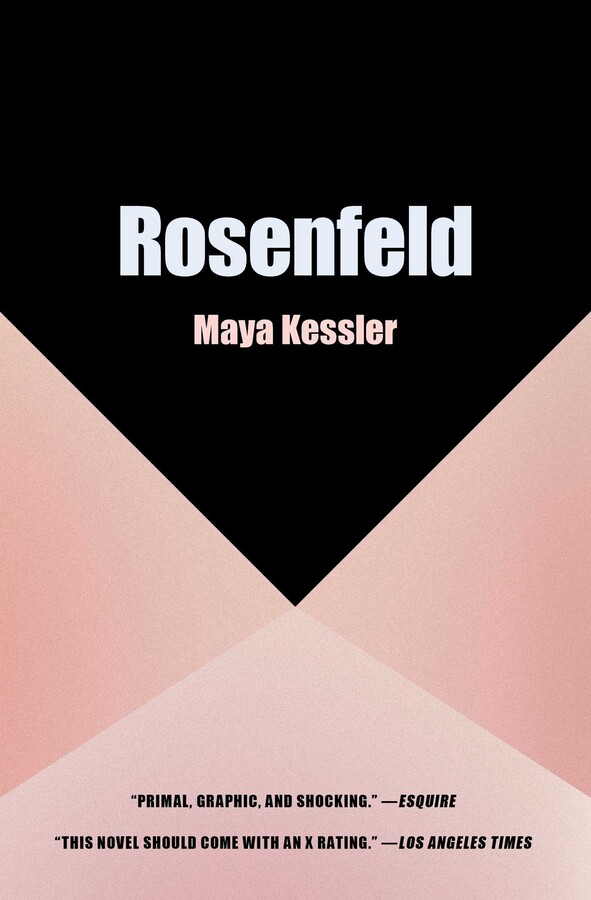
3. As a group, view and compare the various internationals covers of Rosenfeld (the American, Israeli, and German editions). Why do you think the specific designs were selected for this story? Discuss in specificity, comparing typography, colors, and other visual elements.
A Conversation with Maya Kessler
What made you want to write a love story that features such a couple whose differences—whether in age, background, or outlook—create such a tense power dynamic?
The interplay between these characters and their power dynamic intrigued me as a way to explore the vulnerabilities and boundaries of two complex people, and how their pathologies can intertwine into one another. Noa and Teddy meet at different stages in their lives. The conflict between them doesn’t stem from outside circumstances but rather from within—they both want each other, but need different things. This setup allows for tension, which to me felt like a path to reveal the characters’ raw, authentic selves. The differences between them add layers to their interactions, their control, and their resistance in ways that challenge both partners.
There’s a natural tension that arises when there’s real conflict. It elevates the urgency and intensity of the relationship—all elements that are perfect for telling a story about passion. It’s a power struggle, a game of attack and defense, that raises the stakes and drama in the relationship. This dynamic can become very addictive, which I find interesting. I think that for people who experienced very strong emotional intensity at a young age, there’s often a drive to seek that same intensity and conflict-laden intimacy throughout life. That's what happened in my case, anyway.
Why did you choose to put obsession and aggression at the forefront of this text?
I wanted to delve into emotions that aren’t always comfortably associated with characters in general. Obsession and rage are powerful forces, often seen as inappropriate. By putting them at the forefront, I hoped to challenge conventional expectations and explore how these emotions shape identity and relationships, particularly for a character like Noa, who rejects traditional boundaries and has carried her aggression since childhood.
What I’ve come to notice is that some readers perceive the characters as extreme, while others identify with their ways of thinking. Some readers recognize themselves in the characters but resist fully identifying with them—almost as if it forces them to confront an uncomfortable reflection of themselves. On the other hand, those who do identify often feel deeply connected to the text, finding relief in knowing someone else feels and thinks like them.
In your writing, there appears to be a very fine line between repulsion and infatuation. Could you say more about this?
In a love affair, these opposing forces—repulsion and infatuation—are often the currents that drive the emotional experience, pulling us in contradictory directions. To convey the protagonist's emotional journey to the reader, the story is meticulously constructed to mirror the process of falling in love: starting with the first meeting, moving to the spark of connection and attraction, then deepening into closeness and conquest. This leads to a period of familiarity that feels somewhat repetitive—here we are again, same place, same situation—but every time feels slightly different. Each encounter is significant, yet you can’t even recall what happened when.
The sense of foreboding, quietly signaling what is to come, begins subtly from the start but intensifies toward the middle of the story—and that’s where the tilt slowly happens. Gradually, step by step—just like in falling in love—you reach a point of no return. And the emotional tides you experienced at the beginning now ebb to their lowest points.
You and Noa are both filmmakers—you make films for a global oncology company, while she makes films for a marine biotech company. Do you feel a kinship with Noa?
Absolutely, I share Noa’s creative drive and her fascination with complex, sometimes dark subject matter. Both Noa and I navigate unconventional work environments, and I’ve infused parts of my own experience with navigating these worlds into her character. In some ways, her struggles mirror my own journey with storytelling.
Noa is in a different stage of life than I am, but she’s very similar to me, especially in her emotional structure and the way she interacts with the world and the people around her. Sometimes, you create a character who speaks very differently from you—that wasn’t the case here. Most of the things she says are things I could imagine myself saying in different situations.
What made you want to explore such a fraught relationship between the protagonist and her mother?
I knew I had to wound Noa so that Teddy would have something to work with. She needed that wound, that vulnerability, so that he could have a chance to shift something within her and make a difference. So I gave her the wound most familiar to me; There was a period of estrangement between my mother and me. That’s a pain I have a lot to tell about. My mother and I are close today, but for Noa’s character, I was interested in exploring what happens to a woman who reaches her mid-thirties, standing at a crossroad where she has to decide whether she wants a partner, a family, children—while she herself hasn’t yet resolved things with her own mother.
Do you have a favorite scene in the book?
One of my favorite scenes is when Teddy confronts Noa for the first time about not being in contact with her mother (PP. 166-170). It happens in the morning, after a not-so-harmonious evening between them, and she’s feeling a bit unsteady. When she wakes up, he’s already out of bed, as usual, and because she feels vulnerable, she wants to be dressed and composed before facing him. But he walks in while she’s in the shower and, out of nowhere, decides to ask her about her estrangement from her mother.
The way he does it—appearing to lack any sensitivity—actually gives her the space to react aggressively. And she does just that. It’s the first time Noa truly allows herself to get angry and lash out at Teddy. He doesn’t flinch, of course, and that only makes it harder for her: his refusal to retreat, apologize, or comfort her, but instead doubling down and pushing even harder. And yet, beneath the surface and beyond her awareness, this is exactly what she needs from him.
This moment is their first real breaking point. Subsequently, she tries to end things with him, spiraling into days of exhausting obsession until she finally breaks down and waits for him outside his building.
There is a sense, when reading Rosenfeld, that you have great control over the careful pacing and tension. Were there any techniques or practices that helped with this?
My background in film has shaped how I perceive storytelling and undoubtedly influenced my approach to the novel. I don’t use wordy descriptions; instead, I set up the feel and tone of a scene in a way that resembles a movie—place, time, lighting—only the necessary details to create a vivid visual in the reader’s mind. A dominant presence of dialogue drives the plot forward, and the chapters end at points designed to spark interest in the next one. Much like a screenplay, I treat every segment as a scene and use those scenes as building blocks to construct the narrative.
Like in film editing, I aimed to influence the pace of reading based on what each scene required. Sometimes I wanted the reader to slow down, sometimes to speed up—much like shifts in editing rhythm.
Choosing a protagonist with a cinematic mindset further supported this approach. Noa’s perspective, told in the first person as part of the record of events she’s writing herself, gave me the justification and internal logic for telling the story this way.
Can you share the thought process behind naming the novel Rosenfeld?
I think that because I didn’t come from the literary world, I felt the need to justify the existence of the text. It’s hard to explain—it’s as if I had to create a concept to legitimize my writing. Who am I to open a blank document and say, “I’m writing a novel now”? So I invented a character and let her write the text. She essentially creates a kind of memorandum, a subjective account of what happened to her with Teddy Rosenfeld. It only made sense that the title for such a document would simply be his surname—like a title of a case.
During the writing process, I decided to play with this concept and take it a step further: at a certain point in the book, the reader comes to understand what they’ve actually been reading all along—when it was written, and most importantly, why.
Additionally, there’s a reason for my choice to give Teddy the surname Rosenfeld: it’s composed of the German words Rosen (roses) and Feld (field), subtly referencing the phrase "I never promised you a rose garden," which hints at the tension between idealized expectations and the harsher realities of life.
A single arrow, double arrows and “+” symbols precede the paragraphs and sections of the book. What do these visual cues signify, and how do you intend for them to impact the reading experience?
The use of symbols is also connected to my relationship with the novel and how I perceive its legitimacy. The symbols were there from the very beginning, when I first started writing, functioning as a scaffold to indicate the place of each segment in the narrative flow:
» I used two forward arrows to mark the start of a new time sequence or a time jump.
› A single forward arrow indicates a chronological continuation of the previous section—it can usually be replaced with "and so."
+ The plus sign appears when stepping out of the narrative, such as for a memory, a dream, or an anecdote—it can usually be replaced with "and also." And, there’s also an additional hidden meaning to the segments marked by the plus sign.
During the editing process of the original book (in Hebrew), the symbols survived draft after draft, all the way until it was time to send the text for typesetting. At that stage, my editor asked: Maya, what about the symbols? I strongly felt I wanted to keep them, though I couldn’t quite explain why. So I turned to Tzvi Gutter, a close friend who had been deeply involved in the writing process of Rosenfeld, and he helped me make sense of it. He said:
In my opinion, it’s you who needs it, mainly as an “anti-literary” principle. In a way, it represents something about your identity—you’re not exactly an author in the traditional sense—and you have an internal code language that you don’t censor because of the format. You don’t conform to how a novel is supposed to look. It’s a visual element that primarily serves you, not the reader, and your choice to keep it in the novel is an artistic one.
And that clarified it for me: I don’t need the reader to understand it. It’s there because, for me, it’s an inseparable part of the text.
Could you talk about the process of having your novel, originally written in Hebrew, translated into English? Was there anything about the translation process that you found to be surprising or challenging?
“Homer, where are you going?”
“I’m not gonna lie to you Marge…so long!”
I’m not gonna lie to you: I got most of my English from watching (and rewatching!) episodes of The Simpsons. Being the control freak that I am, and considering my semi-sufficient-Simpsons-English, when the time came to translate Rosenfeld, I knew I needed a translator who’d be willing to work together. Like, really work together. Someone who not only had the skills but also loved the book. Maya Thomas was that person.
Translation terrified me because so much of Rosenfeld relies on its unique voice—a mix of sharp, bold, and intimate language I could fully control in Hebrew but felt unsure of in English. Recreating that voice in a language that isn’t mine was daunting. Would the characters feel as alive? Would the humor and intensity translate?
The process was intense: I prepared Hebrew chapters with notes and directions, she translated, and then we’d meet for long sessions (many cigarettes by the window) to finalize each chapter together. After finishing the main translation, I worked with my editor and agent Jessica Kasmer-Jacobs on tightening and sharpening the manuscript further.
As part of this process, I also decided to change most of the characters’ names to American ones. I wanted to keep the focus on the emotional core of the story. This is a universal tale about relationships, and I didn’t want foreign names or places to distract readers or tie the story too firmly to a specific cultural context. By choosing names more familiar to an American audience, I hoped to help readers connect directly with the characters and their journeys. The goal was to keep the spotlight on the dynamics and emotions that drive the narrative.
I’ve enjoyed every minute of working on this book; reinventing Teddy and Noa in their English versions has been absolutely fascinating for me.
Some readers will be surprised by the ending of Rosenfeld. Did you always know that the book would end the way it does?
I didn't initially know how Rosenfeld would end. A book's ending has to be earned, meaning, something you work towards. You can't just pick an ending because it seems convenient—if it doesn't resonate authentically with the characters, readers will notice and feel as if they've been deceived. I invested a lot of time refining the ending, examining every detail.
One reader once told me she dislikes endings that aren't definite and clear. I explained that I feel the same way, but the ending of this novel is the only one that truly suits the characters. It's their genuine outcome. They didn't completely sever their ties to each other's lives, at least not in an absolute sense. But there is a sense of completion to their journey, both individually and together.
And how do you know if an ending works? It gets the fewest complaints!
Introduction
While attending a wedding, 36-year-old filmmaker Noa Simon and older CEO Teddy Rosenfeld meet and become instantly infatuated with one another. Teddy, overweight with crooked teeth, may not be traditionally handsome, but Noa can’t help but want all of him. When Noa is offered a position at Teddy’s company, their relationship heats up and becomes more complicated. As the two of them navigate an intense dynamic filled with graphic sex and rapid-fire, often heated conversations, they must decide if they will let their emotional walls down and allow one another to help them confront circumstances in their families and personal lives. Rosenfeld is a lyrical exploration of female rage and obsession, a coming-of-age tale, and a bold, complex love story.
Topics & Questions for Discussion
1. The sex scenes in Rosenfeld are visceral and captivating. Are there any particular elements of the author’s sex writing that you found most compelling? Did the author’s approach to sex scenes surprise you at all?
2. In what ways is the sex an important arena for Teddy and Noa to grapple with their tense power dynamic?
3. Rosenfeld is a love story. It could also be considered a coming-of-age story, an exploration of the tortured artist’s interior. If you had to describe this novel in four words or fewer, how would you describe it? Discuss as a group.
4. How does Noa’s relationship with herself shift after her accident?
5. How does Noa’s relationship with Teddy shift after her accident?
6. Teddy is an established businessman who has known love and accomplishment, but he, too, has vulnerabilities. How does Noa, as a narrator and as a character, reveal Teddy’s vulnerabilities over time?
7. Noa and Teddy are both powerful characters in various ways. How does this power play a role in their dynamic, and how does it shift between them throughout the story?
8. Noa has a troubled and unresolved past with her mother, Nurit, when Teddy steps in. Do you think it was wrong of Teddy to meet with Nurit behind Noa’s back, or do you see it more as an act of love?
9. The author’s writing is often quite poetic and even lyrical. At one point, Noa confesses that she’s “not sure how to describe the landscape of [her] soul, but [she] guess[es] that a satellite view would reveal a host of black holes.” Were there any other points in the text when you were struck by the lyrical writing? How did this influence your understanding of Noa’s character and your experience of the text as a whole?
10. Why do you think Noa’s interactions with Adrian are so interesting, even bothersome to Teddy?
11. With Noa as the narrator, readers get a deeper understanding of her rage and obsession. How would this story be different, and what might be lost, if Noa was not the narrator?
12. At the end of the book, Nurit shares that when Noa was about two years old, waiting in a doctor’s office, she suddenly hugged a fat man and claimed, “but Mommy, I love him.” What significance does this have to Noa’s story?
13. Why do you think the author chose to have Nurit witness and share the story about young Noa hugging the fat man? Why do you think this story was only shared at the end of the novel?
Enhance Your Book Club
1. As a group, make a list of books that explore female rage, desire, and obsession (Lisa Taddeo’s Animal, Miranda July’s All Fours, Otessa Moshfegh’s My Year of Rest and Relaxation). Compare and contrast the books on this list—what do they have in common with Rosenfeld? In what ways does Noa’s voice and development as a woman set her apart from the other women in these stories?
2. Break into groups and pretend you are casting and directing a film adaption of Rosenfeld. Who do you cast as Noa, Teddy, Nurit, Roy, Milo, and Richard? Discuss.
3. As a group, view and compare the various internationals covers of Rosenfeld (the American, Israeli, and German editions). Why do you think the specific designs were selected for this story? Discuss in specificity, comparing typography, colors, and other visual elements.
A Conversation with Maya Kessler
What made you want to write a love story that features such a couple whose differences—whether in age, background, or outlook—create such a tense power dynamic?
The interplay between these characters and their power dynamic intrigued me as a way to explore the vulnerabilities and boundaries of two complex people, and how their pathologies can intertwine into one another. Noa and Teddy meet at different stages in their lives. The conflict between them doesn’t stem from outside circumstances but rather from within—they both want each other, but need different things. This setup allows for tension, which to me felt like a path to reveal the characters’ raw, authentic selves. The differences between them add layers to their interactions, their control, and their resistance in ways that challenge both partners.
There’s a natural tension that arises when there’s real conflict. It elevates the urgency and intensity of the relationship—all elements that are perfect for telling a story about passion. It’s a power struggle, a game of attack and defense, that raises the stakes and drama in the relationship. This dynamic can become very addictive, which I find interesting. I think that for people who experienced very strong emotional intensity at a young age, there’s often a drive to seek that same intensity and conflict-laden intimacy throughout life. That's what happened in my case, anyway.
Why did you choose to put obsession and aggression at the forefront of this text?
I wanted to delve into emotions that aren’t always comfortably associated with characters in general. Obsession and rage are powerful forces, often seen as inappropriate. By putting them at the forefront, I hoped to challenge conventional expectations and explore how these emotions shape identity and relationships, particularly for a character like Noa, who rejects traditional boundaries and has carried her aggression since childhood.
What I’ve come to notice is that some readers perceive the characters as extreme, while others identify with their ways of thinking. Some readers recognize themselves in the characters but resist fully identifying with them—almost as if it forces them to confront an uncomfortable reflection of themselves. On the other hand, those who do identify often feel deeply connected to the text, finding relief in knowing someone else feels and thinks like them.
In your writing, there appears to be a very fine line between repulsion and infatuation. Could you say more about this?
In a love affair, these opposing forces—repulsion and infatuation—are often the currents that drive the emotional experience, pulling us in contradictory directions. To convey the protagonist's emotional journey to the reader, the story is meticulously constructed to mirror the process of falling in love: starting with the first meeting, moving to the spark of connection and attraction, then deepening into closeness and conquest. This leads to a period of familiarity that feels somewhat repetitive—here we are again, same place, same situation—but every time feels slightly different. Each encounter is significant, yet you can’t even recall what happened when.
The sense of foreboding, quietly signaling what is to come, begins subtly from the start but intensifies toward the middle of the story—and that’s where the tilt slowly happens. Gradually, step by step—just like in falling in love—you reach a point of no return. And the emotional tides you experienced at the beginning now ebb to their lowest points.
You and Noa are both filmmakers—you make films for a global oncology company, while she makes films for a marine biotech company. Do you feel a kinship with Noa?
Absolutely, I share Noa’s creative drive and her fascination with complex, sometimes dark subject matter. Both Noa and I navigate unconventional work environments, and I’ve infused parts of my own experience with navigating these worlds into her character. In some ways, her struggles mirror my own journey with storytelling.
Noa is in a different stage of life than I am, but she’s very similar to me, especially in her emotional structure and the way she interacts with the world and the people around her. Sometimes, you create a character who speaks very differently from you—that wasn’t the case here. Most of the things she says are things I could imagine myself saying in different situations.
What made you want to explore such a fraught relationship between the protagonist and her mother?
I knew I had to wound Noa so that Teddy would have something to work with. She needed that wound, that vulnerability, so that he could have a chance to shift something within her and make a difference. So I gave her the wound most familiar to me; There was a period of estrangement between my mother and me. That’s a pain I have a lot to tell about. My mother and I are close today, but for Noa’s character, I was interested in exploring what happens to a woman who reaches her mid-thirties, standing at a crossroad where she has to decide whether she wants a partner, a family, children—while she herself hasn’t yet resolved things with her own mother.
Do you have a favorite scene in the book?
One of my favorite scenes is when Teddy confronts Noa for the first time about not being in contact with her mother (PP. 166-170). It happens in the morning, after a not-so-harmonious evening between them, and she’s feeling a bit unsteady. When she wakes up, he’s already out of bed, as usual, and because she feels vulnerable, she wants to be dressed and composed before facing him. But he walks in while she’s in the shower and, out of nowhere, decides to ask her about her estrangement from her mother.
The way he does it—appearing to lack any sensitivity—actually gives her the space to react aggressively. And she does just that. It’s the first time Noa truly allows herself to get angry and lash out at Teddy. He doesn’t flinch, of course, and that only makes it harder for her: his refusal to retreat, apologize, or comfort her, but instead doubling down and pushing even harder. And yet, beneath the surface and beyond her awareness, this is exactly what she needs from him.
This moment is their first real breaking point. Subsequently, she tries to end things with him, spiraling into days of exhausting obsession until she finally breaks down and waits for him outside his building.
There is a sense, when reading Rosenfeld, that you have great control over the careful pacing and tension. Were there any techniques or practices that helped with this?
My background in film has shaped how I perceive storytelling and undoubtedly influenced my approach to the novel. I don’t use wordy descriptions; instead, I set up the feel and tone of a scene in a way that resembles a movie—place, time, lighting—only the necessary details to create a vivid visual in the reader’s mind. A dominant presence of dialogue drives the plot forward, and the chapters end at points designed to spark interest in the next one. Much like a screenplay, I treat every segment as a scene and use those scenes as building blocks to construct the narrative.
Like in film editing, I aimed to influence the pace of reading based on what each scene required. Sometimes I wanted the reader to slow down, sometimes to speed up—much like shifts in editing rhythm.
Choosing a protagonist with a cinematic mindset further supported this approach. Noa’s perspective, told in the first person as part of the record of events she’s writing herself, gave me the justification and internal logic for telling the story this way.
Can you share the thought process behind naming the novel Rosenfeld?
I think that because I didn’t come from the literary world, I felt the need to justify the existence of the text. It’s hard to explain—it’s as if I had to create a concept to legitimize my writing. Who am I to open a blank document and say, “I’m writing a novel now”? So I invented a character and let her write the text. She essentially creates a kind of memorandum, a subjective account of what happened to her with Teddy Rosenfeld. It only made sense that the title for such a document would simply be his surname—like a title of a case.
During the writing process, I decided to play with this concept and take it a step further: at a certain point in the book, the reader comes to understand what they’ve actually been reading all along—when it was written, and most importantly, why.
Additionally, there’s a reason for my choice to give Teddy the surname Rosenfeld: it’s composed of the German words Rosen (roses) and Feld (field), subtly referencing the phrase "I never promised you a rose garden," which hints at the tension between idealized expectations and the harsher realities of life.
A single arrow, double arrows and “+” symbols precede the paragraphs and sections of the book. What do these visual cues signify, and how do you intend for them to impact the reading experience?
The use of symbols is also connected to my relationship with the novel and how I perceive its legitimacy. The symbols were there from the very beginning, when I first started writing, functioning as a scaffold to indicate the place of each segment in the narrative flow:
» I used two forward arrows to mark the start of a new time sequence or a time jump.
› A single forward arrow indicates a chronological continuation of the previous section—it can usually be replaced with "and so."
+ The plus sign appears when stepping out of the narrative, such as for a memory, a dream, or an anecdote—it can usually be replaced with "and also." And, there’s also an additional hidden meaning to the segments marked by the plus sign.
During the editing process of the original book (in Hebrew), the symbols survived draft after draft, all the way until it was time to send the text for typesetting. At that stage, my editor asked: Maya, what about the symbols? I strongly felt I wanted to keep them, though I couldn’t quite explain why. So I turned to Tzvi Gutter, a close friend who had been deeply involved in the writing process of Rosenfeld, and he helped me make sense of it. He said:
In my opinion, it’s you who needs it, mainly as an “anti-literary” principle. In a way, it represents something about your identity—you’re not exactly an author in the traditional sense—and you have an internal code language that you don’t censor because of the format. You don’t conform to how a novel is supposed to look. It’s a visual element that primarily serves you, not the reader, and your choice to keep it in the novel is an artistic one.
And that clarified it for me: I don’t need the reader to understand it. It’s there because, for me, it’s an inseparable part of the text.
Could you talk about the process of having your novel, originally written in Hebrew, translated into English? Was there anything about the translation process that you found to be surprising or challenging?
“Homer, where are you going?”
“I’m not gonna lie to you Marge…so long!”
I’m not gonna lie to you: I got most of my English from watching (and rewatching!) episodes of The Simpsons. Being the control freak that I am, and considering my semi-sufficient-Simpsons-English, when the time came to translate Rosenfeld, I knew I needed a translator who’d be willing to work together. Like, really work together. Someone who not only had the skills but also loved the book. Maya Thomas was that person.
Translation terrified me because so much of Rosenfeld relies on its unique voice—a mix of sharp, bold, and intimate language I could fully control in Hebrew but felt unsure of in English. Recreating that voice in a language that isn’t mine was daunting. Would the characters feel as alive? Would the humor and intensity translate?
The process was intense: I prepared Hebrew chapters with notes and directions, she translated, and then we’d meet for long sessions (many cigarettes by the window) to finalize each chapter together. After finishing the main translation, I worked with my editor and agent Jessica Kasmer-Jacobs on tightening and sharpening the manuscript further.
As part of this process, I also decided to change most of the characters’ names to American ones. I wanted to keep the focus on the emotional core of the story. This is a universal tale about relationships, and I didn’t want foreign names or places to distract readers or tie the story too firmly to a specific cultural context. By choosing names more familiar to an American audience, I hoped to help readers connect directly with the characters and their journeys. The goal was to keep the spotlight on the dynamics and emotions that drive the narrative.
I’ve enjoyed every minute of working on this book; reinventing Teddy and Noa in their English versions has been absolutely fascinating for me.
Some readers will be surprised by the ending of Rosenfeld. Did you always know that the book would end the way it does?
I didn't initially know how Rosenfeld would end. A book's ending has to be earned, meaning, something you work towards. You can't just pick an ending because it seems convenient—if it doesn't resonate authentically with the characters, readers will notice and feel as if they've been deceived. I invested a lot of time refining the ending, examining every detail.
One reader once told me she dislikes endings that aren't definite and clear. I explained that I feel the same way, but the ending of this novel is the only one that truly suits the characters. It's their genuine outcome. They didn't completely sever their ties to each other's lives, at least not in an absolute sense. But there is a sense of completion to their journey, both individually and together.
And how do you know if an ending works? It gets the fewest complaints!
About The Author
Photo by Tomer Appelbaum, Haaretz
Maya Kessler is a writer, film director, and producer. Kessler studied arts at the Gerrit Rietveld Academie in Amsterdam. She currently works as a filmmaker for a global oncology company, alongside writing and developing original content for the international television market.
Product Details
- Publisher: Avid Reader Press/Simon & Schuster (November 19, 2024)
- Length: 400 pages
- ISBN13: 9781668053478
Browse Related Books
Raves and Reviews
“Listen up fans of Luster and Vladimir, because you’ll want to mark the release date for Maya Kessler’s new novel… Rosenfeld is all intensity and desire, making for a reading experience that will have you turning the pages as fast as you can to see where it will take you next."—Chicago Review of Books
"[Kessler] has a mastery of the sex scene...This novel should come with an X rating… To say that Noa makes Isadora Wing of Fear of Flying look like a prude is an understatement. She’s utterly insatiable, and Teddy knows exactly how to please and to play her. … In this dynamic, sex is power, and it’s anybody’s guess as to who will end up on top."—Los Angeles Times
"A kinky, moving new novel... Kessler is excellent at depicting the way lovers forcibly burrow into each other to find hidden truths. Love, in this novel, is tearing open the beloved’s closet door to let their skeletons air. Kessler’s writing is at once casual and precise... Never boring, it’s a smart, readable novel about messy people falling agonizingly in love, and having a lot of fun in the sack along the way.”—The Jewish Book Council
"At times sexy, at times hilarious, this book offers a new spin on forbidden lust. . . . [Rosenfeld] challenged me to think about frequented themes in new and unexpected ways."—Debutiful
"An intoxicating and exciting siphoning of power, romance, and desire that will keep your heart pounding and mind lingering."—Our Culture
“While this book is not recommended for human resources personnel or underage readers, the rest of us can enjoy this well-told tale of a ravenous romance set in Israel.”—Hadassah Magazine
"[For] fans of 'Sex and the City,' Raven Leilani’s Luster, and Coco Mellor’s Cleopatra and Frankenstein."—The Millions
“Raw… the characters come alive during the sex scenes, their desire for each other radiating off the page.”—Publishers Weekly
“An erotic obsession [that] becomes all-consuming… X-rated.”—Kirkus Reviews
"A confidently written, graphic and enthralling book.” —Kveller
“A romantic novel on the verge of erotic which cleverly plays with the genre’s formulas.”—Calcalist
“Kessler’s debut novel is an erotic romance with twists, humor and sophistication that doesn't follow the rules—neither literary rules, nor the new laws of relationships."—Haaretz
Resources and Downloads
High Resolution Images
-
Book Cover Image (jpg): Rosenfeld
eBook 9781668053478
-
Author Photo (jpg): Maya Kessler Photo by Tomer Appelbaum, Haaretz(0.1 MB)
Any use of an author photo must include its respective photo credit