
Plus, receive recommendations and exclusive offers on all of your favorite books and authors from Simon & Schuster.
Table of Contents
About The Book
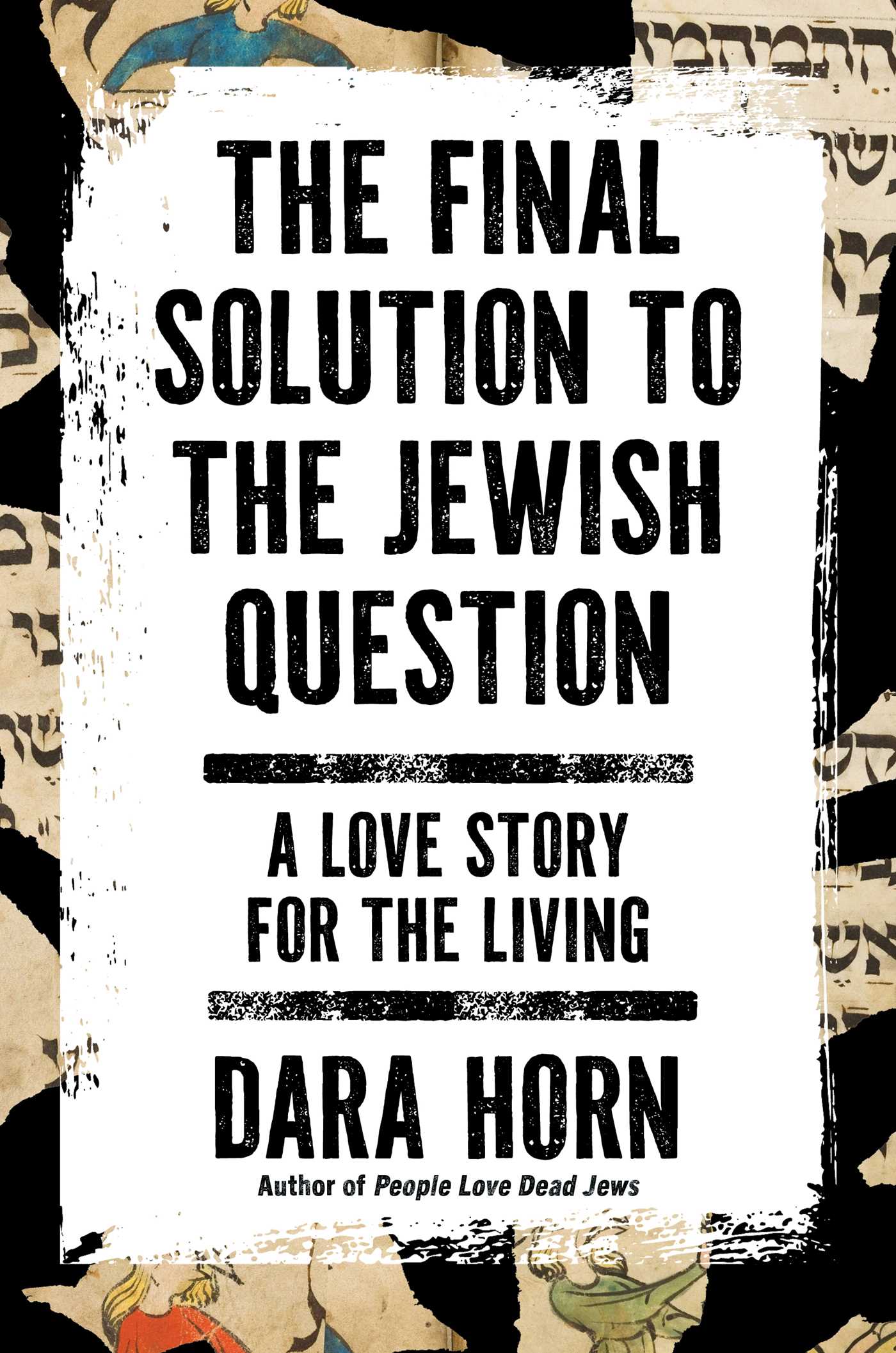
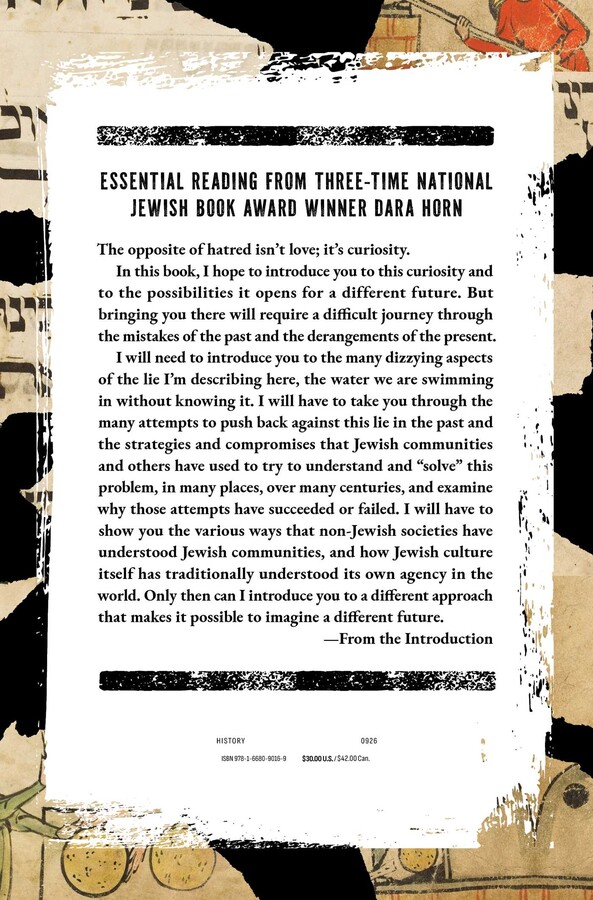
From three-time National Jewish Book Award winner Dara Horn, a masterful new work of nonfiction that boldly confronts and dismantles the myths and lies that have spread antisemitism from ancient times until today—and then offers an audacious but achievable vision for the future.
After publishing the “extremely engaging” (The Washington Post) and award-winning essay collection People Love Dead Jews about the insidious nature of contemporary antisemitism, Dara Horn heard from thousands of people, online and in person, demanding solutions. Then, in the aftermath of the October 7, 2023, massacre in Israel and the subsequent attacks on Jewish communities worldwide, the calls started coming not just from average readers but from university presidents and the United States government. From her front-row seat to this nightmare—including serving on Harvard’s Antisemitism Advisory Group, meeting with the White House and Congress, and speaking with communities of all backgrounds across North America—she was surprised to discover that there was far more ignorance than malice, and saw an opportunity for change.
Combining deep historical research, investigative reporting, and storytelling bravado, The Final Solution to the Jewish Question is both diagnosis and prescription. She explores and exposes the failures of Holocaust education, the long history of the antizionist movement, the compromises of the American Jewish “Golden Age,” and the organized plot to poison artificial intelligence with anti-Jewish propaganda, and weaves it all into an erudite, audacious, and convincing series of arguments that invites readers of every background and inclination to become curious about their blind spots and to absorb new and uncomfortable truths. From there, she proposes a dramatic solution rooted in a new understanding of freedom and responsibility, and clears a path toward a shared future.
The Final Solution to the Jewish Question is a worldview-shifting book by one of our most incisive thinkers and writers—a lamentation, a manifesto, a call to action, and, ultimately, a love story for the living.
After publishing the “extremely engaging” (The Washington Post) and award-winning essay collection People Love Dead Jews about the insidious nature of contemporary antisemitism, Dara Horn heard from thousands of people, online and in person, demanding solutions. Then, in the aftermath of the October 7, 2023, massacre in Israel and the subsequent attacks on Jewish communities worldwide, the calls started coming not just from average readers but from university presidents and the United States government. From her front-row seat to this nightmare—including serving on Harvard’s Antisemitism Advisory Group, meeting with the White House and Congress, and speaking with communities of all backgrounds across North America—she was surprised to discover that there was far more ignorance than malice, and saw an opportunity for change.
Combining deep historical research, investigative reporting, and storytelling bravado, The Final Solution to the Jewish Question is both diagnosis and prescription. She explores and exposes the failures of Holocaust education, the long history of the antizionist movement, the compromises of the American Jewish “Golden Age,” and the organized plot to poison artificial intelligence with anti-Jewish propaganda, and weaves it all into an erudite, audacious, and convincing series of arguments that invites readers of every background and inclination to become curious about their blind spots and to absorb new and uncomfortable truths. From there, she proposes a dramatic solution rooted in a new understanding of freedom and responsibility, and clears a path toward a shared future.
The Final Solution to the Jewish Question is a worldview-shifting book by one of our most incisive thinkers and writers—a lamentation, a manifesto, a call to action, and, ultimately, a love story for the living.
Excerpt
Chapter 1: The Return of the Big Lie CHAPTER 1 THE RETURN OF THE BIG LIE
THE INFAMOUS CONGRESSIONAL HEARING in December of 2023 about antisemitism at American universities, during which the presidents of Harvard University, the University of Pennsylvania, and Massachusetts Institute of Technology all claimed that calls for the genocide of Jews would violate their university’s policies only “depending on the context,” quickly became a well-worn meme. Surely there is nothing left to say about this higher-education train wreck, after the fallout brought down two of those university presidents and spawned a thousand op-eds—except that all of the punditry about free speech and criticism of Israel extravagantly missed the point.
The problem was not that Jewish students on American university campuses didn’t want free speech, or that they didn’t want to hear criticism of Israel. Instead they didn’t want people vandalizing Jewish student organizations’ buildings, or breaking or urinating on the buildings’ windows. They didn’t want people tearing their mezuzahs down from their dorm-room doors. They didn’t want their college instructors spouting antisemitic lies and humiliating them in class. They didn’t want their posters defaced with Hitler caricatures or their dorm windows plastered with “FUCK JEWS.” They didn’t want people punching them in the face, or beating them with a stick, or threatening them with death for being Jewish. At world-class American colleges and universities, all of this happened and more.
I was not merely an observer of this spectacle. I’d been serving on now-former Harvard president Claudine Gay’s Antisemitism Advisory Group, convened after the October 7, 2023, Hamas massacre in Israel and amid student responses to it. I was asked to participate because I was a Harvard alumna who had written a recent book about antisemitism. As soon as my participation became public, I was inundated with messages from Jewish students seeking help. They approached me with their stories after having already tried many other avenues—bewildered not only by what they’d experienced, but also by how many people dismissed or denied those experiences.
In Congress, all three university presidents offered some version of the platitudes that “Hatred comes from ignorance” and “Education is the answer.” But if hatred comes from ignorance, why were America’s best universities full of this very specific ignorance? And why were so many people trying to justify it, explain it away, or even deny it? Our era’s ten-second news cycle was no match for these questions, because the answers were deep and ancient, buried beneath the oldest assumptions about what we think we know.
The through line of antisemitism for thousands of years has been the denial of truth and the promotion of lies. These lies range in scope from conspiracy theories to Holocaust denial to the blood libel to the currently popular claims that Zionism is racism, that Jews are settler colonialists, and that Jewish civilization isn’t native to the land of Israel. These lies are all part of the foundational Big Lie: that antisemitism itself is a righteous act of resistance against evil, because Jews are collectively evil and have no right to exist. Today, the Big Lie is winning.
IN 2013, THE HISTORIAN David Nirenberg published an astonishing book titled Anti-Judaism. Nirenberg’s argument, rigorously laid out in nearly five hundred pages of dense scholarship and more than a hundred pages of footnotes, is that Western cultures—including ancient civilizations, Christianity, Islam (which Nirenberg considers Western in its relationship with Judaism), and post-religious societies—have often defined themselves through their opposition to what they consider “Judaism.” This has little to do with actual Judaism, and a lot to do with whatever evil these non-Jewish cultures aspire to overcome.
Nirenberg is a diligent historian who resists generalizations and avoids connecting the past to contemporary events. But when one reads through his carefully assembled record of twenty-three centuries’ worth of intellectual leaders articulating their societies’ ideals by loudly rejecting whatever they consider “Jewish,” this deep neural groove in Western thought becomes difficult to dismiss, its patterns unmistakable. If piety was a society’s ideal, Jews were impious blasphemers; if secularism was the ideal, Jews were backward pietists. If capitalism was evil, Jews were capitalists; if communism was evil, Jews were communists. If a society was nationalist, Jews were globalists; if globalism was celebrated, Jews were nationalists. If military valor mattered most, Jews were cowardly humanists; if pacifism and human rights mattered most, Jews were warmongering human-rights abusers. If a society was racist, Jews were an inferior race; if a society was anti-racist, Jews were racists. “Anti-Judaism” thus becomes a righteous fight to protect a society’s values.
This dynamic forces Jews into the defensive mode of constantly proving they are not evil. Around 40 CE, after rioters in Alexandria destroyed hundreds of Jewish homes and burned Jews alive, the Jewish Alexandrian intellectual Philo and the non-Jewish Alexandrian intellectual Apion both sailed to Rome for a “debate” before Emperor Caligula about whether Jews deserved citizenship. Apion told the emperor that Jews held an annual ritual in which they kidnapped a non-Jew, fattened him up, and ate him. Caligula delayed Philo’s rebuttal of this lie for five months, and then listened to him only while consulting with designers on palace decor. Alexandrian Jews lost their citizenship rights, though it took until 66 CE for fifty thousand more of them to be slaughtered.
In medieval Europe, Jews were forced into disputations with Christian priests that placed Jewish texts and traditions on public trial, resulting in Jewish books being burned and Jewish disputants exiled. Later legal trials expanded on this concept, requiring Jews to defend themselves against the absurd charge known as the blood libel, in which Jews are accused of murdering and consuming non-Jewish children—a claim that has echoes in current lies about Israelis deliberately targeting Palestinian children and harvesting Palestinians’ organs.
The absurdity of these charges is less remarkable than the high intellectual profiles of those making them: people like Apion, a scholar of Homer and Egyptian history, as well as Christian and Muslim scholars who were among the best-read people of their time. Similarly absurd claims of Jewish perfidy were later endorsed by civilizational luminaries such as Martin Luther and Voltaire. “Anti-Judaism,” Nirenberg argues, “should not be understood as some archaic or irrational closet in the vast edifices of Western thought. It was rather one of the basic tools with which that edifice was constructed.”
I thought often of Nirenberg’s thesis in the months after the October 7, 2023, massacre in Israel, during which (it bears repeating) Hamas, an openly genocidal organization whose stated goal is the murder of Jews, lived up to its mission statement by torturing, raping, and murdering more than twelve hundred people in southern Israel and taking more than two hundred captives, including babies, children, and the elderly. Shortly after the attacks, a Cornell University professor publicly proclaimed the barbarity “exhilarating” and “energizing,” while a Columbia University professor called it “awesome” and an “achievement.” Comparable praise percolated through America’s top universities, where students and faculty began gathering regularly after October 8 to chant “There is only one solution: intifada revolution!” (If there is only one solution, perhaps one could call it the Final Solution.)
Students took these rallies inside libraries and other campus buildings. They vandalized university property with such slogans as “Zionism = Genocide,” “New Intifada,” and “From the river to the sea, Palestine will be free”—referring to a geographic area that encompasses the entirety of the State of Israel. (At Harvard, some students opted for chanting an Arabic version: “From water to water, Palestine is Arab.”) On some campuses, the exhilaration escalated into death threats and physical assaults against Jewish students. When a Jewish Tulane University student tried to stop an anti-Israel protester near campus from burning an Israeli flag in November of 2023, protesters attacked him and other Jewish students, breaking one student’s nose. At Columbia, students eventually expressed their enthusiasm for Hamas by copying its tactics: beating Jewish students, assaulting workers, taking over buildings, and holding custodians hostage.
It wasn’t just universities. Crowds cheering for “intifada” gathered in cities around the country, shutting down and disrupting train stations and airport access roads. Lest their support for Hamas be mistaken for support for Palestinians in general, or for peace, US rally organizers named their efforts “floods” (“Flood Seattle for Palestine,” “Flood Manhattan for Gaza”) after “Operation Al-Aqsa Flood,” Hamas’s name for its October 7 butchery. (On October 7 of 2024 and 2025, these mass rallies in American cities again made their motives clear by advertising their events for this date as “honoring our October 7 martyrs”—that is, including those who were killed while massacring Israelis. One New York group even held a vigil commemorating the death of Yahya Sinwar, the Hamas leader who planned the massacre.) The enthusiasm was hard to contain. Some people tore down or vandalized posters of Israeli hostages. Others targeted synagogues and Jewish-owned businesses, spray-painting them with swastikas and slogans like “Israel’s only religion is capitalism.” In New York City, a Jewish teacher’s online photo holding a sign that said “I Stand with Israel” was enough to prompt a schoolwide protest that devolved into a riot during which students destroyed public school property, causing more than a hundred thousand dollars in damage; the teacher had to be moved to another part of the building to avoid the teenage mob screaming “Free Palestine!” In Los Angeles, a man invaded a Jewish family’s home before dawn with a knife, breaking into the parents’ bedroom while their four children slept, screaming “Kill Jewish people.” When police arrested him, he shouted, “Free Palestine!”
Criticism of Israel is not antisemitic: Jews are now required to recite this humiliatingly obvious sentence, over and over, as the price of admission to public discourse about their own demonization, in “debates” with people who are often unable to name the relevant river or sea. The many legitimate concerns about Israel’s war in Gaza and its policies toward Palestinians could not explain these eliminationist chants and slogans, the glee with which they were delivered, the lawlessness that accompanied them, or the open assaults on Jews. The timing alone laid the game bare. This mass exhilaration emerged not in response to Israel’s war to take down Hamas and rescue its kidnapped citizens, but exactly in response to, and explicitly in celebration of, the most lethal and sadistic barbarity against Jews since the Holocaust.
But there are nuances to sadistic barbarity against Jews, we were told, and sometimes gang-raping Jewish women is actually a movement for human rights. It hardly seemed fair to call people antisemitic if they want only half of the world’s Jews to die. The phrase “Globalize the intifada,” chanted at universities across America, perhaps widened the net a tiny bit—but really, who could say? Even the phrase “Gas the Jews,” chanted at a rally organized by New York University students and faculty, was so very ambiguous. How dare those whiny Jews presume to know what’s in other people’s hearts?
Besides, American Jews had nothing to whine about: Had any of them actually died in the United States from all this exhilaration? That question was answered in November of 2023, when a Jewish man died in California after an anti-Israel protester allegedly clubbed him over the head with a bullhorn, the kind used to chant entirely non-antisemitic slogans—and of course the question had already been answered repeatedly with other antisemitic murders in recent years, some more publicized than others. (One murder even happened on campus: In 2022, an expelled University of Arizona student who repeatedly ranted about Jews and Zionists shot and killed his professor—who wasn’t Jewish, though the student thought he was.) By 2025, more murders were added to the list, enacted by perpetrators who loudly announced their desire to “Free Palestine” as they attacked and killed American Jews.
But then the goalposts moved again: Those actual murders, along with many other physical attacks against American Jews, were all just one-offs, lone wolves, mental-illness cases, unrelated to the anti-Jewish rhetoric swirling through American life. In fact, in addition to being lone-wolf mental-illness cases, some of those murders were just understandable political protests that went a touch too far. One celebrated writer in 2025 took time to explain, in an eloquent essay in a national newspaper, why murdering a young couple emerging from an American Jewish Committee event at the Capital Jewish Museum in Washington, DC, including shooting nineteen additional bullets into a twenty-six-year-old American Jewish woman as she crawled bleeding on the sidewalk, was not antisemitic at all. You see, this couple was employed at the Israeli embassy—something the gunman had no way of knowing—so that made it not a hate crime. Also, the gunman had yelled “Free Palestine!,” which is what people yell to demonstrate that they are not committing hate crimes, but simply shooting people leaving a Jewish museum. Similarly, it wasn’t at all antisemitic for a man in Colorado to set a group of mostly elderly Jews on fire, one of whom later died of her wounds. You see, those Jews were at an event bringing attention to Israeli hostages, so they, too, were asking for it. “It’s worth considering that violence that looks antisemitic may—even when it very effectively serves to scare a great many Jews—be something else,” the thoughtful pundit intoned, while declaring that emptying a clip into an American Jew walking out of an American Jewish group’s event at an American Jewish museum was political violence, not antisemitism. (Antisemitism, of course, is never political!) Why did so many whiny, scaredy-cat Jews stupidly think that these murders were hate crimes? Didn’t they realize they deserved it?
It remained unclear why antisemitism should matter only when it is lethal, or if so, how many unambiguously antisemitic murders would be necessary for antisemitism to be happening outside of whiny Jews’ heads. A realistic estimate might be six million. Even then, Jews have had to spend the past eighty years collecting documentation to prove it, and the world is still full of people who think they made it up.
ONE CONFOUNDING FACT IN this onslaught of the world’s oldest hatred is that American society should have been ready to handle it. Many public and private institutions in recent years have invested enormously in attempts to defang bigotry; ours is an era in which even sneaker companies feel obliged to publicly denounce hate. But diversity, equity and inclusion initiatives have proven to be no match for antisemitism, for a clear reason: the durable idea of antisemitism as justice.
Diversity efforts are designed to combat the effects of social prejudice by insisting on equity. The idea driving such efforts is that some people in our society have too much power and too much privilege, and are overrepresented, so justice requires leveling the playing field. But antisemitism isn’t primarily a social prejudice. It is the lie that Jews are supervillains manipulating others. If one unconsciously accepts this lie, then the righteous fight for justice does not require protecting Jews as a vulnerable minority. It requires taking Jews down.
This idea was tacitly endorsed by Jews’ bizarre exclusion from many diversity, equity and inclusion trainings and policies, despite their top ranking in American hate-crime statistics. The premise, for instance, that Jews don’t experience bigotry because they are “white,” itself a fraught idea, would suggest that white LGBTQ people don’t experience bigotry either, a premise that no DEI policy would endorse (not to mention the fact that many Jews are not white). The contention that Jews are immune to bigotry because they are “rich,” an idea even more fraught and also often false (about 20 percent of Jews in New York City, for instance, live in poverty or near-poverty), is equally nonsensical. No one claims that gay men or Indian Americans never experience bigotry because of those groups’ statistically higher incomes. The idea that money erases bigotry apparently applies only to Jews. Again and again, the ostensible reasons for not addressing antisemitism in diversity initiatives quickly reveal themselves to be founded on ancient, unexamined assumptions about Jews as invulnerable villains.
The sordid history of the concept of antizionism vividly illustrates this dynamic, and it is particularly relevant for its success in scrambling the radar of well-meaning people. Jewish civilization has been centered for thousands of years, in ways large and small, on its homeland in Israel, the only place on earth where Jews have had a continuous presence since ancient times. The modern idea of Zionism as Jewish self-determination in this homeland emerged in the late nineteenth and early twentieth centuries, along with many other anti-colonial movements around the world, as global power dynamics shifted from empires (Habsburg, Russian, Ottoman, British, French, Japanese) toward nation-states. The large and often violent population upheavals following Israel’s creation, including the displacement of 70 percent of Arabs from what became the Jewish state and the displacement of virtually 100 percent of Jews from what became twenty-two Arab states, including the displacement of 100 percent of Jews from the areas now known as the West Bank and Gaza, where centuries-old Jewish communities were completely eradicated, paralleled similar population upheavals around the world as new states emerged from receding empires. In this, Zionism was typical.
But antizionism as an explicit political concept has a history quite independent of the existence of Israel or the actions of Jews. (For that reason, I spell it without a hyphen. Like antisemitism, it is an ideology unrelated to anything real about Jews.) In 1918, thirty years before the establishment of the State of Israel, Bolsheviks established Jewish sections of the Communist party, which they insisted be antizionist. The problem, Bolsheviks argued, was that Jewish particularism (in this case, Zionism) was the obstacle to the righteous universal mission of uniting humanity under communism—just as Christians once saw Jewish particularism as the obstacle to the righteous universal mission of uniting humanity under Christ. The righteousness of this mission was, as usual, the key: The claim that “antizionism is not antisemitism,” repeated ad nauseam in Soviet propaganda for decades, was essential to the Communist Party’s self-branding as humanity’s righteous liberators. It was also a bald-faced lie.
Bolsheviks quickly demonstrated their supposed lack of antisemitism by shutting down every “Zionist” institution under their control, a category that ranged from synagogues to sports clubs; appropriating their assets, taking over their buildings, sometimes physically destroying offices, and arresting and ultimately “purging” Jewish leaders, including those who had endorsed the party line and persecuted their fellow Jews for their “Zionism.” Thousands of Jews were persecuted, imprisoned, tortured, or murdered.
Later, the USSR exported this messaging to its client states in the developing world and ultimately to social-justice-minded circles in the United States. A thick paper trail shows how the KGB adapted its propaganda by explicitly rebranding Zionism as “racism” and “colonialism,” beginning more than half a century ago, when those terms gained currency as potent smears—even though Jews are racially diverse and Zionism is one of the world’s premier examples of a colonized people reclaiming independence. Facts were irrelevant: Soviets labeled Jews as racist colonialist oppressors, just as Nazis had labeled Jews as both capitalist and communist oppressors, and just as Christians and Muslims had labeled Jews as God-killers and Prophet-defilers. Jews were whatever a given society regarded as evil. To borrow the language of DEI, the Big Lie is systemic.
Even naming it—that is, calling out bigotry against Jews—can be classed as yet another sign of assumed evil intent, of Jews “weaponizing antisemitism” to attack beloved principles of justice for all. In an April 2023 lecture, the historian David Nirenberg presented the example of an activist with a large following whose boundary-pushing rhetoric was met with accusations of antisemitism. The activist pointed out, as Nirenberg put it, that antisemitism “was merely an accusation that Jews used to silence criticism and squash free speech.” He brought libel lawsuits against newspapers that accused him of antisemitism and won them. It is unfortunate for those making this argument today that this activist was named Adolf Hitler.
TWO WEEKS AFTER THE October 7 massacre, I wrote an op-ed for a national newspaper about the intergenerational fears many Jews were feeling, describing a few choice moments from several thousand years of antisemitic attacks. A friendly fact-checker followed up, asking me to prove that the Russian Civil War pogroms of 1918–21 involved gang rapes, and appending a judicious reportedly in front of a detail I’d included from the Farhud pogrom in Baghdad in 1941 about attackers taking Jewish women’s severed breasts as trophies. I dutifully provided additional sources, combing through sickening testimonies about mutilated Jewish girls in 1919 and 1941, while simultaneously avoiding videos of mutilated Jewish girls in 2023. As I piled up evidence to prove that these things happened, I remembered an oral history interview my sister once did with our grandfather to share with our family at his ninety-seventh birthday party, in which he described his own grandparents’ decision to leave their town in Ukraine after an aunt was attacked during a pogrom. “They raided her, et cetera, et cetera,” my sister’s family-friendly notes from the interview say. Et cetera, et cetera, I thought over and over, as I hunted down sources on gang rapes of Jewish women to submit to the fact-checker, my vision going blurry. At the time, I hadn’t wondered what the word “raided” or those sanitized “et ceteras” meant.
The same week I spent emailing documentation to the fact-checker of pogroms long past, the newspaper, like many other news outlets, published a banner headline about Israelis bombing a hospital in Gaza and killing five hundred people inside. This was quickly proved to be a lie told by Hamas—a lie similar to the medieval blood libel, about Jews deliberately targeting and murdering innocent non-Jewish babies, and a transparent psychological projection of the crimes that Hamas had actually committed in Israel, where Hamas terrorists had deliberately targeted and murdered hundreds of adults, children, and babies, and also repeatedly fired rockets at a hospital. Israel’s military killed large numbers of innocent people in Gaza during its war to destroy Hamas, and deserves the same scrutiny as any country for its conduct in war. But scrutiny is impossible when lies are substituted for facts. The newspaper later issued an editorial note regretfully acknowledging its error. Unfortunately, Hamas’s lie had already inspired mass demonstrations around the world; rioters in Tunisia were so incensed by it that they burned a historic synagogue to the ground. (This was far from the only instance of respected media outlets running Hamas-laundered reportage as fact. In an even more egregious example, the BBC aired an entire documentary in early 2025 on the plight of suffering children in Gaza. The storied network had to issue a similarly embarrassing apology after a government regulator’s investigation determined that the film’s child protagonist was the son of a Hamas minister.) I had been rightfully asked to prove that the Iraqi and Ukrainian pogroms happened. But the spokespeople for Hamas were taken at their word.
Shortly after the op-ed was published, I was invited to watch video footage of the October 7 attacks that the Israeli army had compiled from security cameras, online videos, and Hamas terrorists’ GoPro cameras. This grim footage was assembled specifically for the purpose of fighting back against denial. But even this horrifying and humiliating evidence, documented largely by the perpetrators themselves, apparently isn’t enough to prove that Jewish experiences are real. At a screening of the footage in Los Angeles, someone in the audience shouted, “Show the rapes!”
The attackers themselves provided footage of a woman’s naked, mutilated corpse and of a teenage girl with blood-soaked pants being dragged by her hair out of a truck. Since then, it has become clear that Hamas used rape and sexual torture systematically against Israeli women. Israeli first responders and forensic scientists found corpses of women and girls with vaginal bleeding and broken pelvises, and dead naked women tied to poles and trees. Teenage sisters were found murdered in their bedroom, one shot in the head with her pants pulled down, covered in semen; one woman was found with nails and other objects in her genitalia, while others were found to have been shot through their vaginas. Eyewitness testimony has included details about a woman who was passed among many men, murdered while one of them was still raping her; at one point, her severed breast was tossed in the air. It’s a detail familiar from the 1941 Baghdad pogrom, just as slicing a fetus out of a pregnant Jewish woman’s body is a tactic Hamas unknowingly replicated from the Khmelnytskyi pogroms of 1648 Ukraine. Et cetera, et cetera.
But who would believe it?
“Show the rapes!”
I was invited to these screenings multiple times but never went. I didn’t want to watch people being brutalized. Also, I didn’t want to watch people being brutalized while hearing someone behind me screaming, “Show the rapes!”
ON MY TRAVELS AROUND the country in the months after the October 7 massacre to discuss my work on Jews in non-Jewish societies, I met many Jewish college and high school students who seem to have accepted the casual denigration of Jews as normal. They are growing up with it. In a Dallas suburb, teenagers told me, shrugging, about how their friends’ Jewish fraternities at Texas colleges have been “chalked.” I had to ask what “chalking” meant: antisemitic graffiti made by vandals who lacked spray paint. Synagogues are often chalked too. Another newly common verb among American Jews is swatting: fake bomb or active-shooter threats that force evacuations and instill fear. (The term is a reference to the SWAT teams that sometimes arrive at the scene, not knowing the threat is a hoax, and instill more fear.) These now happen so often at American Jewish institutions that they’re almost commonplace; nearly two hundred were swatted during one December 2023 weekend alone. (When it happened at my own synagogue in November of 2023, forcing a girl’s bat mitzvah service into a parking lot, the synagogue president warned congregants not to post any specific details about it online, in case people were tracking our evacuation procedures.)
American Jews in recent years have also developed, at great expense, a robust system of threat detection and “target hardening” to prevent or defuse actual attacks. An organization called Secure Community Network trains Jewish leaders and community members in situational awareness and self-defense; a rabbi in Texas who was held hostage with three congregants for eleven hours by a jihadist in 2022 credited this training with saving his and his congregants’ lives. Another group, Community Security Initiative, tracks threats on social media twenty-four hours a day; one flagged online threat to attack synagogues in 2022 led to the arrest in New York’s Penn Station of two men carrying illegal weapons, ammunition, and a swastika armband.
Unfortunately, some bad actors find a sweet spot just past the security cameras. In Los Angeles, harassment of Jews walking to synagogue became common enough in recent years that some formed walking groups with volunteer guards; in December of 2023, one street harasser there assaulted an elderly Jewish couple, hitting the husband in the head with a belt buckle, causing a head wound—which was tame compared with an earlier incident, in which two Jewish men were shot on their way home from two separate synagogues the previous February. A week after the belt attack, a man in Washington, DC, sprayed people leaving a synagogue with what police called a “foul-smelling” substance while shouting “Gas the Jews!”
In Minneapolis, a woman who works in communications for a Jewish organization told me how “Free Palestine” had, even before October 7, become a kind of verbal swastika—not because of its meaning, but because of how it is deployed. Apart from its use in political or protest contexts, it has also been used as an online harassment technique: Trolls tag any post with Jewish content—including material unrelated to Israel—with #FreePalestine, summoning more freedom fighters to the noble cause of verbally abusing Jewish teenagers who dare to post pictures of challah. This verbal vandalism made the jump to real life, the woman explained, and harassers now routinely scrawl it on Jewish communal buildings, shout it at their Jewish schoolmates, and scream it out of car windows at anyone wearing a kippah.
At a Shabbat dinner I attended at one college, students went around the table sharing what they wished they could say to their non-Jewish friends: I wish I could say I want to spend a semester in Israel. I wish I could say I work at a Jewish preschool. I wish I could say I volunteered at a Jewish hospital. I sat at the table stupefied. They were in hiding.
IT WAS DURING THIS ongoing nightmare that Harvard administrators recruited me for advice on the antisemitism problem on campus. Against my better judgment, I agreed to join the committee. The Jewish Harvard students who shared their horror stories with me backed them up with piles of evidence. They knew they needed to prove it.
The problem at Harvard, it quickly became clear from the avalanche of documentation deposited at my feet, was not small. The night of the massacre in Israel, before the blood was dry, more than thirty Harvard student groups proudly announced that they “hold the Israeli regime entirely responsible for all unfolding violence.” The campus was almost instantly saturated with enthusiastic anti-Israel rallies, which many in the media depicted as the centerpiece of a free-speech debate.
These protests were not merely public events that uninterested students could walk past. They also took place inside classroom buildings during lectures, inside the first-year dining hall, and inside the largest campus library and other shared study spaces. Jewish students could no longer expect to be able to study in the library, eat in dining halls, or attend class without being repeatedly told by their classmates, sometimes through a bullhorn, that Jews are genocidal murderers deserving of perpetual intifada. (Civilian casualties in war, however horrific, aren’t genocide—but the demonization was the point. The romanticization of the intifada that targeted, maimed, and murdered Jewish civilians made the point even clearer.) At the law school, hundreds of protesters marched through a classroom building during classes. Jewish students reported being targeted and chased through a building by their screaming peers. One video from the business school showed a Jewish student being physically harassed, accosted by protesters who surrounded him with their keffiyehs.
This demonization of Jews, whether intentional or not, extended to Harvard’s teaching staff. Instructors who graded Jewish students used university-issued class lists to share information about events organized by anti-Israel groups; at least one even canceled class so students could attend an anti-Israel rally. This pattern among Harvard instructors predated the Israel-Hamas war. A third-party investigation conducted in early 2023 found that one professor had discriminated against several Israeli students; Harvard said it took action, but the professor rejected the findings and continued teaching. In a separate incident, one student claimed that a different professor asked her to leave his classroom in the spring of 2023 after learning that she was Israeli, because her Israeliness made people “uncomfortable.” Jewish students who came to Harvard hoping to take courses in Arabic language or Middle Eastern studies told me they often ended up avoiding those courses entirely, wary of professors and peers who made their lack of welcome clear. One recent doctoral student in a field of study unrelated to the Middle East recounted to me that well before October 7, her fellow PhDs in training (the supply pool for teaching assistants) seldom gathered socially without dropping references to “Zionist dirtbags” and “Israeli scum.” Another Harvard student described how a classmate, after learning he was Jewish, told him that “there should be no more Jewish state and no more Jews.”
After October 7, a Harvard-specific social media platform exploded with unambiguous Jew hatred in comments such as “Harvard Hillel [a Jewish student organization] is burning in hell” and “Let ’em cook.” In this environment, many religious Jewish students stopped wearing kippahs on campus or swapped them for baseball hats; someone spat in the face of one kippah-wearing student as he walked down the street. In an echo of medieval disputations, one Jewish student was invited by a Harvard employee to “debate” him about whether Israel plotted the 9/11 terrorist attacks, according to The Harvard Crimson. Later, the employee posted an online video featuring a screenshot from the student’s X account and the employee wielding a toy machete; the student reported the incident to the authorities and was told to file a restraining order.
Amazingly, Jewish students, whose numbers had dramatically declined at Harvard for reasons no one seemed able to explain, did not respond to all this with their own hate-speech campaigns. Instead, both before and after October 7, Harvard Hillel’s students reached out to their peers among Harvard’s anti-Israel activists, asking not for a cease-and-desist, but just for a cup of coffee. Let’s get to know each other, they offered. The anti-Israel activists refused to engage. Jewish students tried again; they were rebuffed again. And again. This was hardly surprising. For some anti-Israel activists, even merely talking to “Zionists” (a label applied to the 80 percent of American Jews who regard Israel as an essential or important part of their Jewish identity according to 2020 polling, and to the 85 percent of American Jews under forty in 2024 polling who believe in Israel’s “right to exist as a Jewish state,” and certainly well over 90 percent of Jews worldwide, given that half of those Jews live in the currently existing Jewish state) counts as “normalization”—that is, treating Jews as if they are normal humans, rather than embodiments of evil.
Again we are obliged to prove that this matters. No one died; why complain? “Has there been actual violence against Jewish students at Harvard or on other campuses?” one tenured Harvard professor wrote to our advisory committee to inquire. (The answer was yes.) “If Jewish student worries about physical danger are, in fact, exaggerated,” the professor authoritatively continued, “then students that hold these fears should be advised to leave campus and go home.”
But a hostile environment emerges from pervasive minor incidents, even those that don’t target individuals. Imagine that you are a woman in an office where your male colleagues and bosses gather regularly by the photocopier to discuss their favorite strip clubs. You avoid the photocopier, but then they expand their discussions to the break room, the lobby, the watercooler, the conference room. You avoid those spaces too, avoid those colleagues, hide in your cubicle, and wind up not getting promoted. In such a situation, your company would be responsible for a hostile environment that discriminated against you. The company would not be absolved by pointing out that no one had raped you yet, or that these men weren’t talking to or about you. It could not defend itself by advising you that if these conversations bothered you, you should leave and go home. A hostile environment is precisely one where tenured professors advise students to leave and go home.
The mountain of proof at Harvard revealed a reality in which Jewish students’ access to their own university (classes, teachers, libraries, dining halls, public spaces, shared student experiences) was directly compromised. Compromised, that is, unless they agreed—or at least agreed to pretend, as many Jewish students who are neither religious nor Israeli now silently do—that there was nothing wrong with wallpapering America’s premier university with the demonization of Jews. Coercing that silent agreement was the goal. The goal was achieved not through arguments or evidence, but through the most laughably idiotic heckler’s veto: screaming at, chasing away, freezing out, or spitting on anyone who dared disagree with supporting the most successful Jew-killers since the Nazis. This left the great minds of Harvard debating the finer points of free speech for hecklers, instead of wondering why their campus was populated by hecklers. The question of why Harvard’s hecklers were heckling in favor of Hamas’s barbarism was too disturbing to consider, and so public discussions ignored it completely.
This heckling was not unrelated to the education that Harvard itself provided. Classes existed at Harvard, it turned out, that were premised on antisemitic lies. A course at the School of Public Health called “The Settler Colonial Determinants of Health” looked at case studies from South Africa, the United States, and Israel; its premise—not a topic of discussion, but the premise on which the course was built—was that Israel is a settler-colonialist state. (A Jewish student who wrote to the professor questioning what they saw as the ideological slant of the readings was told that it was “insulting” to suggest that the course had an agenda.) The School of Public Health’s Palestine Program for Health and Human Rights proudly announced that it “utilizes a decolonial framework in program development, leadership, and engagement”—meaning, one might reasonably assume, the “decolonizing” of Israel through the removal of its seven million Jews. (After I published on this topic, a spokesperson from the School of Public Health contacted me to clarify that this “decolonial framework” was not intended to remove seven million Jews, even though its “decolonial” language mirrored the internet posts among Harvard affiliates celebrating the October 7 massacre with the tagline “Decolonization is not a metaphor.” In fact, the moderator of one 2025 Harvard School of Public Health panel had proudly posted this very sentence online on October 7, 2023. Instead, as the spokesperson clarified to me, the program’s leaders “seek to dismantle the traditional power dynamics that often exist in collaborations between institutions in the Global North and the Global South.” This was an intriguing claim, given the massive funding both Harvard and Hamas received from generous donors in the “Global South” petrostate of Qatar. It was not entirely clear who was colonizing whom.)
An astonishing number of pop-up lectures, panels, and events at Harvard both before and after October 7 were centered on the suffering of Palestinians in Gaza—a worthy topic addressed with almost no mention of Hamas, even though Hamas had by then ruled Gaza for seventeen years. Nor was there much mention of the fact that Hamas was founded in connection with the global Muslim Brotherhood, or of its comically wealthy sponsors in the Persian Gulf. Students had many opportunities to learn about Palestinian suffering from oppression by evil Jews, but far fewer opportunities to learn, for instance, about Hamas’s success in co-opting foreign aid and crushing dissent, or the intifada that students hoped to globalize. Outside of their engagements at Harvard, some guest speakers publicly endorsed extreme antisemitic lies, including the straight-up blood libel that Israelis are harvesting Palestinians’ organs or that the Israeli military uses Palestinian children for weapons testing. One could hardly blame students for repeating their educators’ claims.
WHEN I RELUCTANTLY JOINED the Antisemitism Advisory Group to Harvard’s then-president Claudine Gay three weeks after the October 7 massacre, I worried that I was being dragged into something less than useful. Forming a committee, after all, is a time-honored way to avoid taking action. It seemed possible that the university might be simply giving the problem lip service by publicizing my name and those of the other members, making it look like they were doing something while barely taking time to speak with us at all.
To my surprise, the opposite appeared to be true. The university didn’t even publicize our group’s existence at first. Instead it immediately began convening long meetings with us twice a week, attended by the president, the provost, and other administrators—an enormous time commitment for top administrators that suggested a high priority. In our meetings, I and the group’s members, who included several Harvard professors, a student representative, and a member of Harvard’s Board of Overseers, were not shy about sharing our thoughts.
All of us were facing a fire hose of complaints from Jewish students, many of which involved direct personal harassment. The university had a Code of Conduct forbidding things like harassment and vandalism, which were also potentially criminal acts under Massachusetts law. Activities like disrupting classes and taking over buildings were also clear grounds for suspension or even expulsion. The problem was not students expressing opinions, but students disrupting the university’s core functions, violating the university’s Code of Conduct, and in some cases even possibly committing crimes. No one has a constitutional right to be a Harvard student, the other group members and I often pointed out during our meetings, as we discussed whatever new outrage had occurred in the previous forty-eight hours. Why were these students still on campus? What message did that send about what the university found acceptable?
The administration appeared to take us seriously. Yet in each instance, they explained why they could not do whatever it was we advised them to do. We asked them to respond publicly to egregious events on campus, to dispel rumors about the various incidents, and to make clear to all students that violations of the university’s Code of Conduct would not be tolerated. They told us that some students were indeed being disciplined, but that they could not make this information public because of privacy concerns. We suggested they publicize this information without students’ names. If they didn’t, we explained, faculty and students would continue to dismiss Jewish students’ claims, thereby feeding the narrative that Jewish students were crying wolf, or, as Hitler had once successfully argued, that they were “weaponizing antisemitism” to shut down free speech. We were told this was impossible, due to disciplinary processes that had not yet concluded. (This did not appear to be true. During the previous semester, an incident involving a student punching another student while yelling homophobic slurs at Harvard Law School merited an immediate email to the entire law school community confirming and condemning the event, and announcing that appropriate punitive measures were being taken, without publicizing the student’s name.) It emerged that Harvard Hillel, which received no money from Harvard, had hired someone on its own dime simply to track the overwhelming number of incidents that Jewish students had reported to university offices meant to handle such complaints, and to follow up on them with these offices. This was happening even though those offices employed dozens and dozens of individuals across the university, in what critics might call administrative bloat. What were those dozens of employees doing about any of this? We met with one such office, where staff seemed confused about where to put Jews in their drop-down menus of minorities. Was this about “religious bigotry”? Wasn’t “Zionism” just a “political belief”?
These meetings grew increasingly frustrating. It was impossible to discuss long-term change amid the avalanche of appalling situations in real time. When we suggested responses to the real-time incidents, the administration almost always labeled them unfeasible. At one point nearly all of us, deeply disturbed by the leadership’s failure to publicly condemn even the most highly visible incidents, threatened to quit en masse. The administrators responded with panic, hustling out a much-massaged statement to the university community noting that harassing Jews was bad, and then asking us to compile lists of potential reforms. This was encouraging; perhaps they cared after all. We provided suggestions in good faith, hoping our discussions might finally bear fruit as we produced a consensus document of recommendations. Our committee was dissolved a few weeks later. We were told that our group’s purpose was to pass our recommendations on to a newly formed antisemitism task force, made up entirely of Harvard employees. To me this was strange. Why create a committee just to create another committee? I was assured that this was always how things worked. Such problems needed multiple layers of study, and Harvard task forces—which, unlike our group, were staffed and budgeted—were of course always preceded by advisory groups like ours. It wasn’t possible simply to create an official task force out of whole cloth, which is why we couldn’t be one. Immediately after our group was dissolved, the university announced the formation of an Islamophobia task force, without any prior advisory group at all. The antisemitism task force that replaced our group did not produce its report for another year and a half.
In our group’s many meetings with Harvard’s president Claudine Gay, one thing we did not discuss was Gay’s preparation for her congressional testimony on the topic of antisemitism at Harvard. We were her Antisemitism Advisory Group, meeting with her multiple times a week to advise her on nothing but this. Yet she and other administrators never once asked for our advisory group’s advice on what to say in Congress on this subject. Instead they consulted lawyers, a choice that backfired on national television.
The horror that the congressional hearing laid bare was something far worse than a viral gaffe. Harvard was already being investigated by the Department of Education for allegations of violating Jewish students’ civil rights under Title VI, and perhaps the president was advised against admitting any institutional failure. But the only morally tenable position at that point would have been for Harvard to admit failure, to reveal that the problem was not just in whiny Jews’ heads; that there truly was an antisemitic hostile environment at these incubators of American leadership; that these universities, along with far too many other pockets of the country, had reverted, slowly and then all at once, into what they had been a century earlier: safe spaces for high-minded Jew hatred—not in spite of their aspiration that education should lead to a better world, but because of it.
It was fairly obvious at that point what Harvard and other universities would have needed to do to turn this tide. None of it involved banning slogans or shutting down free speech. Instead it involved things like enforcing existing codes of conduct regarding harassment; protecting classroom buildings, libraries, and dining halls as zones free from advocacy campaigns (similar to rules for polling places); tracking and rejecting funding from entities supporting federally designated terror groups (a topic raised in congressional testimony regarding numerous American universities); gut-renovating diversity bureaucracies to address their obvious failure to tackle antisemitism; investigating and exposing the academic limitations of courses and programs premised on antisemitic lies; and expanding opportunities for students to understand Israeli and Jewish history and to engage with ideas and with one another. There are many ways to advocate for Israeli and Palestinian coexistence that honor the dignity and legitimacy of both groups and the need to build a shared future. The restoration of such a model of civil discourse, which had been decimated by heckling and harassment, would have been a boon to all of higher education.
But I struggled to understand why these possible reforms all still felt so small. It took me another year to fully appreciate the enormity of the problem, how deeply it was rooted in the education that Harvard and other institutions provided, and the collapse of the humanities that had led to it. When our group’s last meeting ended, I felt nothing but confusion. How could it be that this premier institution filled with brilliant people had confronted this problem by essentially doing nothing at all? Why did even the best suggestions for change seem so tiny and useless?
Perhaps it’s because the problem is a multi-thousand-year fatal flaw in the ways our societies conceive of good and evil—and also because somewhere deep within me, I knew what had been lost. There was a time, not so very long ago, when we didn’t have to prove our right to exist.
Among the mountains of evidence that Jewish students sent me, one image stayed in my mind. There were videos of crowds chanting “Long live the intifada!” inside Harvard’s Science Center, and “There is only one solution: intifada revolution!” in Harvard Yard, along with other places equally familiar from my student days. But I kept coming back to the crowds marching and screaming in front of Harvard Law School’s Langdell library, because Langdell is a sacred place for me. On my twenty-second birthday, in 1999, when I was a senior at Harvard, a law student I’d met at Harvard Hillel took me up through Langdell’s maintenance passageways to the library’s rooftop, where he asked me to marry him. I said yes.
I watched the video of the students marching and screaming in front of Langdell, and in an instant I remembered everything: studying in campus libraries for my Hebrew and Yiddish literature courses, talking for hours with Muslim and Christian and progressive and conservative classmates, inviting friends of all backgrounds to join me at Hillel, scrupulously following the Jewish tradition of “argument for the sake of heaven” in even the most heated debates, gathering for Shabbat dinners crowded with hundreds of students—and over those long and beautiful dinners, falling in love. My classmates and I often disagreed about the most important things. But no one screamed in our faces when we wore Hebrew T-shirts on campus. No one shunned us when we talked about our friends and family in Israel, or spat on us on our way to class. No crowds gathered to chant for our deaths. No one told us that there should be no more Jews. That night, the only thing my future husband and I worried about was getting in trouble for sneaking up to the library roof.
THE INFAMOUS CONGRESSIONAL HEARING in December of 2023 about antisemitism at American universities, during which the presidents of Harvard University, the University of Pennsylvania, and Massachusetts Institute of Technology all claimed that calls for the genocide of Jews would violate their university’s policies only “depending on the context,” quickly became a well-worn meme. Surely there is nothing left to say about this higher-education train wreck, after the fallout brought down two of those university presidents and spawned a thousand op-eds—except that all of the punditry about free speech and criticism of Israel extravagantly missed the point.
The problem was not that Jewish students on American university campuses didn’t want free speech, or that they didn’t want to hear criticism of Israel. Instead they didn’t want people vandalizing Jewish student organizations’ buildings, or breaking or urinating on the buildings’ windows. They didn’t want people tearing their mezuzahs down from their dorm-room doors. They didn’t want their college instructors spouting antisemitic lies and humiliating them in class. They didn’t want their posters defaced with Hitler caricatures or their dorm windows plastered with “FUCK JEWS.” They didn’t want people punching them in the face, or beating them with a stick, or threatening them with death for being Jewish. At world-class American colleges and universities, all of this happened and more.
I was not merely an observer of this spectacle. I’d been serving on now-former Harvard president Claudine Gay’s Antisemitism Advisory Group, convened after the October 7, 2023, Hamas massacre in Israel and amid student responses to it. I was asked to participate because I was a Harvard alumna who had written a recent book about antisemitism. As soon as my participation became public, I was inundated with messages from Jewish students seeking help. They approached me with their stories after having already tried many other avenues—bewildered not only by what they’d experienced, but also by how many people dismissed or denied those experiences.
In Congress, all three university presidents offered some version of the platitudes that “Hatred comes from ignorance” and “Education is the answer.” But if hatred comes from ignorance, why were America’s best universities full of this very specific ignorance? And why were so many people trying to justify it, explain it away, or even deny it? Our era’s ten-second news cycle was no match for these questions, because the answers were deep and ancient, buried beneath the oldest assumptions about what we think we know.
The through line of antisemitism for thousands of years has been the denial of truth and the promotion of lies. These lies range in scope from conspiracy theories to Holocaust denial to the blood libel to the currently popular claims that Zionism is racism, that Jews are settler colonialists, and that Jewish civilization isn’t native to the land of Israel. These lies are all part of the foundational Big Lie: that antisemitism itself is a righteous act of resistance against evil, because Jews are collectively evil and have no right to exist. Today, the Big Lie is winning.
IN 2013, THE HISTORIAN David Nirenberg published an astonishing book titled Anti-Judaism. Nirenberg’s argument, rigorously laid out in nearly five hundred pages of dense scholarship and more than a hundred pages of footnotes, is that Western cultures—including ancient civilizations, Christianity, Islam (which Nirenberg considers Western in its relationship with Judaism), and post-religious societies—have often defined themselves through their opposition to what they consider “Judaism.” This has little to do with actual Judaism, and a lot to do with whatever evil these non-Jewish cultures aspire to overcome.
Nirenberg is a diligent historian who resists generalizations and avoids connecting the past to contemporary events. But when one reads through his carefully assembled record of twenty-three centuries’ worth of intellectual leaders articulating their societies’ ideals by loudly rejecting whatever they consider “Jewish,” this deep neural groove in Western thought becomes difficult to dismiss, its patterns unmistakable. If piety was a society’s ideal, Jews were impious blasphemers; if secularism was the ideal, Jews were backward pietists. If capitalism was evil, Jews were capitalists; if communism was evil, Jews were communists. If a society was nationalist, Jews were globalists; if globalism was celebrated, Jews were nationalists. If military valor mattered most, Jews were cowardly humanists; if pacifism and human rights mattered most, Jews were warmongering human-rights abusers. If a society was racist, Jews were an inferior race; if a society was anti-racist, Jews were racists. “Anti-Judaism” thus becomes a righteous fight to protect a society’s values.
This dynamic forces Jews into the defensive mode of constantly proving they are not evil. Around 40 CE, after rioters in Alexandria destroyed hundreds of Jewish homes and burned Jews alive, the Jewish Alexandrian intellectual Philo and the non-Jewish Alexandrian intellectual Apion both sailed to Rome for a “debate” before Emperor Caligula about whether Jews deserved citizenship. Apion told the emperor that Jews held an annual ritual in which they kidnapped a non-Jew, fattened him up, and ate him. Caligula delayed Philo’s rebuttal of this lie for five months, and then listened to him only while consulting with designers on palace decor. Alexandrian Jews lost their citizenship rights, though it took until 66 CE for fifty thousand more of them to be slaughtered.
In medieval Europe, Jews were forced into disputations with Christian priests that placed Jewish texts and traditions on public trial, resulting in Jewish books being burned and Jewish disputants exiled. Later legal trials expanded on this concept, requiring Jews to defend themselves against the absurd charge known as the blood libel, in which Jews are accused of murdering and consuming non-Jewish children—a claim that has echoes in current lies about Israelis deliberately targeting Palestinian children and harvesting Palestinians’ organs.
The absurdity of these charges is less remarkable than the high intellectual profiles of those making them: people like Apion, a scholar of Homer and Egyptian history, as well as Christian and Muslim scholars who were among the best-read people of their time. Similarly absurd claims of Jewish perfidy were later endorsed by civilizational luminaries such as Martin Luther and Voltaire. “Anti-Judaism,” Nirenberg argues, “should not be understood as some archaic or irrational closet in the vast edifices of Western thought. It was rather one of the basic tools with which that edifice was constructed.”
I thought often of Nirenberg’s thesis in the months after the October 7, 2023, massacre in Israel, during which (it bears repeating) Hamas, an openly genocidal organization whose stated goal is the murder of Jews, lived up to its mission statement by torturing, raping, and murdering more than twelve hundred people in southern Israel and taking more than two hundred captives, including babies, children, and the elderly. Shortly after the attacks, a Cornell University professor publicly proclaimed the barbarity “exhilarating” and “energizing,” while a Columbia University professor called it “awesome” and an “achievement.” Comparable praise percolated through America’s top universities, where students and faculty began gathering regularly after October 8 to chant “There is only one solution: intifada revolution!” (If there is only one solution, perhaps one could call it the Final Solution.)
Students took these rallies inside libraries and other campus buildings. They vandalized university property with such slogans as “Zionism = Genocide,” “New Intifada,” and “From the river to the sea, Palestine will be free”—referring to a geographic area that encompasses the entirety of the State of Israel. (At Harvard, some students opted for chanting an Arabic version: “From water to water, Palestine is Arab.”) On some campuses, the exhilaration escalated into death threats and physical assaults against Jewish students. When a Jewish Tulane University student tried to stop an anti-Israel protester near campus from burning an Israeli flag in November of 2023, protesters attacked him and other Jewish students, breaking one student’s nose. At Columbia, students eventually expressed their enthusiasm for Hamas by copying its tactics: beating Jewish students, assaulting workers, taking over buildings, and holding custodians hostage.
It wasn’t just universities. Crowds cheering for “intifada” gathered in cities around the country, shutting down and disrupting train stations and airport access roads. Lest their support for Hamas be mistaken for support for Palestinians in general, or for peace, US rally organizers named their efforts “floods” (“Flood Seattle for Palestine,” “Flood Manhattan for Gaza”) after “Operation Al-Aqsa Flood,” Hamas’s name for its October 7 butchery. (On October 7 of 2024 and 2025, these mass rallies in American cities again made their motives clear by advertising their events for this date as “honoring our October 7 martyrs”—that is, including those who were killed while massacring Israelis. One New York group even held a vigil commemorating the death of Yahya Sinwar, the Hamas leader who planned the massacre.) The enthusiasm was hard to contain. Some people tore down or vandalized posters of Israeli hostages. Others targeted synagogues and Jewish-owned businesses, spray-painting them with swastikas and slogans like “Israel’s only religion is capitalism.” In New York City, a Jewish teacher’s online photo holding a sign that said “I Stand with Israel” was enough to prompt a schoolwide protest that devolved into a riot during which students destroyed public school property, causing more than a hundred thousand dollars in damage; the teacher had to be moved to another part of the building to avoid the teenage mob screaming “Free Palestine!” In Los Angeles, a man invaded a Jewish family’s home before dawn with a knife, breaking into the parents’ bedroom while their four children slept, screaming “Kill Jewish people.” When police arrested him, he shouted, “Free Palestine!”
Criticism of Israel is not antisemitic: Jews are now required to recite this humiliatingly obvious sentence, over and over, as the price of admission to public discourse about their own demonization, in “debates” with people who are often unable to name the relevant river or sea. The many legitimate concerns about Israel’s war in Gaza and its policies toward Palestinians could not explain these eliminationist chants and slogans, the glee with which they were delivered, the lawlessness that accompanied them, or the open assaults on Jews. The timing alone laid the game bare. This mass exhilaration emerged not in response to Israel’s war to take down Hamas and rescue its kidnapped citizens, but exactly in response to, and explicitly in celebration of, the most lethal and sadistic barbarity against Jews since the Holocaust.
But there are nuances to sadistic barbarity against Jews, we were told, and sometimes gang-raping Jewish women is actually a movement for human rights. It hardly seemed fair to call people antisemitic if they want only half of the world’s Jews to die. The phrase “Globalize the intifada,” chanted at universities across America, perhaps widened the net a tiny bit—but really, who could say? Even the phrase “Gas the Jews,” chanted at a rally organized by New York University students and faculty, was so very ambiguous. How dare those whiny Jews presume to know what’s in other people’s hearts?
Besides, American Jews had nothing to whine about: Had any of them actually died in the United States from all this exhilaration? That question was answered in November of 2023, when a Jewish man died in California after an anti-Israel protester allegedly clubbed him over the head with a bullhorn, the kind used to chant entirely non-antisemitic slogans—and of course the question had already been answered repeatedly with other antisemitic murders in recent years, some more publicized than others. (One murder even happened on campus: In 2022, an expelled University of Arizona student who repeatedly ranted about Jews and Zionists shot and killed his professor—who wasn’t Jewish, though the student thought he was.) By 2025, more murders were added to the list, enacted by perpetrators who loudly announced their desire to “Free Palestine” as they attacked and killed American Jews.
But then the goalposts moved again: Those actual murders, along with many other physical attacks against American Jews, were all just one-offs, lone wolves, mental-illness cases, unrelated to the anti-Jewish rhetoric swirling through American life. In fact, in addition to being lone-wolf mental-illness cases, some of those murders were just understandable political protests that went a touch too far. One celebrated writer in 2025 took time to explain, in an eloquent essay in a national newspaper, why murdering a young couple emerging from an American Jewish Committee event at the Capital Jewish Museum in Washington, DC, including shooting nineteen additional bullets into a twenty-six-year-old American Jewish woman as she crawled bleeding on the sidewalk, was not antisemitic at all. You see, this couple was employed at the Israeli embassy—something the gunman had no way of knowing—so that made it not a hate crime. Also, the gunman had yelled “Free Palestine!,” which is what people yell to demonstrate that they are not committing hate crimes, but simply shooting people leaving a Jewish museum. Similarly, it wasn’t at all antisemitic for a man in Colorado to set a group of mostly elderly Jews on fire, one of whom later died of her wounds. You see, those Jews were at an event bringing attention to Israeli hostages, so they, too, were asking for it. “It’s worth considering that violence that looks antisemitic may—even when it very effectively serves to scare a great many Jews—be something else,” the thoughtful pundit intoned, while declaring that emptying a clip into an American Jew walking out of an American Jewish group’s event at an American Jewish museum was political violence, not antisemitism. (Antisemitism, of course, is never political!) Why did so many whiny, scaredy-cat Jews stupidly think that these murders were hate crimes? Didn’t they realize they deserved it?
It remained unclear why antisemitism should matter only when it is lethal, or if so, how many unambiguously antisemitic murders would be necessary for antisemitism to be happening outside of whiny Jews’ heads. A realistic estimate might be six million. Even then, Jews have had to spend the past eighty years collecting documentation to prove it, and the world is still full of people who think they made it up.
ONE CONFOUNDING FACT IN this onslaught of the world’s oldest hatred is that American society should have been ready to handle it. Many public and private institutions in recent years have invested enormously in attempts to defang bigotry; ours is an era in which even sneaker companies feel obliged to publicly denounce hate. But diversity, equity and inclusion initiatives have proven to be no match for antisemitism, for a clear reason: the durable idea of antisemitism as justice.
Diversity efforts are designed to combat the effects of social prejudice by insisting on equity. The idea driving such efforts is that some people in our society have too much power and too much privilege, and are overrepresented, so justice requires leveling the playing field. But antisemitism isn’t primarily a social prejudice. It is the lie that Jews are supervillains manipulating others. If one unconsciously accepts this lie, then the righteous fight for justice does not require protecting Jews as a vulnerable minority. It requires taking Jews down.
This idea was tacitly endorsed by Jews’ bizarre exclusion from many diversity, equity and inclusion trainings and policies, despite their top ranking in American hate-crime statistics. The premise, for instance, that Jews don’t experience bigotry because they are “white,” itself a fraught idea, would suggest that white LGBTQ people don’t experience bigotry either, a premise that no DEI policy would endorse (not to mention the fact that many Jews are not white). The contention that Jews are immune to bigotry because they are “rich,” an idea even more fraught and also often false (about 20 percent of Jews in New York City, for instance, live in poverty or near-poverty), is equally nonsensical. No one claims that gay men or Indian Americans never experience bigotry because of those groups’ statistically higher incomes. The idea that money erases bigotry apparently applies only to Jews. Again and again, the ostensible reasons for not addressing antisemitism in diversity initiatives quickly reveal themselves to be founded on ancient, unexamined assumptions about Jews as invulnerable villains.
The sordid history of the concept of antizionism vividly illustrates this dynamic, and it is particularly relevant for its success in scrambling the radar of well-meaning people. Jewish civilization has been centered for thousands of years, in ways large and small, on its homeland in Israel, the only place on earth where Jews have had a continuous presence since ancient times. The modern idea of Zionism as Jewish self-determination in this homeland emerged in the late nineteenth and early twentieth centuries, along with many other anti-colonial movements around the world, as global power dynamics shifted from empires (Habsburg, Russian, Ottoman, British, French, Japanese) toward nation-states. The large and often violent population upheavals following Israel’s creation, including the displacement of 70 percent of Arabs from what became the Jewish state and the displacement of virtually 100 percent of Jews from what became twenty-two Arab states, including the displacement of 100 percent of Jews from the areas now known as the West Bank and Gaza, where centuries-old Jewish communities were completely eradicated, paralleled similar population upheavals around the world as new states emerged from receding empires. In this, Zionism was typical.
But antizionism as an explicit political concept has a history quite independent of the existence of Israel or the actions of Jews. (For that reason, I spell it without a hyphen. Like antisemitism, it is an ideology unrelated to anything real about Jews.) In 1918, thirty years before the establishment of the State of Israel, Bolsheviks established Jewish sections of the Communist party, which they insisted be antizionist. The problem, Bolsheviks argued, was that Jewish particularism (in this case, Zionism) was the obstacle to the righteous universal mission of uniting humanity under communism—just as Christians once saw Jewish particularism as the obstacle to the righteous universal mission of uniting humanity under Christ. The righteousness of this mission was, as usual, the key: The claim that “antizionism is not antisemitism,” repeated ad nauseam in Soviet propaganda for decades, was essential to the Communist Party’s self-branding as humanity’s righteous liberators. It was also a bald-faced lie.
Bolsheviks quickly demonstrated their supposed lack of antisemitism by shutting down every “Zionist” institution under their control, a category that ranged from synagogues to sports clubs; appropriating their assets, taking over their buildings, sometimes physically destroying offices, and arresting and ultimately “purging” Jewish leaders, including those who had endorsed the party line and persecuted their fellow Jews for their “Zionism.” Thousands of Jews were persecuted, imprisoned, tortured, or murdered.
Later, the USSR exported this messaging to its client states in the developing world and ultimately to social-justice-minded circles in the United States. A thick paper trail shows how the KGB adapted its propaganda by explicitly rebranding Zionism as “racism” and “colonialism,” beginning more than half a century ago, when those terms gained currency as potent smears—even though Jews are racially diverse and Zionism is one of the world’s premier examples of a colonized people reclaiming independence. Facts were irrelevant: Soviets labeled Jews as racist colonialist oppressors, just as Nazis had labeled Jews as both capitalist and communist oppressors, and just as Christians and Muslims had labeled Jews as God-killers and Prophet-defilers. Jews were whatever a given society regarded as evil. To borrow the language of DEI, the Big Lie is systemic.
Even naming it—that is, calling out bigotry against Jews—can be classed as yet another sign of assumed evil intent, of Jews “weaponizing antisemitism” to attack beloved principles of justice for all. In an April 2023 lecture, the historian David Nirenberg presented the example of an activist with a large following whose boundary-pushing rhetoric was met with accusations of antisemitism. The activist pointed out, as Nirenberg put it, that antisemitism “was merely an accusation that Jews used to silence criticism and squash free speech.” He brought libel lawsuits against newspapers that accused him of antisemitism and won them. It is unfortunate for those making this argument today that this activist was named Adolf Hitler.
TWO WEEKS AFTER THE October 7 massacre, I wrote an op-ed for a national newspaper about the intergenerational fears many Jews were feeling, describing a few choice moments from several thousand years of antisemitic attacks. A friendly fact-checker followed up, asking me to prove that the Russian Civil War pogroms of 1918–21 involved gang rapes, and appending a judicious reportedly in front of a detail I’d included from the Farhud pogrom in Baghdad in 1941 about attackers taking Jewish women’s severed breasts as trophies. I dutifully provided additional sources, combing through sickening testimonies about mutilated Jewish girls in 1919 and 1941, while simultaneously avoiding videos of mutilated Jewish girls in 2023. As I piled up evidence to prove that these things happened, I remembered an oral history interview my sister once did with our grandfather to share with our family at his ninety-seventh birthday party, in which he described his own grandparents’ decision to leave their town in Ukraine after an aunt was attacked during a pogrom. “They raided her, et cetera, et cetera,” my sister’s family-friendly notes from the interview say. Et cetera, et cetera, I thought over and over, as I hunted down sources on gang rapes of Jewish women to submit to the fact-checker, my vision going blurry. At the time, I hadn’t wondered what the word “raided” or those sanitized “et ceteras” meant.
The same week I spent emailing documentation to the fact-checker of pogroms long past, the newspaper, like many other news outlets, published a banner headline about Israelis bombing a hospital in Gaza and killing five hundred people inside. This was quickly proved to be a lie told by Hamas—a lie similar to the medieval blood libel, about Jews deliberately targeting and murdering innocent non-Jewish babies, and a transparent psychological projection of the crimes that Hamas had actually committed in Israel, where Hamas terrorists had deliberately targeted and murdered hundreds of adults, children, and babies, and also repeatedly fired rockets at a hospital. Israel’s military killed large numbers of innocent people in Gaza during its war to destroy Hamas, and deserves the same scrutiny as any country for its conduct in war. But scrutiny is impossible when lies are substituted for facts. The newspaper later issued an editorial note regretfully acknowledging its error. Unfortunately, Hamas’s lie had already inspired mass demonstrations around the world; rioters in Tunisia were so incensed by it that they burned a historic synagogue to the ground. (This was far from the only instance of respected media outlets running Hamas-laundered reportage as fact. In an even more egregious example, the BBC aired an entire documentary in early 2025 on the plight of suffering children in Gaza. The storied network had to issue a similarly embarrassing apology after a government regulator’s investigation determined that the film’s child protagonist was the son of a Hamas minister.) I had been rightfully asked to prove that the Iraqi and Ukrainian pogroms happened. But the spokespeople for Hamas were taken at their word.
Shortly after the op-ed was published, I was invited to watch video footage of the October 7 attacks that the Israeli army had compiled from security cameras, online videos, and Hamas terrorists’ GoPro cameras. This grim footage was assembled specifically for the purpose of fighting back against denial. But even this horrifying and humiliating evidence, documented largely by the perpetrators themselves, apparently isn’t enough to prove that Jewish experiences are real. At a screening of the footage in Los Angeles, someone in the audience shouted, “Show the rapes!”
The attackers themselves provided footage of a woman’s naked, mutilated corpse and of a teenage girl with blood-soaked pants being dragged by her hair out of a truck. Since then, it has become clear that Hamas used rape and sexual torture systematically against Israeli women. Israeli first responders and forensic scientists found corpses of women and girls with vaginal bleeding and broken pelvises, and dead naked women tied to poles and trees. Teenage sisters were found murdered in their bedroom, one shot in the head with her pants pulled down, covered in semen; one woman was found with nails and other objects in her genitalia, while others were found to have been shot through their vaginas. Eyewitness testimony has included details about a woman who was passed among many men, murdered while one of them was still raping her; at one point, her severed breast was tossed in the air. It’s a detail familiar from the 1941 Baghdad pogrom, just as slicing a fetus out of a pregnant Jewish woman’s body is a tactic Hamas unknowingly replicated from the Khmelnytskyi pogroms of 1648 Ukraine. Et cetera, et cetera.
But who would believe it?
“Show the rapes!”
I was invited to these screenings multiple times but never went. I didn’t want to watch people being brutalized. Also, I didn’t want to watch people being brutalized while hearing someone behind me screaming, “Show the rapes!”
ON MY TRAVELS AROUND the country in the months after the October 7 massacre to discuss my work on Jews in non-Jewish societies, I met many Jewish college and high school students who seem to have accepted the casual denigration of Jews as normal. They are growing up with it. In a Dallas suburb, teenagers told me, shrugging, about how their friends’ Jewish fraternities at Texas colleges have been “chalked.” I had to ask what “chalking” meant: antisemitic graffiti made by vandals who lacked spray paint. Synagogues are often chalked too. Another newly common verb among American Jews is swatting: fake bomb or active-shooter threats that force evacuations and instill fear. (The term is a reference to the SWAT teams that sometimes arrive at the scene, not knowing the threat is a hoax, and instill more fear.) These now happen so often at American Jewish institutions that they’re almost commonplace; nearly two hundred were swatted during one December 2023 weekend alone. (When it happened at my own synagogue in November of 2023, forcing a girl’s bat mitzvah service into a parking lot, the synagogue president warned congregants not to post any specific details about it online, in case people were tracking our evacuation procedures.)
American Jews in recent years have also developed, at great expense, a robust system of threat detection and “target hardening” to prevent or defuse actual attacks. An organization called Secure Community Network trains Jewish leaders and community members in situational awareness and self-defense; a rabbi in Texas who was held hostage with three congregants for eleven hours by a jihadist in 2022 credited this training with saving his and his congregants’ lives. Another group, Community Security Initiative, tracks threats on social media twenty-four hours a day; one flagged online threat to attack synagogues in 2022 led to the arrest in New York’s Penn Station of two men carrying illegal weapons, ammunition, and a swastika armband.
Unfortunately, some bad actors find a sweet spot just past the security cameras. In Los Angeles, harassment of Jews walking to synagogue became common enough in recent years that some formed walking groups with volunteer guards; in December of 2023, one street harasser there assaulted an elderly Jewish couple, hitting the husband in the head with a belt buckle, causing a head wound—which was tame compared with an earlier incident, in which two Jewish men were shot on their way home from two separate synagogues the previous February. A week after the belt attack, a man in Washington, DC, sprayed people leaving a synagogue with what police called a “foul-smelling” substance while shouting “Gas the Jews!”
In Minneapolis, a woman who works in communications for a Jewish organization told me how “Free Palestine” had, even before October 7, become a kind of verbal swastika—not because of its meaning, but because of how it is deployed. Apart from its use in political or protest contexts, it has also been used as an online harassment technique: Trolls tag any post with Jewish content—including material unrelated to Israel—with #FreePalestine, summoning more freedom fighters to the noble cause of verbally abusing Jewish teenagers who dare to post pictures of challah. This verbal vandalism made the jump to real life, the woman explained, and harassers now routinely scrawl it on Jewish communal buildings, shout it at their Jewish schoolmates, and scream it out of car windows at anyone wearing a kippah.
At a Shabbat dinner I attended at one college, students went around the table sharing what they wished they could say to their non-Jewish friends: I wish I could say I want to spend a semester in Israel. I wish I could say I work at a Jewish preschool. I wish I could say I volunteered at a Jewish hospital. I sat at the table stupefied. They were in hiding.
IT WAS DURING THIS ongoing nightmare that Harvard administrators recruited me for advice on the antisemitism problem on campus. Against my better judgment, I agreed to join the committee. The Jewish Harvard students who shared their horror stories with me backed them up with piles of evidence. They knew they needed to prove it.
The problem at Harvard, it quickly became clear from the avalanche of documentation deposited at my feet, was not small. The night of the massacre in Israel, before the blood was dry, more than thirty Harvard student groups proudly announced that they “hold the Israeli regime entirely responsible for all unfolding violence.” The campus was almost instantly saturated with enthusiastic anti-Israel rallies, which many in the media depicted as the centerpiece of a free-speech debate.
These protests were not merely public events that uninterested students could walk past. They also took place inside classroom buildings during lectures, inside the first-year dining hall, and inside the largest campus library and other shared study spaces. Jewish students could no longer expect to be able to study in the library, eat in dining halls, or attend class without being repeatedly told by their classmates, sometimes through a bullhorn, that Jews are genocidal murderers deserving of perpetual intifada. (Civilian casualties in war, however horrific, aren’t genocide—but the demonization was the point. The romanticization of the intifada that targeted, maimed, and murdered Jewish civilians made the point even clearer.) At the law school, hundreds of protesters marched through a classroom building during classes. Jewish students reported being targeted and chased through a building by their screaming peers. One video from the business school showed a Jewish student being physically harassed, accosted by protesters who surrounded him with their keffiyehs.
This demonization of Jews, whether intentional or not, extended to Harvard’s teaching staff. Instructors who graded Jewish students used university-issued class lists to share information about events organized by anti-Israel groups; at least one even canceled class so students could attend an anti-Israel rally. This pattern among Harvard instructors predated the Israel-Hamas war. A third-party investigation conducted in early 2023 found that one professor had discriminated against several Israeli students; Harvard said it took action, but the professor rejected the findings and continued teaching. In a separate incident, one student claimed that a different professor asked her to leave his classroom in the spring of 2023 after learning that she was Israeli, because her Israeliness made people “uncomfortable.” Jewish students who came to Harvard hoping to take courses in Arabic language or Middle Eastern studies told me they often ended up avoiding those courses entirely, wary of professors and peers who made their lack of welcome clear. One recent doctoral student in a field of study unrelated to the Middle East recounted to me that well before October 7, her fellow PhDs in training (the supply pool for teaching assistants) seldom gathered socially without dropping references to “Zionist dirtbags” and “Israeli scum.” Another Harvard student described how a classmate, after learning he was Jewish, told him that “there should be no more Jewish state and no more Jews.”
After October 7, a Harvard-specific social media platform exploded with unambiguous Jew hatred in comments such as “Harvard Hillel [a Jewish student organization] is burning in hell” and “Let ’em cook.” In this environment, many religious Jewish students stopped wearing kippahs on campus or swapped them for baseball hats; someone spat in the face of one kippah-wearing student as he walked down the street. In an echo of medieval disputations, one Jewish student was invited by a Harvard employee to “debate” him about whether Israel plotted the 9/11 terrorist attacks, according to The Harvard Crimson. Later, the employee posted an online video featuring a screenshot from the student’s X account and the employee wielding a toy machete; the student reported the incident to the authorities and was told to file a restraining order.
Amazingly, Jewish students, whose numbers had dramatically declined at Harvard for reasons no one seemed able to explain, did not respond to all this with their own hate-speech campaigns. Instead, both before and after October 7, Harvard Hillel’s students reached out to their peers among Harvard’s anti-Israel activists, asking not for a cease-and-desist, but just for a cup of coffee. Let’s get to know each other, they offered. The anti-Israel activists refused to engage. Jewish students tried again; they were rebuffed again. And again. This was hardly surprising. For some anti-Israel activists, even merely talking to “Zionists” (a label applied to the 80 percent of American Jews who regard Israel as an essential or important part of their Jewish identity according to 2020 polling, and to the 85 percent of American Jews under forty in 2024 polling who believe in Israel’s “right to exist as a Jewish state,” and certainly well over 90 percent of Jews worldwide, given that half of those Jews live in the currently existing Jewish state) counts as “normalization”—that is, treating Jews as if they are normal humans, rather than embodiments of evil.
Again we are obliged to prove that this matters. No one died; why complain? “Has there been actual violence against Jewish students at Harvard or on other campuses?” one tenured Harvard professor wrote to our advisory committee to inquire. (The answer was yes.) “If Jewish student worries about physical danger are, in fact, exaggerated,” the professor authoritatively continued, “then students that hold these fears should be advised to leave campus and go home.”
But a hostile environment emerges from pervasive minor incidents, even those that don’t target individuals. Imagine that you are a woman in an office where your male colleagues and bosses gather regularly by the photocopier to discuss their favorite strip clubs. You avoid the photocopier, but then they expand their discussions to the break room, the lobby, the watercooler, the conference room. You avoid those spaces too, avoid those colleagues, hide in your cubicle, and wind up not getting promoted. In such a situation, your company would be responsible for a hostile environment that discriminated against you. The company would not be absolved by pointing out that no one had raped you yet, or that these men weren’t talking to or about you. It could not defend itself by advising you that if these conversations bothered you, you should leave and go home. A hostile environment is precisely one where tenured professors advise students to leave and go home.
The mountain of proof at Harvard revealed a reality in which Jewish students’ access to their own university (classes, teachers, libraries, dining halls, public spaces, shared student experiences) was directly compromised. Compromised, that is, unless they agreed—or at least agreed to pretend, as many Jewish students who are neither religious nor Israeli now silently do—that there was nothing wrong with wallpapering America’s premier university with the demonization of Jews. Coercing that silent agreement was the goal. The goal was achieved not through arguments or evidence, but through the most laughably idiotic heckler’s veto: screaming at, chasing away, freezing out, or spitting on anyone who dared disagree with supporting the most successful Jew-killers since the Nazis. This left the great minds of Harvard debating the finer points of free speech for hecklers, instead of wondering why their campus was populated by hecklers. The question of why Harvard’s hecklers were heckling in favor of Hamas’s barbarism was too disturbing to consider, and so public discussions ignored it completely.
This heckling was not unrelated to the education that Harvard itself provided. Classes existed at Harvard, it turned out, that were premised on antisemitic lies. A course at the School of Public Health called “The Settler Colonial Determinants of Health” looked at case studies from South Africa, the United States, and Israel; its premise—not a topic of discussion, but the premise on which the course was built—was that Israel is a settler-colonialist state. (A Jewish student who wrote to the professor questioning what they saw as the ideological slant of the readings was told that it was “insulting” to suggest that the course had an agenda.) The School of Public Health’s Palestine Program for Health and Human Rights proudly announced that it “utilizes a decolonial framework in program development, leadership, and engagement”—meaning, one might reasonably assume, the “decolonizing” of Israel through the removal of its seven million Jews. (After I published on this topic, a spokesperson from the School of Public Health contacted me to clarify that this “decolonial framework” was not intended to remove seven million Jews, even though its “decolonial” language mirrored the internet posts among Harvard affiliates celebrating the October 7 massacre with the tagline “Decolonization is not a metaphor.” In fact, the moderator of one 2025 Harvard School of Public Health panel had proudly posted this very sentence online on October 7, 2023. Instead, as the spokesperson clarified to me, the program’s leaders “seek to dismantle the traditional power dynamics that often exist in collaborations between institutions in the Global North and the Global South.” This was an intriguing claim, given the massive funding both Harvard and Hamas received from generous donors in the “Global South” petrostate of Qatar. It was not entirely clear who was colonizing whom.)
An astonishing number of pop-up lectures, panels, and events at Harvard both before and after October 7 were centered on the suffering of Palestinians in Gaza—a worthy topic addressed with almost no mention of Hamas, even though Hamas had by then ruled Gaza for seventeen years. Nor was there much mention of the fact that Hamas was founded in connection with the global Muslim Brotherhood, or of its comically wealthy sponsors in the Persian Gulf. Students had many opportunities to learn about Palestinian suffering from oppression by evil Jews, but far fewer opportunities to learn, for instance, about Hamas’s success in co-opting foreign aid and crushing dissent, or the intifada that students hoped to globalize. Outside of their engagements at Harvard, some guest speakers publicly endorsed extreme antisemitic lies, including the straight-up blood libel that Israelis are harvesting Palestinians’ organs or that the Israeli military uses Palestinian children for weapons testing. One could hardly blame students for repeating their educators’ claims.
WHEN I RELUCTANTLY JOINED the Antisemitism Advisory Group to Harvard’s then-president Claudine Gay three weeks after the October 7 massacre, I worried that I was being dragged into something less than useful. Forming a committee, after all, is a time-honored way to avoid taking action. It seemed possible that the university might be simply giving the problem lip service by publicizing my name and those of the other members, making it look like they were doing something while barely taking time to speak with us at all.
To my surprise, the opposite appeared to be true. The university didn’t even publicize our group’s existence at first. Instead it immediately began convening long meetings with us twice a week, attended by the president, the provost, and other administrators—an enormous time commitment for top administrators that suggested a high priority. In our meetings, I and the group’s members, who included several Harvard professors, a student representative, and a member of Harvard’s Board of Overseers, were not shy about sharing our thoughts.
All of us were facing a fire hose of complaints from Jewish students, many of which involved direct personal harassment. The university had a Code of Conduct forbidding things like harassment and vandalism, which were also potentially criminal acts under Massachusetts law. Activities like disrupting classes and taking over buildings were also clear grounds for suspension or even expulsion. The problem was not students expressing opinions, but students disrupting the university’s core functions, violating the university’s Code of Conduct, and in some cases even possibly committing crimes. No one has a constitutional right to be a Harvard student, the other group members and I often pointed out during our meetings, as we discussed whatever new outrage had occurred in the previous forty-eight hours. Why were these students still on campus? What message did that send about what the university found acceptable?
The administration appeared to take us seriously. Yet in each instance, they explained why they could not do whatever it was we advised them to do. We asked them to respond publicly to egregious events on campus, to dispel rumors about the various incidents, and to make clear to all students that violations of the university’s Code of Conduct would not be tolerated. They told us that some students were indeed being disciplined, but that they could not make this information public because of privacy concerns. We suggested they publicize this information without students’ names. If they didn’t, we explained, faculty and students would continue to dismiss Jewish students’ claims, thereby feeding the narrative that Jewish students were crying wolf, or, as Hitler had once successfully argued, that they were “weaponizing antisemitism” to shut down free speech. We were told this was impossible, due to disciplinary processes that had not yet concluded. (This did not appear to be true. During the previous semester, an incident involving a student punching another student while yelling homophobic slurs at Harvard Law School merited an immediate email to the entire law school community confirming and condemning the event, and announcing that appropriate punitive measures were being taken, without publicizing the student’s name.) It emerged that Harvard Hillel, which received no money from Harvard, had hired someone on its own dime simply to track the overwhelming number of incidents that Jewish students had reported to university offices meant to handle such complaints, and to follow up on them with these offices. This was happening even though those offices employed dozens and dozens of individuals across the university, in what critics might call administrative bloat. What were those dozens of employees doing about any of this? We met with one such office, where staff seemed confused about where to put Jews in their drop-down menus of minorities. Was this about “religious bigotry”? Wasn’t “Zionism” just a “political belief”?
These meetings grew increasingly frustrating. It was impossible to discuss long-term change amid the avalanche of appalling situations in real time. When we suggested responses to the real-time incidents, the administration almost always labeled them unfeasible. At one point nearly all of us, deeply disturbed by the leadership’s failure to publicly condemn even the most highly visible incidents, threatened to quit en masse. The administrators responded with panic, hustling out a much-massaged statement to the university community noting that harassing Jews was bad, and then asking us to compile lists of potential reforms. This was encouraging; perhaps they cared after all. We provided suggestions in good faith, hoping our discussions might finally bear fruit as we produced a consensus document of recommendations. Our committee was dissolved a few weeks later. We were told that our group’s purpose was to pass our recommendations on to a newly formed antisemitism task force, made up entirely of Harvard employees. To me this was strange. Why create a committee just to create another committee? I was assured that this was always how things worked. Such problems needed multiple layers of study, and Harvard task forces—which, unlike our group, were staffed and budgeted—were of course always preceded by advisory groups like ours. It wasn’t possible simply to create an official task force out of whole cloth, which is why we couldn’t be one. Immediately after our group was dissolved, the university announced the formation of an Islamophobia task force, without any prior advisory group at all. The antisemitism task force that replaced our group did not produce its report for another year and a half.
In our group’s many meetings with Harvard’s president Claudine Gay, one thing we did not discuss was Gay’s preparation for her congressional testimony on the topic of antisemitism at Harvard. We were her Antisemitism Advisory Group, meeting with her multiple times a week to advise her on nothing but this. Yet she and other administrators never once asked for our advisory group’s advice on what to say in Congress on this subject. Instead they consulted lawyers, a choice that backfired on national television.
The horror that the congressional hearing laid bare was something far worse than a viral gaffe. Harvard was already being investigated by the Department of Education for allegations of violating Jewish students’ civil rights under Title VI, and perhaps the president was advised against admitting any institutional failure. But the only morally tenable position at that point would have been for Harvard to admit failure, to reveal that the problem was not just in whiny Jews’ heads; that there truly was an antisemitic hostile environment at these incubators of American leadership; that these universities, along with far too many other pockets of the country, had reverted, slowly and then all at once, into what they had been a century earlier: safe spaces for high-minded Jew hatred—not in spite of their aspiration that education should lead to a better world, but because of it.
It was fairly obvious at that point what Harvard and other universities would have needed to do to turn this tide. None of it involved banning slogans or shutting down free speech. Instead it involved things like enforcing existing codes of conduct regarding harassment; protecting classroom buildings, libraries, and dining halls as zones free from advocacy campaigns (similar to rules for polling places); tracking and rejecting funding from entities supporting federally designated terror groups (a topic raised in congressional testimony regarding numerous American universities); gut-renovating diversity bureaucracies to address their obvious failure to tackle antisemitism; investigating and exposing the academic limitations of courses and programs premised on antisemitic lies; and expanding opportunities for students to understand Israeli and Jewish history and to engage with ideas and with one another. There are many ways to advocate for Israeli and Palestinian coexistence that honor the dignity and legitimacy of both groups and the need to build a shared future. The restoration of such a model of civil discourse, which had been decimated by heckling and harassment, would have been a boon to all of higher education.
But I struggled to understand why these possible reforms all still felt so small. It took me another year to fully appreciate the enormity of the problem, how deeply it was rooted in the education that Harvard and other institutions provided, and the collapse of the humanities that had led to it. When our group’s last meeting ended, I felt nothing but confusion. How could it be that this premier institution filled with brilliant people had confronted this problem by essentially doing nothing at all? Why did even the best suggestions for change seem so tiny and useless?
Perhaps it’s because the problem is a multi-thousand-year fatal flaw in the ways our societies conceive of good and evil—and also because somewhere deep within me, I knew what had been lost. There was a time, not so very long ago, when we didn’t have to prove our right to exist.
Among the mountains of evidence that Jewish students sent me, one image stayed in my mind. There were videos of crowds chanting “Long live the intifada!” inside Harvard’s Science Center, and “There is only one solution: intifada revolution!” in Harvard Yard, along with other places equally familiar from my student days. But I kept coming back to the crowds marching and screaming in front of Harvard Law School’s Langdell library, because Langdell is a sacred place for me. On my twenty-second birthday, in 1999, when I was a senior at Harvard, a law student I’d met at Harvard Hillel took me up through Langdell’s maintenance passageways to the library’s rooftop, where he asked me to marry him. I said yes.
I watched the video of the students marching and screaming in front of Langdell, and in an instant I remembered everything: studying in campus libraries for my Hebrew and Yiddish literature courses, talking for hours with Muslim and Christian and progressive and conservative classmates, inviting friends of all backgrounds to join me at Hillel, scrupulously following the Jewish tradition of “argument for the sake of heaven” in even the most heated debates, gathering for Shabbat dinners crowded with hundreds of students—and over those long and beautiful dinners, falling in love. My classmates and I often disagreed about the most important things. But no one screamed in our faces when we wore Hebrew T-shirts on campus. No one shunned us when we talked about our friends and family in Israel, or spat on us on our way to class. No crowds gathered to chant for our deaths. No one told us that there should be no more Jews. That night, the only thing my future husband and I worried about was getting in trouble for sneaking up to the library roof.
About The Author
Photograph by Michael Priest
Dara Horn is the author of seven books, including the essay collection People Love Dead Jews and the novels The World to Come and Eternal Life. She is the recipient of three National Jewish Book Awards, and her work has appeared in The New York Times, The Wall Street Journal, The Atlantic, and many other publications. She received her doctorate in Hebrew and Yiddish literature from Harvard University, and has taught Jewish literature at Sarah Lawrence, Yeshiva University and Harvard. She lives with her family in New Jersey.
Product Details
- Publisher: Avid Reader Press/Simon & Schuster (September 1, 2026)
- Length: 384 pages
- ISBN13: 9781668090169
Browse Related Books
Raves and Reviews
Praise for People Love Dead Jews
"This is a beautiful book, and in its particular genr—nonfiction meditations on the murder of Jews, particularly in the Holocaust, and the place of the dead in the American imaginatio—it can have few rivals. In fact, I can’t think of any." —Martin Peretz, Wall Street Journal
"This is one of the best books of essays about Jewish history and culture that I have read in years." —David Herman, The Jewish Chronicle
“So necessary and so disquieting…People Love Dead Jews is an outstanding book with a bold mission. It criticizes people, artworks, and public institutions that few others dare to challenge.” —Yaniv Iczkovits, New York Times Book Review
"Extremely engaging... Horn will make you think." —Jeffrey Salkin, Washington Post
"Horn is clearly exhausted about thinking about dead Jews, and about antisemitism, and you can feel her emotion through the page. But she channels the emotion to weave together a large amount of stories—from Russian Jews living in China to Daf Yomi—and what results is a compelling series of essays." —Emily Burack, Alma
"People Love Dead Jews is, of all things, a deeply entertaining book, from its whopper of a title on. Horn’s sarcasm is bracing, reminding us that the politics of Jewish memory often becomes an outrageous marketing of half-truths and outright lies... People Love Dead Jews reminds us that Jewishness is not a museum, a graveyard, or a heritage site but a lively ongoing conversation at a long table that stretches before and behind us. Come out of hiding, Horn urges us, it’s time to take part in Jewish life." —David Mikics, Tablet
"Weaving together history, social science, and personal story, she asks readers to think critically about why we venerate stories and spaces that make the destruction of world Jewry a compelling narrative while also minimizing the current crisis of antisemitism... People Love Dead Jews offers no definitive solution to the paradox it unfolds. Horn leaves the reader with several interwoven explanations, each of which lead us to confront the dark reality that Jewish deaths make for a compelling educational narrative, while facing the antisemitism of the present demands a commitment to equality that the world remains unable to embrace." —Jonathan Fass, Jewish Book Council
"How can a book filled with anger, a book about anti-Semitism and entitled People Love Dead Jews, be delectable at the same time? The novelist Dara Horn has done it, combining previously published pieces in a work that is far greater than the sum of its parts." —Elliot Abrams, Commentary
"The questions and ideas raised by Horn in People Love Dead Jews are—like the Yiddish stories she writes about—endless and defiant of neat solutions. But there is comfort to be found, in the most Jewish ways, in her humour and clear-eyed critical thinking." —Keren David, The Jewish Chronicle
"Barely concealed behind the breezy-sounding words ‘People Love,’ cannily reminiscent of a soap ad, is the implicit understanding that ‘people don’t love live Jews’ and even its complement, ‘people love Jews dead.’ In her latest masterpiece, Horn means them all, and more. The best-selling novelist, professor of Jewish literature, and devoted mother of four does not hesitate to confront this hypocrisy head-on... Horn diagnoses with astonishing accuracy the origins, symptoms, and intransigence of the spiritual cancer at the heart of modern culture." —Juliana Geran Pilon, Israel Journal of Foreign Affairs
"Horn herself [is] sometimes a witness, at others providing insightful commentary full of anguish and rage. This is not an easy book to read. But wrestling with Horn’s ideas makes for a rich experience. In all, a profound lament." —Ilene Cooper, Booklist
"Dara Horn proposes a disturbingly fresh reckoning with an ancient hatred, refusing all categories of victimhood and sentimentality. She offers a passionate display of the self-renewing vitality of Jewish belief and practice. Because antisemitism is a Christian problem more than a Jewish one, Christian readers need this book. It is urgently important." —James Carroll, author of The Truth at the Heart of the Lie
"Dara Horn’s thoughtful, incisive essays constitute a searing investigation of modern-day antisemitism, in all its disguises and complications. No matter where Horn casts her acute critical eye—from the ruins of the Jewish community in Harbin, China, to the tragedy at Pittsburgh’s Tree of Life synagogue—the reports she brings back are at once surprising and enlightening and necessary." —Ruth Franklin, author of Shirley Jackson: A Rather Haunted Life and A Thousand Darknesses: Lies and Truth in Holocaust Fiction
"Dara Horn has an uncommon mastery of the literary essay, and she applies it here with a relentless, even furious purpose. Horn makes well-worn debates—on Anne Frank and Hannah Arendt, for instance—newly provocative and urgent. Her best essays are by turns tragic and comic, and her magnificent mini biography of Varian Fry alone justifies paying the full hardcover price." —Tom Reiss, Pulitzer Prize–winning author of The Black Count: Glory, Revolution, Betrayal, and the Real Count of Monte Cristo
"To see what is in front of one’s nose needs a constant struggle, George Orwell told us. Dara Horn has engaged that struggle, and in People Love Dead Jews she explains why so many prefer the mythologized, dead Jewish victim to the living Jew next door. It’s gripping, and stimulating, and it’s the best collection of essays I have read in a long, long time." —Mark Oppenheimer, author of Squirrel Hill: The Tree of Life Synagogue Shooting and the Soul of a Neighborhood
Praise for Eternal Life:
"A deeply satisfying literary mystery and a funny-sad meditation on how the past haunts the present—and how we haunt the future." —Lev Grossman, Time
"Brilliantly imagined." —Merle Rubin, Wall Street Journal
"Symphonic and piercingly beautiful…the novel suspends us between emotions, never allowing any to become predominant, and we hang there in that indeterminate space, perfectly happy, hoping that the book will never end." —Bethany Scneider, Newsday
"Horn’s deft touch is often wryly funny—but never maliciously so…An accomplished work that beautifully explains how families—in all their maddening, smothering, supportive glory—create us." —Natalie Danford, Los Angeles Times Book Review
"Deeply sympathetic characters, an encyclopedic grasp of 20th-century history and a spiritual sense that sees through the conventional barriers between this life and the one to come—or the one before." —Ron Charles, Washington Post
"This book is the real thing." —Julia Livshin, Chicago Tribune
Resources and Downloads
High Resolution Images
-
Book Cover Image (jpg): The Final Solution to the Jewish Question
Hardcover 9781668090169
-
Author Photo (jpg): Dara Horn Photograph by Michael Priest(0.1 MB)
Any use of an author photo must include its respective photo credit