
Plus, receive recommendations and exclusive offers on all of your favorite books and authors from Simon & Schuster.
Table of Contents
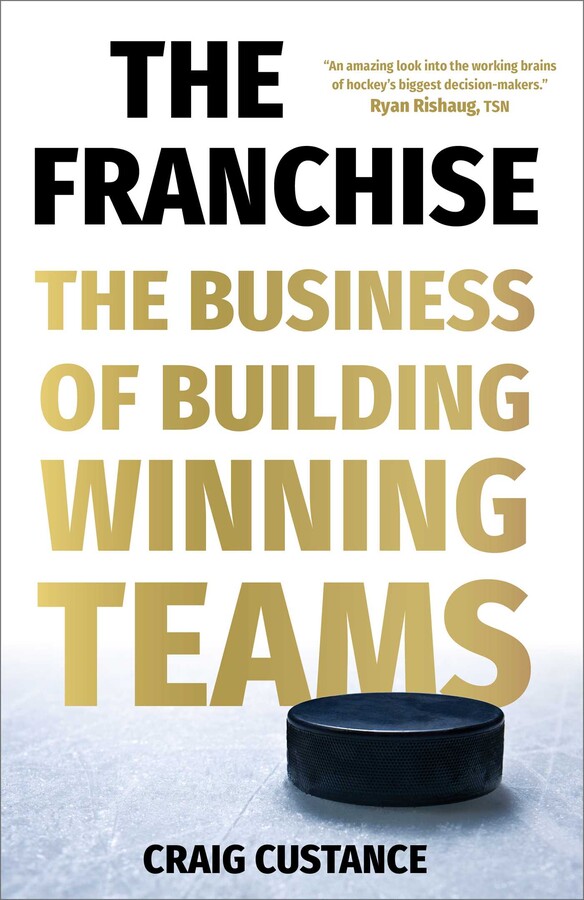
About The Book
Draft Day meets Burke’s Law in this incisive and entertaining behind-the-scenes look at hockey’s highest ranks.
Why do some franchises consistently win, while others may never get to see their players’ names etched on the Cup? Why do some teams draft poorly and others draft all-star teams? Why do some teams just seem to know how to win?
In The Franchise, The Athletic’s Craig Custance delves into the stories about thepeople who make the biggest decisions in hockey. For more than three years, Custance travelled far and wide to connect with the inner circle of hockey, from the owner’s suite of the Carolina Hurricanes to a private championship ring ceremony with the Vegas Golden Knights to a country club for a breakdown of the Pittsburgh Penguins.He had frank conversations with new Leafs’ GM Brad Treliving and former Leafs’ GM Kyle Dubas, and discussed the revolution in women's hockey with three-time Olympic medal winner and Devils’ executive Meghan Duggan.
For fans of any stripe, there are stories behind memorable trades and the biggest free agent signings, and insights into how some of the most successful teams of the last two decades were built. There are never-been-told details about trade demands, a prominent hire that one general manager regretted immediately, and how one general manager risked his life to sign a player he thought could change the course of his NHL team.
The Franchise will change the way you look at hockey. Custance shows that it all starts at the top, not on the ice. The players win, but it’s the people up in the box who break down every aspect of their teams, execute the hard decisions, and make the magic happen. This is essential reading for every hockey fan who wants to get beyond the x’s and o’s in an absorbing testament to why teams win.
Why do some franchises consistently win, while others may never get to see their players’ names etched on the Cup? Why do some teams draft poorly and others draft all-star teams? Why do some teams just seem to know how to win?
In The Franchise, The Athletic’s Craig Custance delves into the stories about thepeople who make the biggest decisions in hockey. For more than three years, Custance travelled far and wide to connect with the inner circle of hockey, from the owner’s suite of the Carolina Hurricanes to a private championship ring ceremony with the Vegas Golden Knights to a country club for a breakdown of the Pittsburgh Penguins.He had frank conversations with new Leafs’ GM Brad Treliving and former Leafs’ GM Kyle Dubas, and discussed the revolution in women's hockey with three-time Olympic medal winner and Devils’ executive Meghan Duggan.
For fans of any stripe, there are stories behind memorable trades and the biggest free agent signings, and insights into how some of the most successful teams of the last two decades were built. There are never-been-told details about trade demands, a prominent hire that one general manager regretted immediately, and how one general manager risked his life to sign a player he thought could change the course of his NHL team.
The Franchise will change the way you look at hockey. Custance shows that it all starts at the top, not on the ice. The players win, but it’s the people up in the box who break down every aspect of their teams, execute the hard decisions, and make the magic happen. This is essential reading for every hockey fan who wants to get beyond the x’s and o’s in an absorbing testament to why teams win.
Excerpt
Chapter 1: The Power of Relentless Preparation CHAPTER 1 THE POWER OF RELENTLESS PREPARATION
That’s it. That’s all I care about. Those are the only things that really bring me happiness.
—Julien BriseBois
I was sore. Not hit-by-a-truck sore, but my legs were starting to tighten and there was a slight pain in my lower back. What concerned me, while writing next to a pool at the Channelside Marriott in Tampa, was that I knew enough about athletic exertion to understand that what I did that morning should have absolutely zero physical impact a few hours later on my body.
Pickleball, by its nature, isn’t a strenuous sport. If you haven’t played, it’s essentially a mix of tennis and ping-pong. Until the last several years, best I can tell, it’s been played mostly by seniors. But one thing that happened during the NHL playoff bubble of 2020 is that teams and their staff played a lot of it. In that same time frame, my wife and I found it a great way to get outside and spend time with some of our close friends during an era in which you couldn’t interact otherwise. I actually started thinking I was getting pretty good at it.
Julien BriseBois ended that illusion.
Julien, who won back-to-back Stanley Cups as general manager of the Tampa Bay Lightning in 2020 and 2021, has one of the most fascinating paths to success of any NHL GM. He arrived at Heenan Blaikie, a Quebec law firm, as an intern hoping to one day become a tax lawyer. He grew up playing baseball. In a sport filled with former hockey players running teams, he’s not that. But he was trained by two of the best. In that 2020 NHL playoff bubble, created because it was being played during a global pandemic, he ended up raising the Stanley Cup. Then his team won it again the following season. All while honing his pickleball game.
He’s thoughtful. He’s analytical. He’s the kind of person I love chatting with.
My initial pitch was to spend the day together with the Stanley Cup in Montreal. But there were travel bans and limits on people who could join him. All the things we dealt with in 2020. So months later, I circled back. His Lightning were facing the Florida Panthers in the first round of the 2021 Stanley Cup playoffs, the first time these two Florida rivals competed in the playoffs. It seemed like a good time to go to Florida.
“Come down and let’s play pickleball,” he suggested.
I didn’t consider the idea nearly long enough. At that moment, I didn’t know Julien had been playing it for years. That he also boxes for fun. That he doesn’t drink or smoke. That he is a believer that a healthy body means a healthy mind. That he has the wingspan of an oversized condor. Why would I know any of this?
“Let’s do it.”
It was the morning of the day before our pickleball showdown and I regretted a couple of things. One, that I never shed my quarantine weight. And two, that I waited so long to prepare. My solution was to go for a light jog outside the Marriott along the channel in Tampa. It was 9:30 a.m. and already hot. At least hot for someone who was coming from a prolonged Michigan winter. The smallest of hills slowed me down. I was not feeling great about any of this.
A few minutes after I returned to my hotel room, my phone rang.
It was the Honorable Daniel Dumais, a judge in the Superior Court in Quebec. But before that he was a lawyer at Heenan Blaikie, then considered one of the best sports law firms in Canada. He had NHL teams as clients, and in some ways, he was the guy who launched BriseBois into the hockey universe.
I answered and explained what I was doing. That I wanted to get to know BriseBois’s backstory a little better before we had an extended conversation. That Julien had mentioned him as one of his biggest mentors.
“Anything for my friend Julien.”
Dumais started describing Julien and he was doing it through the lens of someone who has known him for years, who knows him as well as anyone. Who knew him at the start. But as he kept talking, I thought only of what it meant to me, his pickleball opponent.
“Julien is very serious,” Dumais explained. “He’s very committed to whatever he does. He’s structured, he has a plan. Julien is someone who has an idea, what he wants to do, what he wants to achieve.”
Dumais was in charge of the firm’s NHL work—arbitration cases and salary negotiations—and after BriseBois joined the firm as an intern, he let him know that there were boxes in the archives with all the firm’s work in sports, the decisions on arbitrations that had been awarded over the past decade. So that evening, BriseBois found the boxes and got to work.
He started indexing each case. He built out a binder for easy access to the decisions in an organized way. During the day, he was working on his regular assignments. In the morning and at night, he was organizing years of arbitration cases. Dumais and BriseBois didn’t cross paths for a month. But when they finally did, BriseBois pulled out the binder that took a decade to accumulate and showed it to Dumais.
“I’m ready to call GMs whenever you’re ready,” BriseBois said.
He was twenty-two.
“He didn’t say anything. He just took it and left. But I knew I impressed him,” BriseBois said. “I had to. It was impressive work, I have to say.”
So they started cold-calling general managers and the business started to grow. Nobody knew it was a twenty-two-year-old intern on the other end of the line, just somebody who NHL teams started to believe could help them win arbitration cases. A few weeks later, a group of NHL executives flew to Quebec City so they could work together in person. They gathered in a conference room and started going over all the arbitration cases. For the first few hours BriseBois was quiet, but right before lunch, Anaheim Ducks GM Pierre Gauthier looked over at him and asked him what he thought.
As BriseBois does, he shared his well-prepared opinions with confidence.
“?‘This is what we should do for this because of this award and that award. This is the number for your guy, that guy. This is the number for your guy,’?” BriseBois said in recalling that moment. “And then Pierre said, ‘That sounds awesome. Let’s grab lunch.’?”
Word traveled fast about the arbitration cases this firm was helping teams win. Since Disney owned both the Ducks and the Angels, the success spread into the baseball world. That winter, the firm started doing arbitration cases for the Royals and the first general managers meeting BriseBois ever attended was in baseball. He was now working in the Montreal office, so Dumais told him to meet him in Washington, D.C., at Dulles Airport, where the MLB managers were gathering. A snowstorm wiped out Dumais’s flight, so BriseBois, now twenty-three, was the lone representative from the firm. He walked into a conference room where baseball general managers, most decades older than he was, were going over a list of players eligible for arbitration. At one point, an opposing general manager suggested paying his player an extra half million more than planned. It was put to a vote.
Who thinks it should be the higher number?
The lone GM raised his hand.
Who thinks it should be the old number?
Every other hand went up.
Royals GM Allard Baird leaned over to BriseBois and shifted strategies.
“Julien, when it’s our turn, you do the talking.”
BriseBois laughed hard retelling that story.
The one thing you learn about BriseBois is that he’s very intentional in his actions, especially when it comes to his career path. Even when he wanted to become a general manager, he didn’t interview for every opening, despite outside interest. He was willing to be patient for the right situation. He was willing to take risks to improve the likelihood that the right situation would present itself.
When it was clear tax law wasn’t going to be his future, he changed gears quickly. When he saw an opportunity with the Montreal Canadiens to work on contracts while he was still with the law firm, he took full advantage, and it didn’t take long for everyone to realize he wasn’t going back to the firm. Martin Madden, a former general manager of the Quebec Nordiques, had the office next door at the Bell Centre and immediately noticed how at ease BriseBois was around the rest of the staff. His relentless preparation mixed with his curiosity gave him a confidence to learn quickly in this environment.
“It felt easy for me to sit down with him and discuss hockey, how I felt the game should be played, how it should be managed, and it started that way,” Madden said. “There wasn’t a day in the year that we didn’t discuss his point of view and how I thought things should go. He was always asking questions and, most of the time, had some real good answers.”
After BriseBois joined the Canadiens full-time, GM André Savard said he was intentional about giving BriseBois opportunities on the road with the team, the best way to learn the sport. He also realized quickly that BriseBois was somebody you had to challenge. He was ambitious and learned quickly, and Savard looked for ways to feed that drive.
It came by getting him out of the office.
“It didn’t take me too long, a month. I realized, ‘Get him involved more,’?” Savard said. “I had enough confidence in him to put him in that situation. When you go on the road, on the plane, you’re going after the games, you go see the coaches in the morning practice, you talk to the coaches, there’s a lot of conversations there. There’s a lot of communication between everybody going on the road. I thought that was important.”
BriseBois’s immersion into the world of hockey with the Montreal Canadiens expanded under GM Bob Gainey, who put him in charge of the Canadiens’ American Hockey League franchise in 2006. Gainey walked into BriseBois’s office, told him Hamilton needed a GM and he believed it should be BriseBois. Then he acted like he was handing him the keys.
“He said, ‘Go compete with the other guys. Show me what you can do,’?” BriseBois said. “And he left.”
The Hamilton Bulldogs would win a Calder Cup in 2007. Eight years into his time with the Canadiens, BriseBois started to realize that further growth would mean leaving this comfort zone. He wanted to expand his hockey network. He wanted to learn from new mentors. He wanted to build on the success he had in running the Canadiens AHL team in Hamilton. It was the summer of 2009 and the Canadiens had a long list of free agents that needed new deals. BriseBois’s contract was also expiring, so he went to Gainey to propose an exit strategy. He’d extend his own deal by one year, help work on contract negotiations for guys like Saku Koivu, Alexei Kovalev, and Mike Komisarek. Then, as the year progressed, he said he’d help the Canadiens hire a replacement, work on the transition, and then figure out what was next.
“Let’s keep that between us for now,” Gainey answered. “You may want to change your mind.”
Gainey suggested they do the one-year deal, reconvene during the season, and go from there. But when BriseBois went to him during the season to figure out the best path forward, Gainey put him off. BriseBois tried to connect multiple times, and was unsuccessful each time. Gainey was buying time, but finally relented. He invited BriseBois to breakfast at his home and BriseBois laid it all out.
It’s time for me to go. It’s time for me to learn from other people and from organizations that aren’t as unique as the Montreal Canadiens.
“Well,” Gainey answered, “it’s time for me to go, too. I resigned in December.”
He let BriseBois know that the plan was to promote Pierre Gauthier to the GM spot.
This complicated BriseBois’s plans because Gauthier was crucial to his development as an executive. When he first started working in the NHL, BriseBois reached out to a group of people he trusted and asked for advice on how to be the best assistant GM. David Poile gave him great advice. So did Ray Shero. But Gauthier wrote a three-page memo, in a small font, loaded with career advice. BriseBois still has it. So now BriseBois was concerned that it would look like he didn’t want to work for Gauthier if he left. Gainey let Gauthier know about BriseBois’s concerns and Gauthier went out of his way to help with the transition.
“I understand. I was you once and I did the same thing,” Gauthier told BriseBois. “I felt like I needed to leave the Nordiques. I fully understand what you’re doing and it’s probably the right thing for your career.”
The timing was right, too. The AHL team BriseBois built in Hamilton was going well. The coach he hired, Guy Boucher, was looking like a really smart choice. He had the development program in place that took years to build. Because of it, BriseBois’s reputation in the NHL had grown enough that when the Tampa Bay Lightning had a GM opening that offseason under new owner Jeff Vinik, BriseBois got a screening call from Jac Sperling, who was doing the vetting for the open job.
“I think they had a very long list of candidates, they may have had thirty names,” BriseBois said. “I might have been thirtieth on the list.”
Eventually, the Lightning hired Steve Yzerman away from the Detroit Red Wings’ front office, which meant Yzerman needed an assistant. It was the perfect job for BriseBois, but word was circulating that it might go to Ryan Martin, who Yzerman worked with in Detroit. When BriseBois and Martin chatted on the phone, Martin confirmed the speculation.
“Steve has offered me the job, I’m going to go to Tampa with him,” Martin said.
BriseBois congratulated him. He let him know how highly he felt about that opportunity under Yzerman, and Martin picked up a hint of disappointment. BriseBois filled him in. He told him he was leaving Montreal and was looking for a job. He let him know that was one he thought was probably the best.
“Ryan being the incredible guy he is says, ‘Well, I’ve got that job, but if something happens, I will tell Stevie he should hire you,’?” BriseBois said.
About a month went by and BriseBois was doing dishes at his house in Montreal. It was about 9 p.m. when his phone rang.
Ryan Martin was on the other end of the line.
Martin had agonized over the decision. He’d had several conversations with mentors Ken Holland and Jim Nill in Detroit about staying with the Red Wings. His wife’s job would have to change, too, if he moved to Florida. His role in Detroit was expanding, so was his paycheck, and the opportunity to scout nearby games at all levels and be home with his family was an important factor. It all added up.
“I changed my mind,” Martin said when we chatted years later. “I know there had been a couple other people who had reached out to Steve, but I gave my opinion of Julien that they would work well together.”
Shortly after that, Yzerman reached out to Gauthier for permission to interview BriseBois, and the conversations started. During the day, BriseBois worked for the Canadiens. At night, he talked to Yzerman. For well over a week, they followed the same routine. Every night around nine or ten o’clock, Yzerman would let BriseBois know what he was working on and BriseBois would offer his thoughts.
Eventually the two decided they should meet. BriseBois was going to Hilton Head for the AHL board of governors meeting, but was able to find a flight to Tampa that gave him a five-hour window to meet Yzerman in person at the airport Westin. BriseBois brought a presentation he’d created around team building and the core competencies he believed every organization needed, especially around player procurement and development. The deck broke down what he was able to do along those lines in Hamilton, where he believed the team needed more coaches. In his mind, the AHL is where a player is getting his PhD in hockey and he thought there needed to be a better student-to-teacher ratio than hockey typically allowed. In Hamilton, they added a full-time strength coach. They added a full-time video coach. He worked on bringing in the right veterans to surround the young guys, show them how to be a professional, how to conduct yourself.
“All the pieces kind of fell into place,” BriseBois said.
The pitch worked. On July 16, 2010, BriseBois was named the assistant GM. And almost immediately, BriseBois’s preparation and willingness to take a risk would pay off in a big way.
The interview was nearly over.
BriseBois had taken the candidate to coach Tampa Bay’s AHL team through a binder full of questions he had prepared, while Yzerman injected his own questions as the conversation needed it. Now, apparently satisfied, they had just one more question.
They turned a screen toward the young candidate, who had never coached a single game higher than junior hockey in the United States, a guy who had spent more time as a lawyer than a professional coach, and hit play. A commercial kicked on and the candidate immediately knew what it was. It was a knockoff of the old Dos Equis commercials featuring the Most Interesting Man in the World.
Only this time, the title says “The Most Interesting Man in Hockey.”
A Spanish guitar plays while a camera pans past a table full of beautiful women until it focuses in on the man at the end of the table next to a martini.
It’s Green Bay coach Jon Cooper.
Cooper looks at the camera, says, “Find out what it is in hockey you don’t do well….” He pauses and leans forward slightly. “And don’t do that thing.”
It was an advertisement for the Green Bay Gamblers, a team that had just won a championship with Cooper behind the bench. It was a job that Cooper figured he’d keep the rest of his career. He had just won a championship. He got a raise that paid him six figures. He even had a golf membership. He was pretty content with where his career had landed. But when Newport agent Wade Arnott suggested to Yzerman and BriseBois that they should consider the coach in Green Bay they’d never heard of, that future changed.
Even as BriseBois took him through his binder full of questions during the interview, Cooper didn’t think this job was happening. It wasn’t until the commercial was played and one of them ended it with: Do you really think you’re the most interesting man in hockey—that’s when he started to suspect he might have a shot.
They were having fun with him and that’s usually a good sign in an interview.
“If they didn’t like me, they wouldn’t have shown it,” Cooper explained while sharing the story. “They were looking to see if I could take it.”
Cooper had a flight to catch that was getting dangerously close, so BriseBois offered to drive him to the airport. They hustled to his car, where BriseBois tried making a phone call without success. Cooper sensed frustration.
“He goes, ‘To be honest, I don’t know how to fucking get to the airport,’?” Cooper said, laughing. “I start laughing so hard, and say, ‘Let’s navigate.’ He drops me off, the airplane door hits my ass on the way in, that’s how close I came to missing it.”
But Cooper noticed that BriseBois was using every available minute to assess the guy he was considering as his AHL coach. He volunteered to drive him to the airport, even if he didn’t know the route. It’s a strategy Cooper has now adopted when there’s a new player or staff member who needs a lift. That car time is invaluable. In fact, when I called Cooper to talk about BriseBois, he was on the way home from the airport after dropping off the team’s mental performance coach.
“I took that from Julien,” Cooper said. “It’s a side of caring, getting to know someone and relationship building.”
When he got on the plane, Cooper called his wife. He still felt like the AHL job was a long shot, since the jump from Green Bay to a head spot in the AHL was big, but he thought things were closer than they were the day before.
“I gave them something to think about,” he told his wife.
Less than forty-eight hours later, BriseBois was on the phone offering him the job. When Tampa got the money where it needed to be, Cooper decided to go for it. Even if it meant losing the golf club membership and arguably the best local ad campaign hockey has seen.
“That was when I threw caution to the wind,” Cooper said. “In the end, this is your chance. I didn’t want to leave Green Bay, but I saw this as an opportunity.”
That the interview with BriseBois started with a list of twenty-five or so questions he was reading directly out of a binder was very much by design. So was the intentional decision to wait until the end of the interview to break the ice.
BriseBois’s hiring record on coaches is remarkably strong. He hired an unknown named Guy Boucher in Hamilton, who went on to take the Tampa Bay Lightning to the Eastern Conference Final in 2011. He hired Cooper in Norfolk, and Cooper will end up in the Hall of Fame. He hired Benoit Groulx to replace Cooper, and he ended with the most wins by a Syracuse coach in franchise history, taking the team to the playoffs every season he was there.
BriseBois has a very defined process he uses to make hires and it’s clear by his history that it’s a good one. It’s a topic I was eager to explore after getting run all over a Florida pickleball court.
It had been three games and I could barely breathe. I was sweating through my Torchy’s Tacos T-shirt, and when I looked over at Julien, he’d barely broken a sweat.
I started looking for an exit strategy.
“Is there somewhere we can go to chat?” I asked, taking a seat on the bench next to the pickleball court.
“Do you want one more?”
Julien wanted to keep playing.
“Your call,” he said. “Can your body take one more?”
He was now going after my pride. I told him I’d keep going if he wanted to keep playing but it was clear my heart wasn’t in it.
“All right, we’re done,” he answered. “What do you like to drink? I’m a cold soda type of guy.”
We packed our gear and walked toward his car. As always, he was prepared with a change of clothes, an idea that never even occurred to me until that moment. He said a place called Buddy Brew had great iced tea. In his first sign of mercy of the morning, he turned up the air-conditioning in his car before pulling away from the park.
His cold soda comment sparked a thought. When you cover enough general managers meetings or board of governors meetings, you end up crossing paths with NHL management in hotel bars or enjoying a glass of wine at a nearby restaurant. But Julien was always a guy you’d more likely see ducking out of these events with a tennis bag than posting up at the bar.
I’d heard he didn’t drink alcohol and was wondering what went behind the decision.
“I never started,” he said.
Then he shared a story that explained it a little more. In his earliest days, when he was showing up to work at a law firm starting at 7 a.m. and working until midnight, his dad was playing hockey more often with his close friends than he was able to play. The work-life balance didn’t seem right. He realized that there were three things in his life that brought him happiness. Time with his immediate family. Investing in his career. And doing something physical on the weekends.
“That’s it. That’s all I care about. Those are the only things that really bring me happiness,” he said. “To this day, it’s the same thing. I remember telling Steve [Yzerman] that and he goes, ‘I’m exactly the same way.’ And he is. So that’s what I do.”
It’s that simple. Each of these three areas of his life are working toward a goal. A strong family. A successful career. Physical exhaustion. Anything else seems to just get in the way.
“Everyone can do the easy stuff. There’s no satisfaction that comes with the easy stuff,” he said. “Our pickleball match may not have been the best example, but had you pushed me to my limits there would be a sense of satisfaction that comes from being exhausted. I accomplished something that not everyone—”
“Not everyone beats me, Julien.”
“I know. So yeah, if you’re going to go into the gym, make it count. If it’s short, it’s intense. If it’s long, it’s heavy. When you’re done, you want to feel like you’ve accomplished something.”
He parked the car and we walked around to the front of the coffee shop, entering Buddy Brew as “Call Me Maybe” played in the background. I ordered an iced tea. He got an iced mocha latte and we found a seat outside.
This was when we really dug in.
Even the most intelligent, driven people aren’t going to find success without opportunity, without someone willing to invest in them. BriseBois always seems keenly aware of that. When he talks about his time in the law firm, it isn’t just about the extra work he put in. It’s the guidance and opportunity Dumais provided. When he talks about his success in Tampa Bay, he’s quick to credit owner Jeff Vinik and Steve Yzerman for building an environment conducive to success. He also seems like someone who, if he didn’t have those things, is willing to change jobs until he does. Who he’s working for is every bit as important as where he’s working.
So when our conversation shifted into his hiring process, he began by crediting Bob Gainey. Gainey was the GM in Montreal when the Hamilton Bulldogs needed a new head coach in 2009, and it would have been easy for him to micromanage the process. BriseBois went to Gainey for insight, and while Gainey was there for guidance, this was going to be BriseBois’s call completely.
“Now, you have to be a really strong, confident, and secure person to be the GM of the Montreal Canadiens and be willing to let one of your underlings in that market make mistakes there,” BriseBois said. “Sometimes he knew I was making a mistake and he still let me make the mistake. You need someone special to do that. He wanted this to be my process.”
So BriseBois went to work. He was looking for someone progressive, who saw the game the same way he did. He wanted someone whose focus was on education and teaching as much as it was winning games. He wanted someone focused on player development for the Montreal Canadiens rather than someone just trying to grind out an AHL win.
One of the people who BriseBois got to know while getting his MBA was a guy named André Couillard, now the president of Procom Quebec. Couillard has a great eye for talent and has helped guide people through the hiring process in the world of information and communications technology. BriseBois called Couillard and told him he was about to make his first big hire, a head coach for the Hamilton Bulldogs. He started by asking: What are the mistakes people make when they hire?
“He gave me an education,” BriseBois said.
In an ideal world, you hire someone for three or six months and watch them do the job. See how they operate. See how they solve problems. If you’re able to do this a few times, you find the ideal candidate. Hockey doesn’t work that way. The next best thing is to try to simulate that scenario.
That means digging into how a candidate did in their previous job. If it’s a coach, you talk to their players. You talk to their managers. You talk to their opponents. You try to learn as much as possible about how they operate. Then you use the interview process to put them in the chair of the job you’re filling. In this case, the coach of the Hamilton Bulldogs. You’re not using the interview process to get to know the candidate personally. You want to find out how they’ll act once they get the job.
“So you throw situations at them,” BriseBois said. “And you don’t want to get to know the person until you know the coach. People start getting friendly, start getting to know each other—‘Oh, you play tennis? I play tennis, too.’ The interview is over. You’ve already broken it. It’s broken beyond repair. Avoid that.”
Instead, it’s always the same process, one he shaped with insight from Couillard. Here is the job. Here is the mandate. This is the pay range. Still interested? Okay, then here are some scenarios. BriseBois takes his candidates through open-ended questions in which there are no right or wrong answers. Each coach gets the same group of questions. That binder BriseBois was running through with Yzerman when he interviewed Cooper? It featured these scenarios.
BriseBois shared an example.
Training camp is about to end. You’re going to keep fourteen forwards. Thirteen are no-brainers. We’re down to two guys for one open job. One guy is not the most skilled guy, but he’s super gritty, competes. He works his butt off in practice every day. Will always try his hardest to give you what you want, but he’s very limited as a skill player. The other guy? High-end skill. Effort isn’t always there. You have to get it out of him. Which guy are you keeping and why?
Do this twenty times and you get to know your candidate well. Then the personal questions can begin. Like, do you really think you’re the most interesting man in the world?
“I will say, by the end, they’re exhausted,” BriseBois said. “Whoever I’m interviewing, they need a nap. That’s what I did with Guy that year. The process has to be identical for every guy. Same room. Same time of day. Same questions in the same order. You don’t compare notes with anyone until the end. You put it in writing. There’s a process to try and avoid the mistakes that are made because of our unconscious biases.”
For his interview with BriseBois in 2016, Benoit Groulx remembered meeting him around 1 p.m. at a hotel in New York. It was a beautiful spring afternoon in Manhattan and Groulx noticed that BriseBois was wearing running shoes.
“You like walking? Let’s go for a walk,” BriseBois said.
They walked toward Bryant Park before finding a table a few blocks away. They sat down, BriseBois pulled out a tablet, and here came the scenarios.
“He bombarded me with all kinds of questions,” Groulx told me. “Many, many different situations.”
By the time Groulx got back to his hotel around 11 p.m., he was exhausted. The next morning, Steve Yzerman picked him up for a walk and then a lunch. It was a different conversation, but Groulx left it thinking that the two managers really complemented each other well.
“Two smart guys, but they’re different,” Groulx said. “I knew why that team was successful.”
It wasn’t the interview process that left the most lasting impression on Groulx during his time working for BriseBois. It was how clearly BriseBois set expectations once he hired the coaching staff. Groulx still has the paper that broke down BriseBois’s expectations about the team in Syracuse. They were guiding principles for the organization, principles behind every decision that Groulx and his staff made. It starts with a clear mandate. Then it breaks down how the organization sets the culture and the kind of behavior that is expected from everyone on the team. It includes twelve steps on how to develop the team.
BriseBois sat down with the coaches and explained the mission and then backed it up in written form. Groulx kept it in his office and referred to it often, sometimes more than once in the same day. I sent BriseBois an email asking for a copy. Two days later, my phone was buzzing with his name on the screen. Yes, he still had a copy. No, it wasn’t going to be published somewhere everybody could read it.
“It’s still too much in use,” he said.
Like so many things BriseBois does, this organizational source of truth was him being proactive. He wanted something in writing to guide decisions when stress is high and when decisions aren’t always made with a clear head.
“When it’s written, you have something you can refer to,” he explained. “When it’s written, you’ve taken the time to select the words we’re using. This deck guides all the decisions. Your job is to be disciplined enough to refer to the deck and not waver. This is what we do, this is what we believe in. When we were not feeling the heat, when we were calm and rational, this was the road map to sustained success.”
For seven seasons, that’s exactly what Groulx had in Syracuse. Two hundred fifty-six wins. Two division titles. An Eastern Conference championship. More wins than any coach in franchise history.
But BriseBois decided the team needed a fresh voice in the AHL and he was out. Groulx was considering leaving the organization after one more season but didn’t get that chance. If you learn anything about BriseBois, you need to know this: he’d rather move on too early than too late.
He can be ruthless in how decisive he is. Once all the proper steps are completed and a decision is made, he moves. No matter how it might look from the outside, something the hockey world would learn as his tenure in Tampa Bay continued.
The 2023 NHL trade deadline was closing in and BriseBois agreed to catch up over a coffee at the Lightning’s road hotel in Detroit. The Lightning had won another Stanley Cup since he steamrolled me on the pickleball court a couple years earlier, this time beating the Montreal Canadiens in the Stanley Cup Final, a serendipitous twist to the BriseBois legacy. The following season, BriseBois’s Lightning advanced to a third Stanley Cup Final in three years, one of the most remarkable accomplishments in the salary cap era. They lost to a Colorado Avalanche team built to dethrone them.
I was waiting near some couches in the hotel lobby a few feet away from Lightning assistant GM Mathieu Darche, who was on the phone. I didn’t know it in the moment, but BriseBois, Darche, and the Lightning front office were working on a trade deadline deal that might have been their most bold yet.
Shortly after I arrived, BriseBois turned the corner.
“How’s your pickleball game?” he asked.
It was not great.
His, however, was improving. He’d hired a pickleball pro to train him, doing it because he believes that striving to get better at these skills is a healthy way to live. He was investing more into equipment, explaining that paddle design and evolution had improved considerably in the last year. As with everything, he was constantly looking for small, incremental improvements.
“These new carbon paddles, they fit my stroke,” he said. “I put a lot of top spin on it and they add top spin. There’s going to be a little bit more power. There’s something there. I’m excited.”
I was catching BriseBois at an interesting time. He had a team built to win a Stanley Cup and he’d now gotten in the habit of making a move near the trade deadline to help push his team there. Three straight years he’d made big moves and three straight years he’d advanced to the Stanley Cup Final. The strategy was paying off and it was also an adjustment in how he operated.
In 2019, the Tampa Bay Lightning didn’t do anything at the trade deadline, which is the most rational approach. The way BriseBois calculates the odds, he figures his team has a 6 or 7 percent shot at winning the Stanley Cup. If you’re someone who is always thinking of the future, the idea of using valuable draft capital to trade for players who might only be on the team for a few months during a playoff run that is a coin toss away from ending isn’t a great one. BriseBois believed that, mathematically, doing nothing changes the Stanley Cup odds about as much as a major trade. And in 2019, the Lightning kept winning in the regular season, tying the 1995–96 Detroit Red Wings for the most wins in the history of the game during the regular season. They played four postseason games that year and lost them all, swept by the Columbus Blue Jackets.
That offseason, he had to make a decision about how to respond to the collapse in the playoffs. It certainly would have been understandable to make a change at coach. Or maybe trade one of the underperforming skill players. Really, he could have done anything following the loss to the Blue Jackets and been publicly justified. Instead, he brought everybody back. Part of him believed that if that series was played one hundred times, the Lightning would have had a much different outcome in many of those series. It just turned out that reality included a sweep.
“It really, really sucked and hurt and we ended up drawing the one where we got spanked, and we didn’t even look good doing it. They played great and we didn’t put our best foot forward,” BriseBois said. “That’s all it was. It was seven days.”
He believed in his team and coach. In this case, accountability meant sending the same group out there to do it again.
“We had to come back. If we had made changes, we would have let too many people off the hook. This was a collective fail, we all had to come back,” he explained. “If you change one or two players—it’s those guys. No, no, it’s all of us. And it was all of us. It was a collective failure.”
While the roster stayed essentially the same heading into the next season, there were changes. One was how Jon Cooper held his top players accountable with ice time. The second was how BriseBois approached the following trade deadline and the deadlines to come.
“What it did for Julien, it changed his mentality of what you trade for at the deadline,” Cooper said.
There are three assets a general manager has when building a team. Draft picks, cap space, and players on the reserve list. Of the three, the one thing the Lightning valued most while looking to improve their roster in 2020 was cap space. They had great players. They were trying to win now, so draft picks weren’t as valuable.
“What we were looking to do was buy cap space. We tried to do that, but couldn’t. The other avenue is undervalued players—players worth more than their cap number is the same result.”
Acquiring undervalued players is another form of adding cap space.
“Essentially, yeah,” BriseBois said. “If you’re going to buy at the deadline and pay those prices, odds are, it’s not going to work. Presidents’ Trophy winners are more likely to lose in the first round than win the Cup. We know from experience.”
So they set out to find players that checked these boxes: Undervalued contracts with term remaining. Players who fit needs in the lineup.
In 2020, those players were Barclay Goodrow and Blake Coleman, players who BriseBois felt were worth much more to the Lightning than their cap hit suggested. They fit needs and would be around more than just the one postseason. In both cases BriseBois paid a premium.
“We got it to a place where I was more comfortable living with the regret of doing the trade and not having it work out than not doing the trade, not winning, and then forever asking myself, ‘What if I’d done the trade, would I be a Stanley Cup winner?’ That’s what it comes down to,” he said.
In 2021, they acquired a more traditional trade deadline rental in defenseman David Savard, but BriseBois felt he had good reason. Star forward Nikita Kucherov had missed the entire regular season following hip surgery, so the Lightning were able to use his cap space elsewhere. They were also getting positive reports that he might be able to return for the playoffs, where the salary cap doesn’t apply. This was already a loaded team, with only one real need, in BriseBois’s assessment—a right-shot defenseman. Getting Savard at a salary discount by laundering him through Detroit set up the Lightning for a massive postseason advantage. Since Kucherov’s $9.5 million cap hit wouldn’t count, adding Savard at 25 percent of his salary to a team that could already go well over the regular season cap when Kucherov returned put the Lightning in a unique position.
“The way [long-term injured reserve] worked, I am already working off a ninety-million-dollar cap. I’ll have a ninety-million-dollar team competing against eighty-million-dollar teams,” BriseBois said. “We already have an advantage, let’s push even more chips. Let’s make sure we take advantage of this opportunity. Let’s get someone else to pay, because I got Savard for a million bucks. It’s a four-million-dollar player I’m getting for a million bucks.”
The Lightning would go on to win another Stanley Cup with one of the best rosters assembled in the cap era, using every possible dollar and rule to their advantage. Opponents noticed.
“We lost to a team that’s eighteen million dollars over the cap, or whatever they are,” Hurricanes defenseman Dougie Hamilton said after his season was ended by the Lightning. It was enough of an advantage that the NHL investigated to make sure there wasn’t anything done on the Kucherov front against the rules. They found no wrongdoing.
“At the deadline, I went, ‘We have an unreal team. If Kuch is back and he is Kuch and he’s looking like he will, we have no holes,’?” BriseBois said.
It worked.
BriseBois is creative, decisive, and willing to use every rule to his advantage when building his team. He’s also just as decisive when he has to make difficult changes. This was especially evident with the trade of Ryan McDonagh to the Nashville Predators in the 2022 offseason. This move falls under the category of BriseBois preferring to make a move too early than pay the price for waiting too long. He was being proactive because McDonagh’s $6.75 million in cap space would eventually be needed to sign Mikhail Sergachev, Anthony Cirelli, and Erik Cernak. McDonagh had a no-trade clause in his deal that still had four more seasons, but BriseBois also had leverage. If McDonagh didn’t accept the trade to Nashville, he would be put on waivers, where there were teams in line to claim him.
This is the kind of move where BriseBois has to walk the uncomfortable line between ruthless and empathetic. He doesn’t deny that he was willing to put McDonagh on waivers. He believes it was the right thing for the organization. He also knows that his name isn’t on the Stanley Cup without Ryan McDonagh, someone who bled for the organization.
“You’re dealing with a high-character, highly professional, mature person who’s been around. I’m sure it was shitty. I know his wife. She’s awesome. Kaylee,” BriseBois said.
Then there was a long pause.
“They and our guys all have, they all for the most part—especially our veteran, more established guys—all live on the same street. Like, they literally golf cart to each other’s house. The kids all play on the same T-ball teams or Learn to Skate teams. It’s a tight group. So I knew the repercussions of all that.”
And still made the deal.
There are times when leading an organization can be lonely. This trade probably didn’t get a lot of support from the coaches. It was a leader having the most difficult of conversations because he truly believed it put the organization in the best position moving forward. The moment you can’t make those tough moves, Vegas president George McPhee would say later, is the moment you should no longer be running a team.
It doesn’t make it any easier.
“It’s not about me in that moment,” BriseBois said. “I never lose sight of that. I don’t pity myself in that situation. I feel for the other person more than I do for myself. I’m doing my job. They’re the victims of me doing my job.”
There’s a book by management consultant Olivier Sibony called You’re About to Make a Terrible Mistake. It’s a book about how biases can distort the decision-making process for even the top people in business. The book features case studies on those mistakes and solutions on how to create organizational processes to help collect information that might avoid as many mistakes as possible.
Prior to the 2023 trade deadline, BriseBois sent a message to the group text chain for his front office recommending that they read this book. It might be the perfect book title for any NHL team’s trade deadline, a time filled with short-term bias and where processes pay off. A few days after we chatted before the 2023 deadline, BriseBois traded defenseman Cal Foote, a 2025 first-round pick, and four other draft picks to the Nashville Predators for forward Tanner Jeannot. It was a steep price to pay for a guy who only had five goals for the Predators when he was dealt. This was BriseBois tripling down on the trade deadline theory of acquiring a player he believed was worth more than his cap charge and do it with someone who will be around a couple years.
But now, three years after using that strategy successfully to acquire Goodrow and Coleman, BriseBois had competition in trying to strike a deal like this. Jeannot wasn’t a player the Predators were eager to trade. He had the leadership and work-ethic qualities that then-GM David Poile felt like the organization needed to help bridge the gap through roster reconstruction. He also had a style of play conducive to postseason success. All the reasons Poile wanted to keep him made him a major target for contenders.
“The most calls I had was on Tanner Jeannot,” Poile said. “Everybody wanted him.”
So Poile set a high price. He told every GM who called that it would cost two first-round picks to acquire him from the Predators. Multiple teams offered a first-round pick and prospects, but nobody reached the asking price. And then BriseBois called.
“He has no cap space, he has no younger players who were of interest to me. He had no first-round pick this season. I just looked and said, ‘Here’s your draft picks. You have a first in ’25, a second in ’24, a third, fourth, and fifth. I think that’s equivalent to two first-round picks.”
They made the deal.
“We’ll attach names to those picks someday and we’ll actually know how it turned out,” Poile said.
Poile has talked to BriseBois as much as any GM in the league through the years. Sometimes about trades, but more often BriseBois was just trying to tap into Poile’s years of experience. Why did you make this move? How did you handle that issue?
“Julien separates himself from the other ones. He is calling everybody. He is asking about situations. I’m just answering questions,” Poile said.
And he’s answering from his experience and from those who preceded him. Poile was mentored by Cliff Fletcher, Glen Sather, Emile Francis, and Harry Sinden, among others, through the years, and whether he knew it or not, BriseBois was getting their experiences as well in Poile’s answers. Poile was there at the start of BriseBois’s career. He spent time with the intern version of BriseBois while he was doing Predators arbitration cases for Dumais. He saw a kid who was very smart and very prepared.
“Little did I know or think this was his passion,” Poile said.
In that span of time, BriseBois has seen the league completely transform from a management perspective. He once did a presentation while getting his MBA that compared the hockey operations departments of the Montreal Canadiens during the 1970s to the one in the early 2000s. The change was remarkable. It was nothing like it is now.
“Today, it’s almost seventy people in hockey ops, it’s incredible,” BriseBois said. “When you factor in skating consultants, skill development people, player development people, sports psychologists, we have seven coaches in Tampa, we have four in Syracuse, there’s so much.”
It means, even as he taps into knowledge of those who came before him, his job now is completely different.
“You have to delegate. There’s no other way,” he said. “Your most important job is hiring really good people and then trusting them, delegating responsibilities, giving them support and resources to be successful. That’s it.”
That’s it. BriseBois almost makes it sound simple. But to succeed over time in a league changing as rapidly as the NHL takes someone willing to evolve, someone willing to learn constantly. It also takes someone with core beliefs on management that are sharpened over time. To many of his admirers around the NHL, the leader who embodied that more than anyone in hockey was the person I would visit next.
That’s it. That’s all I care about. Those are the only things that really bring me happiness.
—Julien BriseBois
I was sore. Not hit-by-a-truck sore, but my legs were starting to tighten and there was a slight pain in my lower back. What concerned me, while writing next to a pool at the Channelside Marriott in Tampa, was that I knew enough about athletic exertion to understand that what I did that morning should have absolutely zero physical impact a few hours later on my body.
Pickleball, by its nature, isn’t a strenuous sport. If you haven’t played, it’s essentially a mix of tennis and ping-pong. Until the last several years, best I can tell, it’s been played mostly by seniors. But one thing that happened during the NHL playoff bubble of 2020 is that teams and their staff played a lot of it. In that same time frame, my wife and I found it a great way to get outside and spend time with some of our close friends during an era in which you couldn’t interact otherwise. I actually started thinking I was getting pretty good at it.
Julien BriseBois ended that illusion.
Julien, who won back-to-back Stanley Cups as general manager of the Tampa Bay Lightning in 2020 and 2021, has one of the most fascinating paths to success of any NHL GM. He arrived at Heenan Blaikie, a Quebec law firm, as an intern hoping to one day become a tax lawyer. He grew up playing baseball. In a sport filled with former hockey players running teams, he’s not that. But he was trained by two of the best. In that 2020 NHL playoff bubble, created because it was being played during a global pandemic, he ended up raising the Stanley Cup. Then his team won it again the following season. All while honing his pickleball game.
He’s thoughtful. He’s analytical. He’s the kind of person I love chatting with.
My initial pitch was to spend the day together with the Stanley Cup in Montreal. But there were travel bans and limits on people who could join him. All the things we dealt with in 2020. So months later, I circled back. His Lightning were facing the Florida Panthers in the first round of the 2021 Stanley Cup playoffs, the first time these two Florida rivals competed in the playoffs. It seemed like a good time to go to Florida.
“Come down and let’s play pickleball,” he suggested.
I didn’t consider the idea nearly long enough. At that moment, I didn’t know Julien had been playing it for years. That he also boxes for fun. That he doesn’t drink or smoke. That he is a believer that a healthy body means a healthy mind. That he has the wingspan of an oversized condor. Why would I know any of this?
“Let’s do it.”
It was the morning of the day before our pickleball showdown and I regretted a couple of things. One, that I never shed my quarantine weight. And two, that I waited so long to prepare. My solution was to go for a light jog outside the Marriott along the channel in Tampa. It was 9:30 a.m. and already hot. At least hot for someone who was coming from a prolonged Michigan winter. The smallest of hills slowed me down. I was not feeling great about any of this.
A few minutes after I returned to my hotel room, my phone rang.
It was the Honorable Daniel Dumais, a judge in the Superior Court in Quebec. But before that he was a lawyer at Heenan Blaikie, then considered one of the best sports law firms in Canada. He had NHL teams as clients, and in some ways, he was the guy who launched BriseBois into the hockey universe.
I answered and explained what I was doing. That I wanted to get to know BriseBois’s backstory a little better before we had an extended conversation. That Julien had mentioned him as one of his biggest mentors.
“Anything for my friend Julien.”
Dumais started describing Julien and he was doing it through the lens of someone who has known him for years, who knows him as well as anyone. Who knew him at the start. But as he kept talking, I thought only of what it meant to me, his pickleball opponent.
“Julien is very serious,” Dumais explained. “He’s very committed to whatever he does. He’s structured, he has a plan. Julien is someone who has an idea, what he wants to do, what he wants to achieve.”
Dumais was in charge of the firm’s NHL work—arbitration cases and salary negotiations—and after BriseBois joined the firm as an intern, he let him know that there were boxes in the archives with all the firm’s work in sports, the decisions on arbitrations that had been awarded over the past decade. So that evening, BriseBois found the boxes and got to work.
He started indexing each case. He built out a binder for easy access to the decisions in an organized way. During the day, he was working on his regular assignments. In the morning and at night, he was organizing years of arbitration cases. Dumais and BriseBois didn’t cross paths for a month. But when they finally did, BriseBois pulled out the binder that took a decade to accumulate and showed it to Dumais.
“I’m ready to call GMs whenever you’re ready,” BriseBois said.
He was twenty-two.
“He didn’t say anything. He just took it and left. But I knew I impressed him,” BriseBois said. “I had to. It was impressive work, I have to say.”
So they started cold-calling general managers and the business started to grow. Nobody knew it was a twenty-two-year-old intern on the other end of the line, just somebody who NHL teams started to believe could help them win arbitration cases. A few weeks later, a group of NHL executives flew to Quebec City so they could work together in person. They gathered in a conference room and started going over all the arbitration cases. For the first few hours BriseBois was quiet, but right before lunch, Anaheim Ducks GM Pierre Gauthier looked over at him and asked him what he thought.
As BriseBois does, he shared his well-prepared opinions with confidence.
“?‘This is what we should do for this because of this award and that award. This is the number for your guy, that guy. This is the number for your guy,’?” BriseBois said in recalling that moment. “And then Pierre said, ‘That sounds awesome. Let’s grab lunch.’?”
Word traveled fast about the arbitration cases this firm was helping teams win. Since Disney owned both the Ducks and the Angels, the success spread into the baseball world. That winter, the firm started doing arbitration cases for the Royals and the first general managers meeting BriseBois ever attended was in baseball. He was now working in the Montreal office, so Dumais told him to meet him in Washington, D.C., at Dulles Airport, where the MLB managers were gathering. A snowstorm wiped out Dumais’s flight, so BriseBois, now twenty-three, was the lone representative from the firm. He walked into a conference room where baseball general managers, most decades older than he was, were going over a list of players eligible for arbitration. At one point, an opposing general manager suggested paying his player an extra half million more than planned. It was put to a vote.
Who thinks it should be the higher number?
The lone GM raised his hand.
Who thinks it should be the old number?
Every other hand went up.
Royals GM Allard Baird leaned over to BriseBois and shifted strategies.
“Julien, when it’s our turn, you do the talking.”
BriseBois laughed hard retelling that story.
The one thing you learn about BriseBois is that he’s very intentional in his actions, especially when it comes to his career path. Even when he wanted to become a general manager, he didn’t interview for every opening, despite outside interest. He was willing to be patient for the right situation. He was willing to take risks to improve the likelihood that the right situation would present itself.
When it was clear tax law wasn’t going to be his future, he changed gears quickly. When he saw an opportunity with the Montreal Canadiens to work on contracts while he was still with the law firm, he took full advantage, and it didn’t take long for everyone to realize he wasn’t going back to the firm. Martin Madden, a former general manager of the Quebec Nordiques, had the office next door at the Bell Centre and immediately noticed how at ease BriseBois was around the rest of the staff. His relentless preparation mixed with his curiosity gave him a confidence to learn quickly in this environment.
“It felt easy for me to sit down with him and discuss hockey, how I felt the game should be played, how it should be managed, and it started that way,” Madden said. “There wasn’t a day in the year that we didn’t discuss his point of view and how I thought things should go. He was always asking questions and, most of the time, had some real good answers.”
After BriseBois joined the Canadiens full-time, GM André Savard said he was intentional about giving BriseBois opportunities on the road with the team, the best way to learn the sport. He also realized quickly that BriseBois was somebody you had to challenge. He was ambitious and learned quickly, and Savard looked for ways to feed that drive.
It came by getting him out of the office.
“It didn’t take me too long, a month. I realized, ‘Get him involved more,’?” Savard said. “I had enough confidence in him to put him in that situation. When you go on the road, on the plane, you’re going after the games, you go see the coaches in the morning practice, you talk to the coaches, there’s a lot of conversations there. There’s a lot of communication between everybody going on the road. I thought that was important.”
BriseBois’s immersion into the world of hockey with the Montreal Canadiens expanded under GM Bob Gainey, who put him in charge of the Canadiens’ American Hockey League franchise in 2006. Gainey walked into BriseBois’s office, told him Hamilton needed a GM and he believed it should be BriseBois. Then he acted like he was handing him the keys.
“He said, ‘Go compete with the other guys. Show me what you can do,’?” BriseBois said. “And he left.”
The Hamilton Bulldogs would win a Calder Cup in 2007. Eight years into his time with the Canadiens, BriseBois started to realize that further growth would mean leaving this comfort zone. He wanted to expand his hockey network. He wanted to learn from new mentors. He wanted to build on the success he had in running the Canadiens AHL team in Hamilton. It was the summer of 2009 and the Canadiens had a long list of free agents that needed new deals. BriseBois’s contract was also expiring, so he went to Gainey to propose an exit strategy. He’d extend his own deal by one year, help work on contract negotiations for guys like Saku Koivu, Alexei Kovalev, and Mike Komisarek. Then, as the year progressed, he said he’d help the Canadiens hire a replacement, work on the transition, and then figure out what was next.
“Let’s keep that between us for now,” Gainey answered. “You may want to change your mind.”
Gainey suggested they do the one-year deal, reconvene during the season, and go from there. But when BriseBois went to him during the season to figure out the best path forward, Gainey put him off. BriseBois tried to connect multiple times, and was unsuccessful each time. Gainey was buying time, but finally relented. He invited BriseBois to breakfast at his home and BriseBois laid it all out.
It’s time for me to go. It’s time for me to learn from other people and from organizations that aren’t as unique as the Montreal Canadiens.
“Well,” Gainey answered, “it’s time for me to go, too. I resigned in December.”
He let BriseBois know that the plan was to promote Pierre Gauthier to the GM spot.
This complicated BriseBois’s plans because Gauthier was crucial to his development as an executive. When he first started working in the NHL, BriseBois reached out to a group of people he trusted and asked for advice on how to be the best assistant GM. David Poile gave him great advice. So did Ray Shero. But Gauthier wrote a three-page memo, in a small font, loaded with career advice. BriseBois still has it. So now BriseBois was concerned that it would look like he didn’t want to work for Gauthier if he left. Gainey let Gauthier know about BriseBois’s concerns and Gauthier went out of his way to help with the transition.
“I understand. I was you once and I did the same thing,” Gauthier told BriseBois. “I felt like I needed to leave the Nordiques. I fully understand what you’re doing and it’s probably the right thing for your career.”
The timing was right, too. The AHL team BriseBois built in Hamilton was going well. The coach he hired, Guy Boucher, was looking like a really smart choice. He had the development program in place that took years to build. Because of it, BriseBois’s reputation in the NHL had grown enough that when the Tampa Bay Lightning had a GM opening that offseason under new owner Jeff Vinik, BriseBois got a screening call from Jac Sperling, who was doing the vetting for the open job.
“I think they had a very long list of candidates, they may have had thirty names,” BriseBois said. “I might have been thirtieth on the list.”
Eventually, the Lightning hired Steve Yzerman away from the Detroit Red Wings’ front office, which meant Yzerman needed an assistant. It was the perfect job for BriseBois, but word was circulating that it might go to Ryan Martin, who Yzerman worked with in Detroit. When BriseBois and Martin chatted on the phone, Martin confirmed the speculation.
“Steve has offered me the job, I’m going to go to Tampa with him,” Martin said.
BriseBois congratulated him. He let him know how highly he felt about that opportunity under Yzerman, and Martin picked up a hint of disappointment. BriseBois filled him in. He told him he was leaving Montreal and was looking for a job. He let him know that was one he thought was probably the best.
“Ryan being the incredible guy he is says, ‘Well, I’ve got that job, but if something happens, I will tell Stevie he should hire you,’?” BriseBois said.
About a month went by and BriseBois was doing dishes at his house in Montreal. It was about 9 p.m. when his phone rang.
Ryan Martin was on the other end of the line.
Martin had agonized over the decision. He’d had several conversations with mentors Ken Holland and Jim Nill in Detroit about staying with the Red Wings. His wife’s job would have to change, too, if he moved to Florida. His role in Detroit was expanding, so was his paycheck, and the opportunity to scout nearby games at all levels and be home with his family was an important factor. It all added up.
“I changed my mind,” Martin said when we chatted years later. “I know there had been a couple other people who had reached out to Steve, but I gave my opinion of Julien that they would work well together.”
Shortly after that, Yzerman reached out to Gauthier for permission to interview BriseBois, and the conversations started. During the day, BriseBois worked for the Canadiens. At night, he talked to Yzerman. For well over a week, they followed the same routine. Every night around nine or ten o’clock, Yzerman would let BriseBois know what he was working on and BriseBois would offer his thoughts.
Eventually the two decided they should meet. BriseBois was going to Hilton Head for the AHL board of governors meeting, but was able to find a flight to Tampa that gave him a five-hour window to meet Yzerman in person at the airport Westin. BriseBois brought a presentation he’d created around team building and the core competencies he believed every organization needed, especially around player procurement and development. The deck broke down what he was able to do along those lines in Hamilton, where he believed the team needed more coaches. In his mind, the AHL is where a player is getting his PhD in hockey and he thought there needed to be a better student-to-teacher ratio than hockey typically allowed. In Hamilton, they added a full-time strength coach. They added a full-time video coach. He worked on bringing in the right veterans to surround the young guys, show them how to be a professional, how to conduct yourself.
“All the pieces kind of fell into place,” BriseBois said.
The pitch worked. On July 16, 2010, BriseBois was named the assistant GM. And almost immediately, BriseBois’s preparation and willingness to take a risk would pay off in a big way.
The interview was nearly over.
BriseBois had taken the candidate to coach Tampa Bay’s AHL team through a binder full of questions he had prepared, while Yzerman injected his own questions as the conversation needed it. Now, apparently satisfied, they had just one more question.
They turned a screen toward the young candidate, who had never coached a single game higher than junior hockey in the United States, a guy who had spent more time as a lawyer than a professional coach, and hit play. A commercial kicked on and the candidate immediately knew what it was. It was a knockoff of the old Dos Equis commercials featuring the Most Interesting Man in the World.
Only this time, the title says “The Most Interesting Man in Hockey.”
A Spanish guitar plays while a camera pans past a table full of beautiful women until it focuses in on the man at the end of the table next to a martini.
It’s Green Bay coach Jon Cooper.
Cooper looks at the camera, says, “Find out what it is in hockey you don’t do well….” He pauses and leans forward slightly. “And don’t do that thing.”
It was an advertisement for the Green Bay Gamblers, a team that had just won a championship with Cooper behind the bench. It was a job that Cooper figured he’d keep the rest of his career. He had just won a championship. He got a raise that paid him six figures. He even had a golf membership. He was pretty content with where his career had landed. But when Newport agent Wade Arnott suggested to Yzerman and BriseBois that they should consider the coach in Green Bay they’d never heard of, that future changed.
Even as BriseBois took him through his binder full of questions during the interview, Cooper didn’t think this job was happening. It wasn’t until the commercial was played and one of them ended it with: Do you really think you’re the most interesting man in hockey—that’s when he started to suspect he might have a shot.
They were having fun with him and that’s usually a good sign in an interview.
“If they didn’t like me, they wouldn’t have shown it,” Cooper explained while sharing the story. “They were looking to see if I could take it.”
Cooper had a flight to catch that was getting dangerously close, so BriseBois offered to drive him to the airport. They hustled to his car, where BriseBois tried making a phone call without success. Cooper sensed frustration.
“He goes, ‘To be honest, I don’t know how to fucking get to the airport,’?” Cooper said, laughing. “I start laughing so hard, and say, ‘Let’s navigate.’ He drops me off, the airplane door hits my ass on the way in, that’s how close I came to missing it.”
But Cooper noticed that BriseBois was using every available minute to assess the guy he was considering as his AHL coach. He volunteered to drive him to the airport, even if he didn’t know the route. It’s a strategy Cooper has now adopted when there’s a new player or staff member who needs a lift. That car time is invaluable. In fact, when I called Cooper to talk about BriseBois, he was on the way home from the airport after dropping off the team’s mental performance coach.
“I took that from Julien,” Cooper said. “It’s a side of caring, getting to know someone and relationship building.”
When he got on the plane, Cooper called his wife. He still felt like the AHL job was a long shot, since the jump from Green Bay to a head spot in the AHL was big, but he thought things were closer than they were the day before.
“I gave them something to think about,” he told his wife.
Less than forty-eight hours later, BriseBois was on the phone offering him the job. When Tampa got the money where it needed to be, Cooper decided to go for it. Even if it meant losing the golf club membership and arguably the best local ad campaign hockey has seen.
“That was when I threw caution to the wind,” Cooper said. “In the end, this is your chance. I didn’t want to leave Green Bay, but I saw this as an opportunity.”
That the interview with BriseBois started with a list of twenty-five or so questions he was reading directly out of a binder was very much by design. So was the intentional decision to wait until the end of the interview to break the ice.
BriseBois’s hiring record on coaches is remarkably strong. He hired an unknown named Guy Boucher in Hamilton, who went on to take the Tampa Bay Lightning to the Eastern Conference Final in 2011. He hired Cooper in Norfolk, and Cooper will end up in the Hall of Fame. He hired Benoit Groulx to replace Cooper, and he ended with the most wins by a Syracuse coach in franchise history, taking the team to the playoffs every season he was there.
BriseBois has a very defined process he uses to make hires and it’s clear by his history that it’s a good one. It’s a topic I was eager to explore after getting run all over a Florida pickleball court.
It had been three games and I could barely breathe. I was sweating through my Torchy’s Tacos T-shirt, and when I looked over at Julien, he’d barely broken a sweat.
I started looking for an exit strategy.
“Is there somewhere we can go to chat?” I asked, taking a seat on the bench next to the pickleball court.
“Do you want one more?”
Julien wanted to keep playing.
“Your call,” he said. “Can your body take one more?”
He was now going after my pride. I told him I’d keep going if he wanted to keep playing but it was clear my heart wasn’t in it.
“All right, we’re done,” he answered. “What do you like to drink? I’m a cold soda type of guy.”
We packed our gear and walked toward his car. As always, he was prepared with a change of clothes, an idea that never even occurred to me until that moment. He said a place called Buddy Brew had great iced tea. In his first sign of mercy of the morning, he turned up the air-conditioning in his car before pulling away from the park.
His cold soda comment sparked a thought. When you cover enough general managers meetings or board of governors meetings, you end up crossing paths with NHL management in hotel bars or enjoying a glass of wine at a nearby restaurant. But Julien was always a guy you’d more likely see ducking out of these events with a tennis bag than posting up at the bar.
I’d heard he didn’t drink alcohol and was wondering what went behind the decision.
“I never started,” he said.
Then he shared a story that explained it a little more. In his earliest days, when he was showing up to work at a law firm starting at 7 a.m. and working until midnight, his dad was playing hockey more often with his close friends than he was able to play. The work-life balance didn’t seem right. He realized that there were three things in his life that brought him happiness. Time with his immediate family. Investing in his career. And doing something physical on the weekends.
“That’s it. That’s all I care about. Those are the only things that really bring me happiness,” he said. “To this day, it’s the same thing. I remember telling Steve [Yzerman] that and he goes, ‘I’m exactly the same way.’ And he is. So that’s what I do.”
It’s that simple. Each of these three areas of his life are working toward a goal. A strong family. A successful career. Physical exhaustion. Anything else seems to just get in the way.
“Everyone can do the easy stuff. There’s no satisfaction that comes with the easy stuff,” he said. “Our pickleball match may not have been the best example, but had you pushed me to my limits there would be a sense of satisfaction that comes from being exhausted. I accomplished something that not everyone—”
“Not everyone beats me, Julien.”
“I know. So yeah, if you’re going to go into the gym, make it count. If it’s short, it’s intense. If it’s long, it’s heavy. When you’re done, you want to feel like you’ve accomplished something.”
He parked the car and we walked around to the front of the coffee shop, entering Buddy Brew as “Call Me Maybe” played in the background. I ordered an iced tea. He got an iced mocha latte and we found a seat outside.
This was when we really dug in.
Even the most intelligent, driven people aren’t going to find success without opportunity, without someone willing to invest in them. BriseBois always seems keenly aware of that. When he talks about his time in the law firm, it isn’t just about the extra work he put in. It’s the guidance and opportunity Dumais provided. When he talks about his success in Tampa Bay, he’s quick to credit owner Jeff Vinik and Steve Yzerman for building an environment conducive to success. He also seems like someone who, if he didn’t have those things, is willing to change jobs until he does. Who he’s working for is every bit as important as where he’s working.
So when our conversation shifted into his hiring process, he began by crediting Bob Gainey. Gainey was the GM in Montreal when the Hamilton Bulldogs needed a new head coach in 2009, and it would have been easy for him to micromanage the process. BriseBois went to Gainey for insight, and while Gainey was there for guidance, this was going to be BriseBois’s call completely.
“Now, you have to be a really strong, confident, and secure person to be the GM of the Montreal Canadiens and be willing to let one of your underlings in that market make mistakes there,” BriseBois said. “Sometimes he knew I was making a mistake and he still let me make the mistake. You need someone special to do that. He wanted this to be my process.”
So BriseBois went to work. He was looking for someone progressive, who saw the game the same way he did. He wanted someone whose focus was on education and teaching as much as it was winning games. He wanted someone focused on player development for the Montreal Canadiens rather than someone just trying to grind out an AHL win.
One of the people who BriseBois got to know while getting his MBA was a guy named André Couillard, now the president of Procom Quebec. Couillard has a great eye for talent and has helped guide people through the hiring process in the world of information and communications technology. BriseBois called Couillard and told him he was about to make his first big hire, a head coach for the Hamilton Bulldogs. He started by asking: What are the mistakes people make when they hire?
“He gave me an education,” BriseBois said.
In an ideal world, you hire someone for three or six months and watch them do the job. See how they operate. See how they solve problems. If you’re able to do this a few times, you find the ideal candidate. Hockey doesn’t work that way. The next best thing is to try to simulate that scenario.
That means digging into how a candidate did in their previous job. If it’s a coach, you talk to their players. You talk to their managers. You talk to their opponents. You try to learn as much as possible about how they operate. Then you use the interview process to put them in the chair of the job you’re filling. In this case, the coach of the Hamilton Bulldogs. You’re not using the interview process to get to know the candidate personally. You want to find out how they’ll act once they get the job.
“So you throw situations at them,” BriseBois said. “And you don’t want to get to know the person until you know the coach. People start getting friendly, start getting to know each other—‘Oh, you play tennis? I play tennis, too.’ The interview is over. You’ve already broken it. It’s broken beyond repair. Avoid that.”
Instead, it’s always the same process, one he shaped with insight from Couillard. Here is the job. Here is the mandate. This is the pay range. Still interested? Okay, then here are some scenarios. BriseBois takes his candidates through open-ended questions in which there are no right or wrong answers. Each coach gets the same group of questions. That binder BriseBois was running through with Yzerman when he interviewed Cooper? It featured these scenarios.
BriseBois shared an example.
Training camp is about to end. You’re going to keep fourteen forwards. Thirteen are no-brainers. We’re down to two guys for one open job. One guy is not the most skilled guy, but he’s super gritty, competes. He works his butt off in practice every day. Will always try his hardest to give you what you want, but he’s very limited as a skill player. The other guy? High-end skill. Effort isn’t always there. You have to get it out of him. Which guy are you keeping and why?
Do this twenty times and you get to know your candidate well. Then the personal questions can begin. Like, do you really think you’re the most interesting man in the world?
“I will say, by the end, they’re exhausted,” BriseBois said. “Whoever I’m interviewing, they need a nap. That’s what I did with Guy that year. The process has to be identical for every guy. Same room. Same time of day. Same questions in the same order. You don’t compare notes with anyone until the end. You put it in writing. There’s a process to try and avoid the mistakes that are made because of our unconscious biases.”
For his interview with BriseBois in 2016, Benoit Groulx remembered meeting him around 1 p.m. at a hotel in New York. It was a beautiful spring afternoon in Manhattan and Groulx noticed that BriseBois was wearing running shoes.
“You like walking? Let’s go for a walk,” BriseBois said.
They walked toward Bryant Park before finding a table a few blocks away. They sat down, BriseBois pulled out a tablet, and here came the scenarios.
“He bombarded me with all kinds of questions,” Groulx told me. “Many, many different situations.”
By the time Groulx got back to his hotel around 11 p.m., he was exhausted. The next morning, Steve Yzerman picked him up for a walk and then a lunch. It was a different conversation, but Groulx left it thinking that the two managers really complemented each other well.
“Two smart guys, but they’re different,” Groulx said. “I knew why that team was successful.”
It wasn’t the interview process that left the most lasting impression on Groulx during his time working for BriseBois. It was how clearly BriseBois set expectations once he hired the coaching staff. Groulx still has the paper that broke down BriseBois’s expectations about the team in Syracuse. They were guiding principles for the organization, principles behind every decision that Groulx and his staff made. It starts with a clear mandate. Then it breaks down how the organization sets the culture and the kind of behavior that is expected from everyone on the team. It includes twelve steps on how to develop the team.
BriseBois sat down with the coaches and explained the mission and then backed it up in written form. Groulx kept it in his office and referred to it often, sometimes more than once in the same day. I sent BriseBois an email asking for a copy. Two days later, my phone was buzzing with his name on the screen. Yes, he still had a copy. No, it wasn’t going to be published somewhere everybody could read it.
“It’s still too much in use,” he said.
Like so many things BriseBois does, this organizational source of truth was him being proactive. He wanted something in writing to guide decisions when stress is high and when decisions aren’t always made with a clear head.
“When it’s written, you have something you can refer to,” he explained. “When it’s written, you’ve taken the time to select the words we’re using. This deck guides all the decisions. Your job is to be disciplined enough to refer to the deck and not waver. This is what we do, this is what we believe in. When we were not feeling the heat, when we were calm and rational, this was the road map to sustained success.”
For seven seasons, that’s exactly what Groulx had in Syracuse. Two hundred fifty-six wins. Two division titles. An Eastern Conference championship. More wins than any coach in franchise history.
But BriseBois decided the team needed a fresh voice in the AHL and he was out. Groulx was considering leaving the organization after one more season but didn’t get that chance. If you learn anything about BriseBois, you need to know this: he’d rather move on too early than too late.
He can be ruthless in how decisive he is. Once all the proper steps are completed and a decision is made, he moves. No matter how it might look from the outside, something the hockey world would learn as his tenure in Tampa Bay continued.
The 2023 NHL trade deadline was closing in and BriseBois agreed to catch up over a coffee at the Lightning’s road hotel in Detroit. The Lightning had won another Stanley Cup since he steamrolled me on the pickleball court a couple years earlier, this time beating the Montreal Canadiens in the Stanley Cup Final, a serendipitous twist to the BriseBois legacy. The following season, BriseBois’s Lightning advanced to a third Stanley Cup Final in three years, one of the most remarkable accomplishments in the salary cap era. They lost to a Colorado Avalanche team built to dethrone them.
I was waiting near some couches in the hotel lobby a few feet away from Lightning assistant GM Mathieu Darche, who was on the phone. I didn’t know it in the moment, but BriseBois, Darche, and the Lightning front office were working on a trade deadline deal that might have been their most bold yet.
Shortly after I arrived, BriseBois turned the corner.
“How’s your pickleball game?” he asked.
It was not great.
His, however, was improving. He’d hired a pickleball pro to train him, doing it because he believes that striving to get better at these skills is a healthy way to live. He was investing more into equipment, explaining that paddle design and evolution had improved considerably in the last year. As with everything, he was constantly looking for small, incremental improvements.
“These new carbon paddles, they fit my stroke,” he said. “I put a lot of top spin on it and they add top spin. There’s going to be a little bit more power. There’s something there. I’m excited.”
I was catching BriseBois at an interesting time. He had a team built to win a Stanley Cup and he’d now gotten in the habit of making a move near the trade deadline to help push his team there. Three straight years he’d made big moves and three straight years he’d advanced to the Stanley Cup Final. The strategy was paying off and it was also an adjustment in how he operated.
In 2019, the Tampa Bay Lightning didn’t do anything at the trade deadline, which is the most rational approach. The way BriseBois calculates the odds, he figures his team has a 6 or 7 percent shot at winning the Stanley Cup. If you’re someone who is always thinking of the future, the idea of using valuable draft capital to trade for players who might only be on the team for a few months during a playoff run that is a coin toss away from ending isn’t a great one. BriseBois believed that, mathematically, doing nothing changes the Stanley Cup odds about as much as a major trade. And in 2019, the Lightning kept winning in the regular season, tying the 1995–96 Detroit Red Wings for the most wins in the history of the game during the regular season. They played four postseason games that year and lost them all, swept by the Columbus Blue Jackets.
That offseason, he had to make a decision about how to respond to the collapse in the playoffs. It certainly would have been understandable to make a change at coach. Or maybe trade one of the underperforming skill players. Really, he could have done anything following the loss to the Blue Jackets and been publicly justified. Instead, he brought everybody back. Part of him believed that if that series was played one hundred times, the Lightning would have had a much different outcome in many of those series. It just turned out that reality included a sweep.
“It really, really sucked and hurt and we ended up drawing the one where we got spanked, and we didn’t even look good doing it. They played great and we didn’t put our best foot forward,” BriseBois said. “That’s all it was. It was seven days.”
He believed in his team and coach. In this case, accountability meant sending the same group out there to do it again.
“We had to come back. If we had made changes, we would have let too many people off the hook. This was a collective fail, we all had to come back,” he explained. “If you change one or two players—it’s those guys. No, no, it’s all of us. And it was all of us. It was a collective failure.”
While the roster stayed essentially the same heading into the next season, there were changes. One was how Jon Cooper held his top players accountable with ice time. The second was how BriseBois approached the following trade deadline and the deadlines to come.
“What it did for Julien, it changed his mentality of what you trade for at the deadline,” Cooper said.
There are three assets a general manager has when building a team. Draft picks, cap space, and players on the reserve list. Of the three, the one thing the Lightning valued most while looking to improve their roster in 2020 was cap space. They had great players. They were trying to win now, so draft picks weren’t as valuable.
“What we were looking to do was buy cap space. We tried to do that, but couldn’t. The other avenue is undervalued players—players worth more than their cap number is the same result.”
Acquiring undervalued players is another form of adding cap space.
“Essentially, yeah,” BriseBois said. “If you’re going to buy at the deadline and pay those prices, odds are, it’s not going to work. Presidents’ Trophy winners are more likely to lose in the first round than win the Cup. We know from experience.”
So they set out to find players that checked these boxes: Undervalued contracts with term remaining. Players who fit needs in the lineup.
In 2020, those players were Barclay Goodrow and Blake Coleman, players who BriseBois felt were worth much more to the Lightning than their cap hit suggested. They fit needs and would be around more than just the one postseason. In both cases BriseBois paid a premium.
“We got it to a place where I was more comfortable living with the regret of doing the trade and not having it work out than not doing the trade, not winning, and then forever asking myself, ‘What if I’d done the trade, would I be a Stanley Cup winner?’ That’s what it comes down to,” he said.
In 2021, they acquired a more traditional trade deadline rental in defenseman David Savard, but BriseBois felt he had good reason. Star forward Nikita Kucherov had missed the entire regular season following hip surgery, so the Lightning were able to use his cap space elsewhere. They were also getting positive reports that he might be able to return for the playoffs, where the salary cap doesn’t apply. This was already a loaded team, with only one real need, in BriseBois’s assessment—a right-shot defenseman. Getting Savard at a salary discount by laundering him through Detroit set up the Lightning for a massive postseason advantage. Since Kucherov’s $9.5 million cap hit wouldn’t count, adding Savard at 25 percent of his salary to a team that could already go well over the regular season cap when Kucherov returned put the Lightning in a unique position.
“The way [long-term injured reserve] worked, I am already working off a ninety-million-dollar cap. I’ll have a ninety-million-dollar team competing against eighty-million-dollar teams,” BriseBois said. “We already have an advantage, let’s push even more chips. Let’s make sure we take advantage of this opportunity. Let’s get someone else to pay, because I got Savard for a million bucks. It’s a four-million-dollar player I’m getting for a million bucks.”
The Lightning would go on to win another Stanley Cup with one of the best rosters assembled in the cap era, using every possible dollar and rule to their advantage. Opponents noticed.
“We lost to a team that’s eighteen million dollars over the cap, or whatever they are,” Hurricanes defenseman Dougie Hamilton said after his season was ended by the Lightning. It was enough of an advantage that the NHL investigated to make sure there wasn’t anything done on the Kucherov front against the rules. They found no wrongdoing.
“At the deadline, I went, ‘We have an unreal team. If Kuch is back and he is Kuch and he’s looking like he will, we have no holes,’?” BriseBois said.
It worked.
BriseBois is creative, decisive, and willing to use every rule to his advantage when building his team. He’s also just as decisive when he has to make difficult changes. This was especially evident with the trade of Ryan McDonagh to the Nashville Predators in the 2022 offseason. This move falls under the category of BriseBois preferring to make a move too early than pay the price for waiting too long. He was being proactive because McDonagh’s $6.75 million in cap space would eventually be needed to sign Mikhail Sergachev, Anthony Cirelli, and Erik Cernak. McDonagh had a no-trade clause in his deal that still had four more seasons, but BriseBois also had leverage. If McDonagh didn’t accept the trade to Nashville, he would be put on waivers, where there were teams in line to claim him.
This is the kind of move where BriseBois has to walk the uncomfortable line between ruthless and empathetic. He doesn’t deny that he was willing to put McDonagh on waivers. He believes it was the right thing for the organization. He also knows that his name isn’t on the Stanley Cup without Ryan McDonagh, someone who bled for the organization.
“You’re dealing with a high-character, highly professional, mature person who’s been around. I’m sure it was shitty. I know his wife. She’s awesome. Kaylee,” BriseBois said.
Then there was a long pause.
“They and our guys all have, they all for the most part—especially our veteran, more established guys—all live on the same street. Like, they literally golf cart to each other’s house. The kids all play on the same T-ball teams or Learn to Skate teams. It’s a tight group. So I knew the repercussions of all that.”
And still made the deal.
There are times when leading an organization can be lonely. This trade probably didn’t get a lot of support from the coaches. It was a leader having the most difficult of conversations because he truly believed it put the organization in the best position moving forward. The moment you can’t make those tough moves, Vegas president George McPhee would say later, is the moment you should no longer be running a team.
It doesn’t make it any easier.
“It’s not about me in that moment,” BriseBois said. “I never lose sight of that. I don’t pity myself in that situation. I feel for the other person more than I do for myself. I’m doing my job. They’re the victims of me doing my job.”
There’s a book by management consultant Olivier Sibony called You’re About to Make a Terrible Mistake. It’s a book about how biases can distort the decision-making process for even the top people in business. The book features case studies on those mistakes and solutions on how to create organizational processes to help collect information that might avoid as many mistakes as possible.
Prior to the 2023 trade deadline, BriseBois sent a message to the group text chain for his front office recommending that they read this book. It might be the perfect book title for any NHL team’s trade deadline, a time filled with short-term bias and where processes pay off. A few days after we chatted before the 2023 deadline, BriseBois traded defenseman Cal Foote, a 2025 first-round pick, and four other draft picks to the Nashville Predators for forward Tanner Jeannot. It was a steep price to pay for a guy who only had five goals for the Predators when he was dealt. This was BriseBois tripling down on the trade deadline theory of acquiring a player he believed was worth more than his cap charge and do it with someone who will be around a couple years.
But now, three years after using that strategy successfully to acquire Goodrow and Coleman, BriseBois had competition in trying to strike a deal like this. Jeannot wasn’t a player the Predators were eager to trade. He had the leadership and work-ethic qualities that then-GM David Poile felt like the organization needed to help bridge the gap through roster reconstruction. He also had a style of play conducive to postseason success. All the reasons Poile wanted to keep him made him a major target for contenders.
“The most calls I had was on Tanner Jeannot,” Poile said. “Everybody wanted him.”
So Poile set a high price. He told every GM who called that it would cost two first-round picks to acquire him from the Predators. Multiple teams offered a first-round pick and prospects, but nobody reached the asking price. And then BriseBois called.
“He has no cap space, he has no younger players who were of interest to me. He had no first-round pick this season. I just looked and said, ‘Here’s your draft picks. You have a first in ’25, a second in ’24, a third, fourth, and fifth. I think that’s equivalent to two first-round picks.”
They made the deal.
“We’ll attach names to those picks someday and we’ll actually know how it turned out,” Poile said.
Poile has talked to BriseBois as much as any GM in the league through the years. Sometimes about trades, but more often BriseBois was just trying to tap into Poile’s years of experience. Why did you make this move? How did you handle that issue?
“Julien separates himself from the other ones. He is calling everybody. He is asking about situations. I’m just answering questions,” Poile said.
And he’s answering from his experience and from those who preceded him. Poile was mentored by Cliff Fletcher, Glen Sather, Emile Francis, and Harry Sinden, among others, through the years, and whether he knew it or not, BriseBois was getting their experiences as well in Poile’s answers. Poile was there at the start of BriseBois’s career. He spent time with the intern version of BriseBois while he was doing Predators arbitration cases for Dumais. He saw a kid who was very smart and very prepared.
“Little did I know or think this was his passion,” Poile said.
In that span of time, BriseBois has seen the league completely transform from a management perspective. He once did a presentation while getting his MBA that compared the hockey operations departments of the Montreal Canadiens during the 1970s to the one in the early 2000s. The change was remarkable. It was nothing like it is now.
“Today, it’s almost seventy people in hockey ops, it’s incredible,” BriseBois said. “When you factor in skating consultants, skill development people, player development people, sports psychologists, we have seven coaches in Tampa, we have four in Syracuse, there’s so much.”
It means, even as he taps into knowledge of those who came before him, his job now is completely different.
“You have to delegate. There’s no other way,” he said. “Your most important job is hiring really good people and then trusting them, delegating responsibilities, giving them support and resources to be successful. That’s it.”
That’s it. BriseBois almost makes it sound simple. But to succeed over time in a league changing as rapidly as the NHL takes someone willing to evolve, someone willing to learn constantly. It also takes someone with core beliefs on management that are sharpened over time. To many of his admirers around the NHL, the leader who embodied that more than anyone in hockey was the person I would visit next.
About The Author
na
For over a decade, Craig Custance has been a national hockey writer at ESPN and The Athletic, developing a reputation as a trusted source for thoughtful and comprehensive coverage of the NHL. He’s the author of the book Behind the Bench: Inside the Minds of Hockey’s Greatest Coaches, named as one of the greatest hockey books of all time by Book Authority, and was the longtime host of the in-depth interview podcast The Full 60. He’s currently the Head of Creative Development at The Athletic, a New York Times company. He lives in Michigan.
Product Details
- Publisher: Simon & Schuster (October 15, 2024)
- Length: 304 pages
- ISBN13: 9781668035443
Browse Related Books
Raves and Reviews
“It’s one thing, and not an insignificant one, just to get access to the inner sanctums of Stanley Cup–winning executives. It’s quite another to get them to openly share their insights and experiences in how they have built and led their NHL franchises. Craig Custance has done an exceptional job of both in The Franchise.”
— BOB McKENZIE, TSN Hockey Insider
“I have spent the past 45-plus years in pro sports and the value of leadership is never overstated – it is one of the prominent factors separating contenders from pretenders. Craig Custance does masterful work in portraying the settings, circumstances, and thought processes of some of the top leaders of the NHL, leadership styles that are transferable to many walks of life. The access is enlightening and provides the reader with not only how leaders think, but the trust they have in the author to tell their story.”
— NED COLLETTI, sports executive in MLB and the NHL and former general manager of the Los Angeles Dodgers
“The Franchise takes you deep inside the minds and organizations of the visionary leaders shaping the NHL today. Thanks to Craig Custance’s strong connections with these key figures, they open up and share little-known stories and anecdotes that reveal how elite leaders in the NHL operate and make decisions. You get an inside look at the thought processes and philosophies of the top people in the sport. But this book goes beyond just hockey. The lessons Craig reveals apply to anyone interested in leadership. From management and culture-building to talent evaluation, the insights are invaluable for any leader. Craig’s ability to uncover compelling human stories and relatable details makes these powerful leaders come to life, offering wisdom that’s easy to understand and apply. If you want to learn from the best and apply their wisdom to your own life and business, this book is a must-read.”
— MIKE VALLEY, entrepreneur and former NHL goalie coach
“This book is so good. The Franchise takes you on a journey into the minds of some of hockey’s elite builders, revealing how they developed teams, won Cups, and changed the sport. Craig makes you feel like you’re there with him in each conversation, diving into the personality of each decision-maker as they discuss significant moments in their lives and careers. Reading this narrative will provide you with a glimpse into how those inside the top ranks of hockey operate, how they have achieved success, and how impactful their relationships with others are.”
— DR. AIMEE KIMBALL, organizational development expert for NHL teams
“Wow, what a book. The Franchise is very interesting, well written and hard to put down! As a lifelong learner and avid reader, it met all of the expectations I had for it; it gave me insight into how some of our sports' top people think, operate and conduct themselves on a day-to-day basis. This book is a must-read for any hockey fan, coach or 'would-be' general manager.”
— JAY WOODCROFT, NHL coach
“As a long-suffering hockey fan, I’ve often looked at the management and ownership of teams around the league and thought ‘What on earth are they thinking?’ Thanks to Craig Custance and his dogged pursuit of insight from some of the biggest and most influential names inside the game, fans can now find out how the sausage is made.”
— STEVE DANGLE, author and host of The Steve Dangle Podcast
“The Franchise is a fantastic deep dive into strategy and process with the NHL's most high-profile, cerebral leaders. Custance gathered his material with a genuine curiosity that resulted in a nuanced, quirky, yet thoroughly informative hockey read. He delivers an amazing look into the working brains of hockey's biggest decision-makers.”
— RYAN RISHAUG, TSN
“Craig Custance has swung open the office doors and climbed into the minds of hockey’s most powerful executives. From old school curmudgeons to analytics darlings, The Franchise reveals the work ethic, philosophy, decision-making and – without question – the ego that it takes to eventually build a Stanley Cup winner. Three years in the making, and with the depth of reporting to show for it, The Franchise is one of the most investigative books on hockey’s powerbrokers ever written.”
— GREG WYSHYNSKI, ESPN
Praise for Behind the Bench: Inside the Minds of Hockey's Greatest Coaches
“Should a hockey fan buy this book? Yes. Undoubtedly.”
— Raw Charge
Resources and Downloads
High Resolution Images
-
Book Cover Image (jpg): The Franchise
Hardcover 9781668035443
-
Author Photo (jpg): Craig Custance na(0.1 MB)
Any use of an author photo must include its respective photo credit