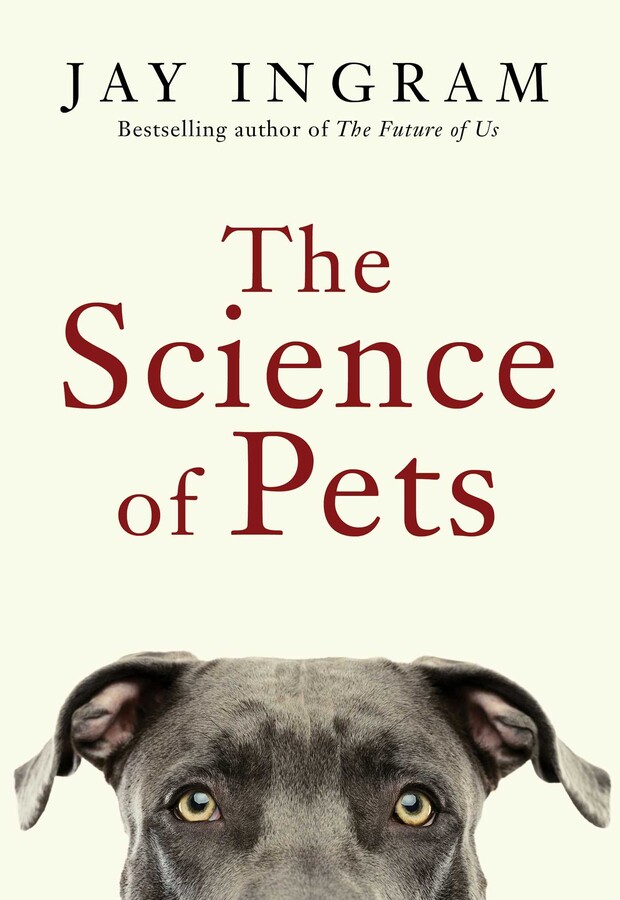
The Science of Pets

See More Retailers

About The Book

In the tradition of The Inside of a Dog, top science writer and TV personality Jay Ingram shares new insights into the hearts, minds, and bodies of the animals who love us (or do they?).

More than one billion pets live in homes around the world, sleeping on dog beds, clawing at cat trees, swimming in bowls, crawling around in aquariums. Canada, the United States, Brazil, the EU, and China make up half of those households, with half of the world’s population owning a pet of some sort. Yet despite the ubiquitous animals that lick our faces and steal food off the counter, we really don’t know a lot about the scientific side of their existence: why do dogs spin around when excited, do our cats really love us, do lizards make good pets, can single-celled organisms be considered pets (you can cut the hydra in two and have two pets!), what are parrots thinking, and can a horse be considered a pet? Or pigs (even those sent to market)? Or praying mantises? Or how about robot pets in Japan, caring for the elderly?

Veteran science broadcaster and journalist Jay Ingram, author of twenty popular science titles, including the bestselling Science of Why series, has researched the latest science behind our beloved furry, and not-so-furry, creatures that sleep on our sofas and eat our pizza crusts. Along the way, he discusses the myths and misconceptions about our companions: do dogs always do their business facing north? Why are we seeing a rise in exotic pets such as tigers and bears? Are the deer and foxes we see “rescued” on Instagram considered pets and could they be domesticated? Did dogs entirely evolve from wolves, and why? Can you communicate with a turtle? Do highly intelligent octopi make good pets? And why are baby animals, like baby humans, so darned cute: have they evolved to be born cute as a survival mechanism, and would that cuteness matter to others of their own kind who might consider them their next lunch?

Full of fabulous insights, humorous asides, and the wisdom of decades in science reporting, The Science of Pets will elucidate as it entertains. You will never look at your pets the same way again (but be sure they’re watching you closely).

Excerpt

Chapter 1: Biophilia

– CHAPTER 1 – Biophilia


In 1984, the renowned biologist Edward O. Wilson, already famed for his studies of ant societies, published a slim book called Biophilia.I Subtitled The Human Bond with Other Species, the book has had a profound impact on how we think about life on earth. Blending his own world travels with the history of biology and the bond between science and the humanities, Wilson built the case that humans are uniquely attracted to all other species, plant and animal.

He wasn’t shy about it either. In the first edition of the book, Wilson made statements that strongly suggest he believed biophilia was innate; that is, genetic: “Biophilia… I will be so bold as to define as the innate tendency to focus on life and life processes.”1

Did he really mean that we have genes that underlie our “focus on life”? If so, they are there because they promoted survival in the past—they’ve been naturally selected. You don’t have to rack your brain to think of what might look like obvious examples: being attentive to the movements of prey like deer, or the calls of the wolf, or knowing through learned experience (tuned by genes) where to find food—plants, insects, other animals—as challenging as that might have been. Yet the idea of biophilia being a genetic trait seemed an overreach to some, and concrete evidence for that has been hard to come by. Wilson himself changed his stance somewhat nine years later, with this statement: “Biophilia is not a single instinct, but a complex set of learning rules.”2 That either muddied the waters or opened the door to new ideas, depending on your point of view. A surprise twist to this? You could even use the exact opposite—biophobia—to argue that the much better evidence for the genetic basis of fear of spiders and snakes shows that emotional attitudes toward nature, positive or negative, can be genetic, as Wilson himself believed: “We need to include biophobia under the broad umbrella of biophilia.”3

Whether biophilia is indeed genetic or, more likely, some combination of genes, culture, and individual variation, it plays a supremely important role in pet-keeping. “Pet-keeping” is a broad term; you’d expect it to manifest in a myriad of ways, and indeed, there’s a huge variety of relationships between people and pets. We all know pet owners who treat their pet as a member of the family, but even E. O. Wilson seems to have treated his pet lizard Methuselah as just another piece of lab equipment on the table: “It would often remain in the same spot for hours or even days without changing its position.”4

Beyond pets, there’s no question that we have a special interest in, and focus on, other forms of life, but sometimes that interest can go a little haywire. Given the interest is expressed by humans, it’s not surprising that it can be exclusively focused on humans. Here are two examples, one ancient, one contemporary; one used animals for political purposes, the other for boosting self-image. But first, a brief history of the artistic origins of biophilia.

The inner walls of European caves at Chauvet and Lascaux in France and Altamira in Spain are enlivened by hundreds of vividly colored images of animals and people. The Chauvet cave art is the oldest, estimated to date to about 35,000 years ago. It is Ice Age art. Several of the animals are long gone, like the aurochs, cave lion, cave hyena, and woolly rhino. Altamira, in Spain, is nearly the same age, with its own array of animals, like horses, goats, and bison. Lascaux, an elaborate series of chambers, is more recent, about 20,000 years old, but again devoted to depictions of local wildlife. The discovery of these caves in the nineteenth century led to a radical new appreciation of early modern humans and their culture—these people were clearly obsessed by large animals, some dangerous predators, others potential dinner.

There is actually evidence of a much earlier connection between art and the animals that surrounded these ancient humans. The Neanderthal people were fascinated by birds’ feathers and talons. One example is an arrangement of eight white eagle talons that were cut and polished, presumably intended to make a bracelet. That was an incredible 130,000 years ago. That and the much later Ice Age art in France and Spain confirm an all-consuming fascination with wildlife. Exactly what that fascination meant is still uncertain, but the existence of images of what appear to be human-animal hybrids suggests imaginative, visionary thinking about humans, animals, and nature. At the very least, the relationship went beyond hunting or being hunted: ancient biophilia. But change was on its way.

Move forward millennia to the great kingdoms of three, four, or five thousand years ago and our knowledge of what transpired is much more detailed and authenticated, and it doesn’t paint a pretty picture. Wildlife continued to play a central role not in the way it did in the lives of ordinary people, which the cave paintings arguably suggest, but for the very rich and very powerful. And the role of the wildlife was integral to that social standing.

There were menageries, similar to zoos in the sense that they were collections of wildlife unfamiliar to the people who would see them, but with a very different purpose from the zoos of today. Hierakonpolis is a good example.

Hierakonpolis was an important city in ancient Egypt about 5,500 years ago, long before the reigns of the pharaohs. A series of archaeological excavations have revealed what has been called the first zoo, including the bones of baboons, elephants, hippos, wildcats, crocodiles, and a hartebeest—even some dogs. The animals were buried beside some of the most celebrated humans of the time, and there might have been a connection: that is, that the death of a ruler prompted the sacrifice of exotic animals as tribute. If so, this wouldn’t be the last time the demonstration of power and influence would be realized by the death of exotic animals. At the same time, though, there was respect; one elephant was buried on a reed mat and covered with linen.

The Egyptian fascination with wild animals continued through the following millennia. Most of the later pharaohs maintained gardens and zoos with animals mostly imported from far up the Nile River. (In fact, recent DNA analysis of the remains of baboons buried in ancient Egypt has located the formerly mysterious Land of Punt as being in or near modern-day Eritrea.) It might not be a step too far to make a connection between the Ice Age paintings of large animals on cave walls to their burial with powerful humans thousands of years later; they might be comparable gestures of respect, awe, and control. We don’t really know, but of those three, control soon took over.

In ancient Assyria and Babylon, a mix of conquest, wealth, the need to promote and celebrate a leader’s power, and the ability to do that by seizing foreign territory, animals, and human labor conspired to make possible jaw-dropping exhibitions of wild animals.

It wasn’t enough just to display the animals. Yes, bringing back a variety of species of deer implied the king’s dominance over foreign lands, but it would be even better if he dominated the animals themselves. The Assyrian king Ashurnasirpal II once bragged that, at the behest of the gods, he killed 30 elephants, 257 wild oxen, and 370 lions. These likely weren’t what you’d call free-range lions, though.

A series of carved reliefs found in the excavated ruins of the ancient city of Nineveh detailed the hunting prowess of the last king of Assyria, Ashurbanipal. Lions were released from cages in the game park, where he was positioned nearby to thrust a sword into them, or fire arrows from close range. If an arrow missed, he was immediately protected by guardsmen who were standing by. The killing was the point, and the drama associated with it, not necessarily the skill deployed in doing so.

However—and this hints at a deeper relationship between humans and animals—bloodshed wasn’t always wrapped into the spectacular display of foreign beasts. A perfect example was the extravagant all-day, mile-long (1.6 kilometer) procession in Alexandria, Egypt, in the middle of February, 278 BCE, a few hundred years after the fall of Assyria. It was a tribute to the god Dionysus, but equally a celebration of the reign of King Ptolemy II. There was a seemingly endless series of chariots pulled first by teams of four elephants apiece, then by antelopes and eight pairs of ostriches (!); buffalo followed, then zebras, spice-bearing camels, hundreds of sheep, cages of parrots, pheasants, peacocks and guinea fowl, Ethiopian oxen, a gigantic white bear, leopards, panthers, lynx, innumerable horses, twenty-four large lions, and a rhinoceros. No word on their final fate.5

Somehow, as time passed and Rome became ascendant, violence took center stage again as animals became objects of slaughter in front of huge, approving crowds. While there had been mass killings of animals for joyful Roman crowds before the reign of Emperor Augustus (63 BCE–14 CE), he really kick-started the idea, claiming that he had been responsible, over a total of twenty-six public shows, for the killing of 3,500 animals, including such exotics spectacles as the execution of thirty-six Egyptian crocodiles.

Augustus’s alleged kill of 3,500 might have been a solid start, but it was quickly bested by a well-documented 11,000 in a massive 123-day death carnival sponsored by Emperor Trajan in 108–109 CE. Eventually, though, this lust for blood, both human and animal, waned in Rome, ending this bizarre, millennia-long extravagance of animal life and death.

But while the slaughter abated, the attraction of exotic animal collections didn’t die out, suggesting that somewhere in there a thread of biophilia remained, manifesting in something closer to the modern zoo, a collection of animals from far-off places to entertain and educate the local crowds. The first zoos of this kind appeared in Europe in the mid-1700s, first in Vienna, then Madrid, then Paris. They were designed pretty much exclusively for the audience, not the animals themselves, and reversing that has been a slow process. Today, zoos make efforts to accommodate their animals in more naturalistic circumstances and restrict themselves to animals born in captivity. Forward-looking zoos have captive breeding programs to reverse, even in some small way, the decline of wild populations. Zoo enclosures are much more natural, and behavior can be studied scientifically.

While these early zoos were the mainstream expression of the human desire for animal menageries, the void left by past Assyrian kings and Roman emperors was occupied by a few who still wished to use collections of exotic animals to project wealth and power.

William Randolph Hearst was a good example. He gradually assembled a one-thousand-square-kilometer (250,000 acre) ranch near San Simeon, California. He built Hearst Castle on the property but also, in the 1920s, began to establish a giant zoo, called the Hearst Garden of Comparative Zoology. Guests drove through it on their way to the castle. The biggest private zoo in the world, it had an open area for herbivores to graze, and enclosures for others. There were about three hundred herbivores, including African and Asian antelope, sambar deer, giraffes, zebras, camels, red deer, axis deer, llamas, kangaroos, ostriches, emus, Barbary sheep, bighorn sheep, musk oxen, and yaks. Carnivores like grizzlies, black bears, tigers, leopards, jaguars, and cougars were kept in the enclosures. When Hearst ran into financial trouble in the late 1930s, the zoo began to sell off the animals, but that process was never completed; even today, you can sometimes see zebras descended from the original ones running wild on the hills near San Simeon.

The Hearst Garden of Comparative Zoology, while obviously a symbol of power, was at least there to entertain the public, if only those on Hearst’s invitation list. Cocaine magnate Pablo Escobar’s zoo made it halfway there: It was definitely an expression of power, but visiting it was another matter, considering it was at his headquarters, Hacienda Nápoles, east of Medellín, Colombia. The entire estate was not nearly as large as Hearst’s, covering about twenty square kilometers (nearly five thousand acres), and the array of animals was smaller, although not too bad for a private zoo: giraffes, zebras, camels, antelopes, elephants, flamingos, rhinoceroses, and, crucially, four hippopotamuses.

As is well known now, after Escobar’s death in 1993, the Colombian government dismantled the zoo, transferring most of the animals to other parks or zoos, but the four hippos, three females and a male, were too difficult to handle, so they were released into the jungle. They managed incredibly well, so much so that there is now an estimated population of about two hundred. This is an invasive species, the largest in the world, one that is dangerous (hippos kill five hundred people a year in Africa) and threatens to upset the ecology in and around the Magdalena River. The difficult choice facing the Colombian government is what to do with Escobar’s cocaine hippos. Culling is distasteful; sterilizing awkward, dangerous, and expensive; transferring them to zoos complicated and also expensive. But probably the worst option is waiting.

Hearst and Escobar are dead. So is the tradition of the rich and powerful creating a zoo as a monument to self-glorification over? Perhaps not.

Anant Ambani, son of the richest person in India, Mukesh Ambani, the twelfth richest man in the world, has created a giant combination wildlife rescue rehabilitation center and zoo called Greens Zoological Rescue and Rehabilitation Kingdom. Anant Ambani refers to it as an “animal shelter.” It has a pretty cool Instagram account (@vantara), and depending on what you read, you find variable accounts of the number of animals either already in residence or pending arrival. It could be nearly five thousand; it could include three thousand herbivores and thirty-three big cats. A spokesperson claimed that no wildlife would be “exposed for entertainment” for his guests, and that safaris would be “solely for educational purposes.”6 Just to tie everything together, the Greens Zoological Rescue and Rehabilitation Kingdom has apparently applied to import cocaine hippos from Colombia.

Even if this becomes a giant personal zoo, albeit with some rescue features, the ancient habit of procuring animals to show them on a grand scale has virtually disappeared. On a grand scale, yes, but that doesn’t prevent the existence of Tiger King or people like him who love to have a few exotic animals in their possession. Mike Tyson’s Bengal tigers, Paris Hilton’s kinkajou, all pretty small stuff really.

Is all this a shade of biophilia? Not really for the human owners—they’re in it for their image. But they realized the human-animal link is the most efficient way of impressing the crowds via their biophilia.

From the ancient Assyrians and Egyptians on, animals were the tools of the expression of power, control, and wealth. While the modern private zookeepers have eliminated ritual slaughter, it still carries on in another realm.

Here’s one detailed account of the end of a trophy hunt:

My bullet has smashed its shoulder, blowing away the top part of its heart and destroying a lung. Van Aswegen’s bullet has broken the spine. He and I circle the lion, then I put two more bullets through its backbone and into the lungs from behind and above…. Its boiled-out skull should rank very high in the SCI [Safari Club International, a trophy-hunting advocacy organization] Record Book of Trophy Animals.7

These accounts are hard to read but not hard to find. If you’re unfamiliar with trophy hunting, it is hunting and killing wild animals to display the slain animal, or its head, or its antlers. Typical targets might be leopards, lions, bighorn sheep, or elephants. It is an expensive activity.

Trophy hunting causes pain and suffering. But it generates a lot of money. Some of that money is said to enhance conservation, although that position is highly controversial.II

And, before going further, I am not talking here about hunting for food, hunting to experience nature, hunting for spiritual or ceremonial reasons, or government-approved hunting of animals deemed as pests. Trophy hunting overlaps with some of those, but its themes are adventure, the chase, reputation, and ultimately personal experience.

I have been in the home of a trophy hunter, an overwhelming display of mounted animals, birds, and fish, including some more elaborate stagings, like elephant-foot umbrella holders and deer-foot lamp stands. There were hundreds. Trophies replaced art and furniture. Surrounding yourself with animal trophies is extreme, though perverse, biophilia.

Of course trophy hunting has nothing to do with pet owning—or does it? I think it does—trophy hunters aren’t bragging about their skill on the firing range. An animal, preferably one that’s large and fierce, has to be a part of it. Accounts like the one above can be found where the gory details are omitted and the hunter describes the prolonged search, the affinity with the animal, and his/her intense emotional response both to the hunt and the kill. Love of nature bridges the gap between trophy hunters and pet owners, however faintly. We all share this positive feeling and express it in different ways.

E. O. Wilson, a dedicated conservationist, would never approve of trophy hunting were he alive. Such experiences were remote from Wilson’s life as a biologist, walking through forests, ever alert for familiar—or even new—species of ants—or anything! Yet a close reading of Wilson suggests he glimpsed common ground between the naturalist and the hunter when it came to finding the desired species: “The naturalist is a civilized hunter. He goes alone into a field or woodland and closes his mind to everything but the time and place…. The hunter-in-naturalist knows that he does not know what is going to happen.”8

Here is hunter Jadine Jedresko with her attitude toward the hunt: “I have a huge respect for each species that I hunt…. You take a picture because it’s a respect to that animal. Hunting is not about killing for me.”9

Taking pictures of an animal you’ve just killed as a sign of respect is an odd pairing, yet naturalists and trophy hunters do share some similar thoughts, especially the sense of achievement. If you think I’m stretching this, don’t forget that old-time naturalists, even Wilson, killed animals or birds if they suspected an undiscovered new species; a museum collection would be their destination. Wilson again: “My Papuan guides stopped hunting alpine wallabies with dogs and arrows, I stopped putting beetles and frogs in bottles of alcohol, and together we scanned the panoramic view.”10

While it’s beetles, frogs, and salamanders in this case, a century before it could have been something on the trophy-hunting scale (where do the animals in old-style museum dioramas come from?). But while some of that experience might be shared with hunters, the purpose is definitely not. Naturalists have their eye on both present and future, accumulating knowledge of what lives where, and preserving that record for the naturalists to come. Trophy hunters want to achieve bigger and more impressive kills, be photographed with them (posed, really), and the bigger the kill, the better. The size is both advertised by hunters’ photos on social media and, if it’s big enough, acknowledged by one of the hunting organizations that keep such metrics (see the quote from the trophy hunter earlier in this chapter).

So yes, biophilia runs through both the naturalists’ and trophy hunters’ experiences, but the goals couldn’t be more different. Both in a sense are extreme: Few people go to the lengths naturalists like E. O. Wilson and trophy hunters do to achieve their ends, but even as extremes they have something in common.

Pet owning is a strong expression of biophilia. It is probably the easiest too (other than couch-bound adventuring with David Attenborough), but bird-watching, whale-watching, gardening, visiting zoos, and collecting wildlife art would all qualify. But how far does biophilia stretch? Greyhound racing? Rodeo? Other sorts of hunting? People who participate in these activities argue that they respect, honor, and even love the animals involved, despite the obvious downsides for those animals. Can that really be called an outlying expression of biophilia? Does this really connect at all to pets?

The funny thing is that pets have been there all along; while Assyrian kings were killing lions at close quarters, dogs and cats were living quieter lives nearby. When President Teddy Roosevelt was gunning down big game, caged birds and goldfish were kept around the world. When the Hearst Garden of Comparative Zoology was thriving in the 1930s, dogs and cats were cementing their status as the most common animals living with people. Now, with pet numbers exploding, and increasing pressure on the illegal animal trade, with zoos committing to taking no more animals from the wild, pets are ascendant.

There are now several studies showing that pet ownership correlates with positive feeling about animals other than pets, such as farm and wild animals, as well as with pro-environment attitudes and even reduced eating of meat. Owning a pet encourages a closer and healthier relationship between humans and animals.11

Whatever value you would put on interactions with animals—of any kind—as we look forward to 2050, when two-thirds of all humans will be living in cities, you can envision how important pets will be to maintaining the human-animal bond. Animals as ambassadors, not targets.
  1. I. The originator of the term was the psychoanalyst Erich Fromm, who defined “biophilia” as “the passionate love of life and of all that is alive” (The Anatomy of Human Destructiveness [Henry Holt, 1973]).
  2. II. Trophy-hunting supporters (which surprisingly include organizations like the International Union for Conservation of Nature) argue that the money hunters spend to bag a giraffe or elephant supports local people and communities, preserves habitat, and ensures that conservation efforts will be sustained. Opponents contend that there’s no solid evidence for such benefits and suspect most of the money gets into the hands of less-deserving recipients.

About The Author

(c) Richard Siemens

Jay Ingram has hosted two national science programs in Canada, Quirks & Quarks on CBC radio and Daily Planet on Discovery Channel Canada. He is the author of twenty books, which have been translated into fifteen languages, including the bestselling five-volume The Science of Why series. In 2015, he won the Walter C. Alvarez Award from the American Medical Writers’ Association for excellence in communicating health care developments and concepts to the public, and from 2005 to 2015 he chaired the Science Communications Program at the Banff Centre. Jay has seven honorary degrees, was awarded the Queen Elizabeth II Diamond Jubilee Medal, and is a Member of the Order of Canada. He is a cofounder of the arts and engineering street festival called Beakerhead in Calgary. He lives in Victoria, British Columbia. Connect with him on X @JayIngram.

Product Details

  • Publisher: Simon & Schuster (November 4, 2025)
  • Length: 304 pages
  • ISBN13: 9781668069264

Browse Related Books

Raves and Reviews

“In The Science of Pets, the fascinating behaviours of the animals we call our own are explored, challenging common myths and misconceptions.”
— CBC Books

“Science writer Ingram (The Future of Us) provides an intriguing . . . exploration of the creatures humans keep as pets . . . this solid work of popular science will likely have wide appeal.”
— Publishers Weekly

“This expansive look at people and pets is a fun read for young adults to seniors, whether they are dog people, cat people, or not pet people at all.”
— Library Journal

The Science of Pets paints a vivid picture of what we know about our relationship to dogs and cats, as well as a variety of exotic pets, like horses, parrots, and even robots. In a light accessible manner, Jay Ingram tells us about the people and personalities that are attracted to different pets, and even whether it is true that people look like their dogs. A must-read for all pet owners.”
— STANLEY COREN, author of How to Speak Dog and How Dogs Think

“Jay Ingram himself would make the ideal pet: he’s a joy to spend time with (as you’ll see when you read this wise and witty book) and he’s always reliable (The Science of Pets is just the latest home run in a long line of excellent books by him). Curling up with a book as good as this one is the next best thing to having your favourite pooch at your side or cat in your lap. From the origin of dogs to the robotic pets of the future, Ingram covers every aspect of our relationships with the animals that become beloved members of our families, seamlessly combining rich insights across the sciences, from evolution to the psychology of both humans and our furry (or feathered or scaly!) companions. A wonderful read!”
— ROBERT J. SAWYER, Hugo Award-winning author of The Downloaded

“Overall, The Science of Pets is enjoyable and illuminating and a book that pet owners should read, if only to do some soul-searching about their need to keep an animal.”
Literary Review of Canada

“Jay Ingram takes his keen eye for the science behind everyday things to illuminate everything pet, from the history of how humans and pets came to align, through the science behind why we have pets and how our relationship with pets has influenced our own and their evolution. Fascinating, engaging, and approachable, The Science of Pets deepens our appreciation for how and why we relate to the animals we cherish.”
— MARK L. WINSTON, FRSC, Professor Emeritus and Senior Fellow, Morris J. Wosk Centre for Dialogue, Simon Fraser University

Resources and Downloads

High Resolution Images

More books from this author: Jay Ingram

BACK TO TOP