Plus, receive recommendations and exclusive offers on all of your favorite books and authors from Simon & Schuster.
Table of Contents
About The Book
A lyrical and suspenseful debut novel about a mysteriously gifted Korean family confronting the brutality of the Japanese empire, Honey in the Wound is an epic tale of survival and the reclamation of power.
A sister disappears and returns as a tiger. A mother’s voice compels the truth from any tongue. A granddaughter divines secrets in others’ dreams. These women are all of one lineage—a Korean family split across decades and borders by Japanese imperialism.
At this saga’s heart is Young-Ja, a girl who infuses food with her emotions. She revels in her gift for cooking, nourishing the people she loves with her cheerfulness. But her sunny childhood comes to an end in 1931 when Japanese soldiers crush her family’s defiance against the Empire. Young-Ja is cast adrift, her food turning increasingly bitter with grief. When a Korean rebel fighter notices her talents, however, she is whisked off to Manchuria to join a secretive sisterhood of beautiful teahouse spies. There, Young-Ja finds a new sense of belonging and starts using her abilities for the resistance. But the Imperial Army is not yet finished with her…
Decades later, Young-Ja lives alone in Seoul, withdrawn from the world until her Tokyo-born granddaughter Rinako bursts into her life with the ability to see into dreams. In cultivating a tentative bond, they confront the long-buried past in a stunning emotional climax.
As an unforgettable family perseveres in the long shadow of colonialism, Honey in the Wound transports readers to mountain forests where tiger-girls stalk, to Manchurian teahouses and opium dens where charming smiles veil secrets, and to the modern metropolises of Tokyo and Seoul where restless ghosts stir. This debut novel is a tender yet powerful multi-generational drama that shines light onto the twentieth century’s darkest corners and gives voice to those who bore witness.
A sister disappears and returns as a tiger. A mother’s voice compels the truth from any tongue. A granddaughter divines secrets in others’ dreams. These women are all of one lineage—a Korean family split across decades and borders by Japanese imperialism.
At this saga’s heart is Young-Ja, a girl who infuses food with her emotions. She revels in her gift for cooking, nourishing the people she loves with her cheerfulness. But her sunny childhood comes to an end in 1931 when Japanese soldiers crush her family’s defiance against the Empire. Young-Ja is cast adrift, her food turning increasingly bitter with grief. When a Korean rebel fighter notices her talents, however, she is whisked off to Manchuria to join a secretive sisterhood of beautiful teahouse spies. There, Young-Ja finds a new sense of belonging and starts using her abilities for the resistance. But the Imperial Army is not yet finished with her…
Decades later, Young-Ja lives alone in Seoul, withdrawn from the world until her Tokyo-born granddaughter Rinako bursts into her life with the ability to see into dreams. In cultivating a tentative bond, they confront the long-buried past in a stunning emotional climax.
As an unforgettable family perseveres in the long shadow of colonialism, Honey in the Wound transports readers to mountain forests where tiger-girls stalk, to Manchurian teahouses and opium dens where charming smiles veil secrets, and to the modern metropolises of Tokyo and Seoul where restless ghosts stir. This debut novel is a tender yet powerful multi-generational drama that shines light onto the twentieth century’s darkest corners and gives voice to those who bore witness.
Reading Group Guide
Get a FREE ebook by joining our mailing list today! Plus, receive recommendations for your next Book Club read.
By clicking 'Sign me up', I consent to Simon & Schuster sending me email offers and updates, including offers for a free eBook. I understand I can unsubscribe at any time. Any offer for an eBook may be subject to exclusions, terms, conditions, and registration with our fulfillment partners. We collect and use your information in accordance with our Privacy Policy. Free ebook offer available to NEW CA subscribers only. Offer redeemable at Simon & Schuster's ebook fulfillment partner. Must redeem within 90 days. See the full terms and conditions.
HONEY IN THE WOUND by Jiyoung Han
This reading group guide for Honey in the Wound includes an introduction, discussion questions, ideas for enhancing your book club, and a Q&A with author Jiyoung Han. The suggested questions are intended to help your reading group find new and interesting angles and topics for your discussion. We hope that these ideas will enrich your conversation and increase your enjoyment of the book.
Introduction
A sister disappears and returns as a tiger. A mother’s voice compels the truth from any tongue. A granddaughter divines secrets in others’ dreams. These women are all of one lineage—a Korean family split across decades and borders by Japanese imperialism.
At this saga’s heart is Young-Ja, a girl who infuses food with her emotions. She revels in her gift for cooking, nourishing the people she loves with her cheerfulness. But her sunny childhood comes to an end in 1931 when Japanese soldiers crush her family’s defiance against the empire. Young-Ja is cast adrift, her food turning increasingly bitter with grief. When a Korean rebel fighter notices her talents, however, she is whisked off to Manchuria to join a secretive sisterhood of beautiful teahouse spies. There, Young-Ja finds a new sense of belonging and starts using her abilities for the resistance. But the Imperial Army is not yet finished with her . . .
Decades later, Young-Ja lives alone in Seoul, withdrawn from the world until her Tokyo-born granddaughter Rinako bursts into her life with the ability to see into dreams. In cultivating a tentative bond, they confront the long-buried past in a stunning emotional climax.
Topics & Questions for Discussion
1. In the novel’s first pages, Myoung-Ok nurses her twins with “despair and joy flow[ing] from her breasts, swirling out with her milk” (4). How does the coexistence of these opposing emotions carry through the rest of the book and the family lineage, and how do they relate to the family’s existence within a colonized state?
2. Nearly every woman in the family has their own unique power, whether it relates to the earth, tigers, food, or varying aspects of the human mind. How do you find these gifts relate to one another, the person who carries any given gift, and the overall story at hand?
3. Recently orphaned, Young-Ja is taken in by Seiko and Masaharu, an older Japanese couple that considers themselves particularly “benevolen[t]” landowners because they make “an effort to show charity to their tenant farmers” (70). Yet shortly after arriving, Young-Ja’s adoptive father begins sexually assaulting her. Seiko discovers this and sends Young-Ja off with Baek Yong-Woo. She comes to this decision because “she did not know how to live without Masaharu after so many decades” but knows that “she would not let Kiyoko come to harm under their roof” (80). Do you find Seiko’s decision cowardly, kind, or somewhere in between? How might this awareness yet ultimate abandonment relate to Seiko’s identification as a “benevolent” settler?
4. Initially, Young-Ja is miserable at Feng-nüshi’s teahouse, fearing her verbal and physical reprimand. We learn that Feng-nüshi is particularly cruel to the girl in order to encourage the negative emotions that Young-Ja then transfers to the cheong fruit preserves. Do you find Feng-nüshi’s intentional cruelty to Young-Ja a justifiable means to an end? How might Feng-nüshi’s treatment of Young-Ja reflect the frequent rhetoric that pain and suffering are necessary for the greater good, particularly in moments of political resistance?
5. Early in the family tree, Geum-Jin witnesses his gentle giant of a father transform after he’s shot by a Japanese gun. There is a “fire in Dahn’s blood” that was not there before, leading to increasingly more violent outbursts (23). Decades later, Baek Yong-Woo turns to morphine as the resistance movement falters so that he may better “shoulder his duties” (148). However, the drug turns the compassionate man into someone who is anything but: “the darkness that marred [his] face made him a stranger” (152). In both these instances, men known for their kindness become cruel by circumstances related to life under occupation. What do you make of both these characters and their descent, the conditions that lead to it, as well as the women that must endure these shifts?
6. Throughout the book, there are several instances of communities women form to survive and even resist the conditions of occupation, like the teatimes when Jung-Soon and the village women gather to find ways to “help their neighbors and protect their families”; the intimate relationships between the servers at Fenghuang Teahouse; and the bond between the girls at the comfort station (50). What do these relationships say about women’s existence within the conditions of colonialism? How do some of these communities falter in the face of external or internal threats?
7. Sparrows offer critical moments of observation and discovery to various characters in the book. Initially, sparrows provided Tayiji intel that he used to “protect himself and transform into riches” (141). Eventually, they begin “watching China transform under occupation,” helping Tayiji “identify soldiers who might be susceptible to the enticements of opium” (145). Years later, they call attention to Young-Ja’s body in the marsh after she escapes the comfort station (207) and appear in the Tokyo apartment “swirling around in a frenetic, piercing chorus” until Shun agrees to let Rinako visit her grandma (239). How does the purpose of the sparrows morph as the plot progresses?
8. After the war, Young-Ja vows to never tell her son or anyone else about the trauma she endured at the comfort station, “will[ing] her voice to stay hidden” so that she could bury this “shameful truth” (210). This decision is borne not only out of personal shame but also the desire to give her son “a clean start” (217). Later, when the professor asks Young-Ja to provide her testimony, she hesitates for fear of “taint[ing] the success of her son, the peace of her granddaughter” (260). What does Young-Ja’s hesitation say about the silence those who undergo colonial trauma might enact upon themselves as a perceived means of survival for themselves and their loved ones? How does this silence and its negative effects trickle down for generations to come—in this case, for Shun and Rinako?
9. Why does reporter Andō Makoto ignore Rinako’s entreaty to interview Young-Ja and write about the comfort women? How does the haunting of the yellow sticky notes exemplify the role of unexplained phenomena in exposing hidden truths? What other phenomena in the novel serve this purpose, and do any examples work against it?
10. As Young-Ja contemplates the decision to come forward with her testimony, the novel becomes more interspersed with short, dreamlike passages. Some are instances of vengeance, like the nurse with a “long, thin pink scar” injecting the Japanese veteran with an unknown substance (231), or General Akagawa dying after eating a “glazed brown cookie” in the final pages (299). There are also vaguer moments, like the yellow butterflies snatched from the sky (276), a boy falling “into a pit” (283), and an old woman “pass[ing] into the darkness” (293). What do you make of these passages? How might they relate to the atrocities faced by Young-Ja and other women gradually coming to light?
11. For Shun, material comfort and acceptance into Japanese society are critical. As a young man, he drops his Korean name for a Japanese one to “secure a position in a respectable company” (219), and prides himself on providing Rinako with a “privileged upbringing: wealth, stability, an attentive family” (237). He overworks himself at a company that treats him poorly, allowing his family to fall to the wayside, so that he might attain these pillars of supposed happiness. Later, when he leaves his job and meets Rinako at the Yasukuni Jinja protest, Shun is agitated for having “walked out on his responsibilities” despite his daughter’s happiness at having him join her (289). Why do you think Shun clings to these aspects of his life as evidence of success, despite them not amounting to true satisfaction for him or his family? How does this affect his relationship with his ex-wife, Rinako, and Young-Ja?
12. “Chop ‘em up and feed ‘em to my family’s pigs!” . . .
“How horrid. I don’t want to think like that. Like them.”
“How else do we get even?”
“We don’t have to stoop to their level.” . . .
“They win if you wallow here in your self-pity.” (248)
When Rinako falls into a feverish sleep and the spirits of the women her grandmother knew at the comfort station possess her momentarily, they debate what justice looks like to them. While some view violence as a means of righting the wrongs committed against them, others argue that this would only make them just as cruel. How does this disagreement resemble conversations had in the past and present about how to achieve justice in the face of oppression? What do you think justice for the comfort women might look like?
Enhance Your Book Club
1. This book is filled with mentions of Korean treats: songpyeon rice cakes, yeot candies, cheong, and yakgwa cookies, to name a few. Make one of these sweets with your book club and discuss its significance within the plot.
2. Take a deeper look into the history of comfort stations and the women that endured them via UCLA’s Comfort Women Resource Center: https://www.international.ucla.edu/cks/care.
3. Write a letter to an elder in your family inviting them to share a historic memory with you; or write a letter to your younger self looking back at an event that you lived through and how it affected you.
A Conversation with Jiyoung Han
Q: You’ve noted that you didn’t consider yourself a writer prior to this book. What was the catalyst that made you feel as though you had to write this story?
A: In 2023, I read that there were only nine surviving comfort women left in Korea. I was filled with intense rage and grief thinking about these grandmothers in their nineties who would pass away soon without having received a formal apology from the Japanese government. I desperately wanted more people to engage with this issue, to help call for justice and remembrance for victims of sexual slavery. While I’m not a journalist or a historian, I’ve turned to fiction countless times to learn histories I never did in school. And so, this novel became my attempt to amplify the voices of these women and provide another vessel for their testimonies.
Q: What was your reason for choosing tigers and sparrows as animals of symbolic and plot-related importance?
A: As animals feature prominently in Korean folklore, it wouldn’t have felt quite right without them in the story’s magic. Tigers loom large in Korea as a national symbol of strength—it’s even said that the country is shaped like a tiger. Their unfortunate extinction on the peninsula was a greater metaphor for Japanese colonialism that I wanted woven into the book from the start. The sparrows as a hive mind keeping tabs on humans is somewhat of a departure from Korean folklore, where magpies are the more favored bird. (They’re an auspicious sign of good luck or a visitor-to-come; Tayiji’s nickname for Young-Ja is Joseon kkachi, or “Korean magpie.”) But I’ve always been drawn to the idea of very common flock animals like sparrows having a communal intelligence where the whole is greater than the sum of its parts. They’re one of my favorite elements of resistance and hope in the novel.
Q: While researching, were there any facts you learned regarding Asia under Japanese occupation that particularly struck you?
A: Although I was already familiar with much of the history in the novel—the March First Movement, the comfort women system, the Nanjing Massacre, Zhongma Fortress/Unit 731—I did a lot of additional research to ensure I could portray these pieces faithfully. One of the things I didn’t know as much about prior to the book was Japan’s use of opium as a form of colonial control and profit in Manchuria. I didn’t realize the extent to which the Japanese had built a monopoly over narcotics and deliberately sought to subjugate the Chinese population through addiction, using the revenue they extracted from the people to then finance their occupation. The totality of control the imperialists sought continues to chill me to the bone.
Q: Are there any authors that write on the lived experience of Japanese occupation that guided your own storytelling?
A: If we’re talking just Koreans, so many pull from the experience of occupation, either explicitly or implicitly. Anti-colonial poems I read in college from Yi Sang and Kim Suyoung have really stuck with me (in particular, the haunting repetition of “Petal 2” is seared into my brain forever). Han Kang layers the weight of colonial trauma into her works despite centering events from the latter half of the twentieth century. Korean diaspora writers like Min Jin Lee and Juhea Kim deserve their flowers as trailblazers who proved there was a market for Korean historical fiction in the West. Zainichi Korean Yu Miri also writes in Japanese to great critical acclaim—I admire her courage and vision in releasing The End of August. Iris Chang is Chinese, but I can’t compile this list without The Rape of Nanking, an incredibly important piece of scholarship that should be required reading.
Q: Food and memory are deeply intertwined in the book. What compelled you to link the two within the plot? Any favorite treats that you mention?
A: I think food as a vessel for memory is something all people can relate to regardless of nationality, class, or upbringing. Taste and scent are both so transporting and, for me, can evoke very specific sentiments from past experiences. There’s also something visceral and undeniable about reactions to food—I leaned on this each time I wanted to make a character truly feel something. In general, I love to eat, and Korean food unsurprisingly is my favorite cuisine. I adore all foods mentioned in the novel but yakgwa was my preferred treat as a child. Even now, biting into one takes me back to my youth in Seoul when the family would gather for the Chuseok holiday to feast, reminisce, and play traditional games in the most quintessentially Korean tableau. It was incredibly satisfying to give yakgwa plot significance as an emotional coup de grâce delivered to a Japanese general.
Q: Were there any women in your life that served as inspiration for the powerful women you wrote?
A: None of my characters were really modeled after any single person. I focused instead on imbuing the cast with the qualities I admire from a wide range of extraordinary “ordinary” women I’ve seen and loved throughout my life—family, friends, teachers, public figures. Strength can manifest in so many different ways, from physical stamina to unacknowledged sacrifice, from quiet determination to loudly asserted authority. Strength can also come with certain costs—cruelty in Feng-nüshi’s case or avoidance and PTSD in Young-Ja’s. Empathy and the will to protect the community around them is a common thread of strength that runs through all the women in the central family. They’re also the traits I tend to gravitate to most in real-life women.
Q: What motivated you to primarily center this story on a single family tree?
A: Half for conventions of the genre, half for thematic necessity. My literary education comprised a lot of the magical realist canon—Toni Morrison, Salman Rushdie, Gabriel García Márquez, Isabel Allende—and its texts all center on single family trees. When you’re dealing with such a large cast, it helps to have the grounding anchor of one bloodline so readers can process new characters in relation to previous generations. Magical realism also tends to examine the political histories of the author’s heritage, which must cover decades and multiple generations to truly understand cause and consequence. This speaks to the thematic importance of intergenerational trauma as well, and the responsibility to show how past traumas can affect not just the people who directly experienced it but also their children and grandchildren. History is not experienced in a vacuum, and carrying the narrative torch through a single family best illustrates this.
Q: What was the inspiration behind your queer characters and how are they important to the story?
A: My life is all the richer for the many queer and genderqueer people in it, and I couldn’t imagine conceiving of even a fictional world without a nod to that. Queerness has always existed despite whatever rigid social conventions prevailed at a given era of humanity, and it was especially important to me to reflect that in a work of historical fiction. While many Asian countries hold more conservative views today, homosexuality has been recorded in Korean and Chinese history for more than a millennium. Many nobles, Buddhist monks, and even kings exhibited same-sex attraction or gender fluidity (the general population certainly did too, but they were much less likely to be documented). It’s also no coincidence that the novel’s queer characters are deeply entrenched in anti-colonial resistance: the teahouse women, Baek Yong-Woo, Tayiji. It’s in their very nature to subvert the oppressive dictates of society.
Q: The title, Honey in the Wound, is borrowed from one of the last sentences in the book—specifically, the line states that there is no honey in the wound (300). What is the significance of that last scene as it relates to the title choice, as well as the greater intent of your book?
A: Many high-ranking Japanese officials were tried and some executed through the Tokyo War Crimes Tribunal following World War II, but I took some liberties by imagining General Akagawa as an old man who had lived a full, privileged life. If someone like him had survived, what would justice look like? I wanted him to experience the emotions of the comfort women he subjugated, but to be so overwhelmed by them that they literally take his breath away. Honey as both healing balm and weapon is a recurring motif, and General Akagawa experienced this full range in the final scene: the honeyed yakgwa forced him to take on the emotions of his victims while triggering his demise with the weight of their sorrow. There is no honey in his wound and the scars remain from the damage he’s done, but there’s a palliative relief for us in his finally understanding.
Q: The ending feels like a moment of closure for Young-Ja as well as a sort of beginning for Rinako and the comfort women’s movement. What was your thought process in concluding your book on that note, and where do you see the story going beyond your writing?
A: I wanted the novel to mirror reality, which is that comfort women have not yet received the justice due to them and may all pass on before such a resolution. Young-Ja does finally speak her truth and reconnect with her family in her twilight years, but she dies before she has a chance to let it all sink in. I wanted readers to feel the same frustrated grief Koreans feel about the comfort women issue through the curtailed arc of Young-Ja’s life while also having a call to action in Rinako. Rinako—who is notably not 100 percent ethnically Korean—and the next generation must carry on that torch in the fight for truth and justice. We must continue to demand formal governmental accountability and memorialization of this history so that we can prevent such atrocities from occurring ever again.
This reading group guide for Honey in the Wound includes an introduction, discussion questions, ideas for enhancing your book club, and a Q&A with author Jiyoung Han. The suggested questions are intended to help your reading group find new and interesting angles and topics for your discussion. We hope that these ideas will enrich your conversation and increase your enjoyment of the book.
Introduction
A sister disappears and returns as a tiger. A mother’s voice compels the truth from any tongue. A granddaughter divines secrets in others’ dreams. These women are all of one lineage—a Korean family split across decades and borders by Japanese imperialism.
At this saga’s heart is Young-Ja, a girl who infuses food with her emotions. She revels in her gift for cooking, nourishing the people she loves with her cheerfulness. But her sunny childhood comes to an end in 1931 when Japanese soldiers crush her family’s defiance against the empire. Young-Ja is cast adrift, her food turning increasingly bitter with grief. When a Korean rebel fighter notices her talents, however, she is whisked off to Manchuria to join a secretive sisterhood of beautiful teahouse spies. There, Young-Ja finds a new sense of belonging and starts using her abilities for the resistance. But the Imperial Army is not yet finished with her . . .
Decades later, Young-Ja lives alone in Seoul, withdrawn from the world until her Tokyo-born granddaughter Rinako bursts into her life with the ability to see into dreams. In cultivating a tentative bond, they confront the long-buried past in a stunning emotional climax.
Topics & Questions for Discussion
1. In the novel’s first pages, Myoung-Ok nurses her twins with “despair and joy flow[ing] from her breasts, swirling out with her milk” (4). How does the coexistence of these opposing emotions carry through the rest of the book and the family lineage, and how do they relate to the family’s existence within a colonized state?
2. Nearly every woman in the family has their own unique power, whether it relates to the earth, tigers, food, or varying aspects of the human mind. How do you find these gifts relate to one another, the person who carries any given gift, and the overall story at hand?
3. Recently orphaned, Young-Ja is taken in by Seiko and Masaharu, an older Japanese couple that considers themselves particularly “benevolen[t]” landowners because they make “an effort to show charity to their tenant farmers” (70). Yet shortly after arriving, Young-Ja’s adoptive father begins sexually assaulting her. Seiko discovers this and sends Young-Ja off with Baek Yong-Woo. She comes to this decision because “she did not know how to live without Masaharu after so many decades” but knows that “she would not let Kiyoko come to harm under their roof” (80). Do you find Seiko’s decision cowardly, kind, or somewhere in between? How might this awareness yet ultimate abandonment relate to Seiko’s identification as a “benevolent” settler?
4. Initially, Young-Ja is miserable at Feng-nüshi’s teahouse, fearing her verbal and physical reprimand. We learn that Feng-nüshi is particularly cruel to the girl in order to encourage the negative emotions that Young-Ja then transfers to the cheong fruit preserves. Do you find Feng-nüshi’s intentional cruelty to Young-Ja a justifiable means to an end? How might Feng-nüshi’s treatment of Young-Ja reflect the frequent rhetoric that pain and suffering are necessary for the greater good, particularly in moments of political resistance?
5. Early in the family tree, Geum-Jin witnesses his gentle giant of a father transform after he’s shot by a Japanese gun. There is a “fire in Dahn’s blood” that was not there before, leading to increasingly more violent outbursts (23). Decades later, Baek Yong-Woo turns to morphine as the resistance movement falters so that he may better “shoulder his duties” (148). However, the drug turns the compassionate man into someone who is anything but: “the darkness that marred [his] face made him a stranger” (152). In both these instances, men known for their kindness become cruel by circumstances related to life under occupation. What do you make of both these characters and their descent, the conditions that lead to it, as well as the women that must endure these shifts?
6. Throughout the book, there are several instances of communities women form to survive and even resist the conditions of occupation, like the teatimes when Jung-Soon and the village women gather to find ways to “help their neighbors and protect their families”; the intimate relationships between the servers at Fenghuang Teahouse; and the bond between the girls at the comfort station (50). What do these relationships say about women’s existence within the conditions of colonialism? How do some of these communities falter in the face of external or internal threats?
7. Sparrows offer critical moments of observation and discovery to various characters in the book. Initially, sparrows provided Tayiji intel that he used to “protect himself and transform into riches” (141). Eventually, they begin “watching China transform under occupation,” helping Tayiji “identify soldiers who might be susceptible to the enticements of opium” (145). Years later, they call attention to Young-Ja’s body in the marsh after she escapes the comfort station (207) and appear in the Tokyo apartment “swirling around in a frenetic, piercing chorus” until Shun agrees to let Rinako visit her grandma (239). How does the purpose of the sparrows morph as the plot progresses?
8. After the war, Young-Ja vows to never tell her son or anyone else about the trauma she endured at the comfort station, “will[ing] her voice to stay hidden” so that she could bury this “shameful truth” (210). This decision is borne not only out of personal shame but also the desire to give her son “a clean start” (217). Later, when the professor asks Young-Ja to provide her testimony, she hesitates for fear of “taint[ing] the success of her son, the peace of her granddaughter” (260). What does Young-Ja’s hesitation say about the silence those who undergo colonial trauma might enact upon themselves as a perceived means of survival for themselves and their loved ones? How does this silence and its negative effects trickle down for generations to come—in this case, for Shun and Rinako?
9. Why does reporter Andō Makoto ignore Rinako’s entreaty to interview Young-Ja and write about the comfort women? How does the haunting of the yellow sticky notes exemplify the role of unexplained phenomena in exposing hidden truths? What other phenomena in the novel serve this purpose, and do any examples work against it?
10. As Young-Ja contemplates the decision to come forward with her testimony, the novel becomes more interspersed with short, dreamlike passages. Some are instances of vengeance, like the nurse with a “long, thin pink scar” injecting the Japanese veteran with an unknown substance (231), or General Akagawa dying after eating a “glazed brown cookie” in the final pages (299). There are also vaguer moments, like the yellow butterflies snatched from the sky (276), a boy falling “into a pit” (283), and an old woman “pass[ing] into the darkness” (293). What do you make of these passages? How might they relate to the atrocities faced by Young-Ja and other women gradually coming to light?
11. For Shun, material comfort and acceptance into Japanese society are critical. As a young man, he drops his Korean name for a Japanese one to “secure a position in a respectable company” (219), and prides himself on providing Rinako with a “privileged upbringing: wealth, stability, an attentive family” (237). He overworks himself at a company that treats him poorly, allowing his family to fall to the wayside, so that he might attain these pillars of supposed happiness. Later, when he leaves his job and meets Rinako at the Yasukuni Jinja protest, Shun is agitated for having “walked out on his responsibilities” despite his daughter’s happiness at having him join her (289). Why do you think Shun clings to these aspects of his life as evidence of success, despite them not amounting to true satisfaction for him or his family? How does this affect his relationship with his ex-wife, Rinako, and Young-Ja?
12. “Chop ‘em up and feed ‘em to my family’s pigs!” . . .
“How horrid. I don’t want to think like that. Like them.”
“How else do we get even?”
“We don’t have to stoop to their level.” . . .
“They win if you wallow here in your self-pity.” (248)
When Rinako falls into a feverish sleep and the spirits of the women her grandmother knew at the comfort station possess her momentarily, they debate what justice looks like to them. While some view violence as a means of righting the wrongs committed against them, others argue that this would only make them just as cruel. How does this disagreement resemble conversations had in the past and present about how to achieve justice in the face of oppression? What do you think justice for the comfort women might look like?
Enhance Your Book Club
1. This book is filled with mentions of Korean treats: songpyeon rice cakes, yeot candies, cheong, and yakgwa cookies, to name a few. Make one of these sweets with your book club and discuss its significance within the plot.
2. Take a deeper look into the history of comfort stations and the women that endured them via UCLA’s Comfort Women Resource Center: https://www.international.ucla.edu/cks/care.
3. Write a letter to an elder in your family inviting them to share a historic memory with you; or write a letter to your younger self looking back at an event that you lived through and how it affected you.
A Conversation with Jiyoung Han
Q: You’ve noted that you didn’t consider yourself a writer prior to this book. What was the catalyst that made you feel as though you had to write this story?
A: In 2023, I read that there were only nine surviving comfort women left in Korea. I was filled with intense rage and grief thinking about these grandmothers in their nineties who would pass away soon without having received a formal apology from the Japanese government. I desperately wanted more people to engage with this issue, to help call for justice and remembrance for victims of sexual slavery. While I’m not a journalist or a historian, I’ve turned to fiction countless times to learn histories I never did in school. And so, this novel became my attempt to amplify the voices of these women and provide another vessel for their testimonies.
Q: What was your reason for choosing tigers and sparrows as animals of symbolic and plot-related importance?
A: As animals feature prominently in Korean folklore, it wouldn’t have felt quite right without them in the story’s magic. Tigers loom large in Korea as a national symbol of strength—it’s even said that the country is shaped like a tiger. Their unfortunate extinction on the peninsula was a greater metaphor for Japanese colonialism that I wanted woven into the book from the start. The sparrows as a hive mind keeping tabs on humans is somewhat of a departure from Korean folklore, where magpies are the more favored bird. (They’re an auspicious sign of good luck or a visitor-to-come; Tayiji’s nickname for Young-Ja is Joseon kkachi, or “Korean magpie.”) But I’ve always been drawn to the idea of very common flock animals like sparrows having a communal intelligence where the whole is greater than the sum of its parts. They’re one of my favorite elements of resistance and hope in the novel.
Q: While researching, were there any facts you learned regarding Asia under Japanese occupation that particularly struck you?
A: Although I was already familiar with much of the history in the novel—the March First Movement, the comfort women system, the Nanjing Massacre, Zhongma Fortress/Unit 731—I did a lot of additional research to ensure I could portray these pieces faithfully. One of the things I didn’t know as much about prior to the book was Japan’s use of opium as a form of colonial control and profit in Manchuria. I didn’t realize the extent to which the Japanese had built a monopoly over narcotics and deliberately sought to subjugate the Chinese population through addiction, using the revenue they extracted from the people to then finance their occupation. The totality of control the imperialists sought continues to chill me to the bone.
Q: Are there any authors that write on the lived experience of Japanese occupation that guided your own storytelling?
A: If we’re talking just Koreans, so many pull from the experience of occupation, either explicitly or implicitly. Anti-colonial poems I read in college from Yi Sang and Kim Suyoung have really stuck with me (in particular, the haunting repetition of “Petal 2” is seared into my brain forever). Han Kang layers the weight of colonial trauma into her works despite centering events from the latter half of the twentieth century. Korean diaspora writers like Min Jin Lee and Juhea Kim deserve their flowers as trailblazers who proved there was a market for Korean historical fiction in the West. Zainichi Korean Yu Miri also writes in Japanese to great critical acclaim—I admire her courage and vision in releasing The End of August. Iris Chang is Chinese, but I can’t compile this list without The Rape of Nanking, an incredibly important piece of scholarship that should be required reading.
Q: Food and memory are deeply intertwined in the book. What compelled you to link the two within the plot? Any favorite treats that you mention?
A: I think food as a vessel for memory is something all people can relate to regardless of nationality, class, or upbringing. Taste and scent are both so transporting and, for me, can evoke very specific sentiments from past experiences. There’s also something visceral and undeniable about reactions to food—I leaned on this each time I wanted to make a character truly feel something. In general, I love to eat, and Korean food unsurprisingly is my favorite cuisine. I adore all foods mentioned in the novel but yakgwa was my preferred treat as a child. Even now, biting into one takes me back to my youth in Seoul when the family would gather for the Chuseok holiday to feast, reminisce, and play traditional games in the most quintessentially Korean tableau. It was incredibly satisfying to give yakgwa plot significance as an emotional coup de grâce delivered to a Japanese general.
Q: Were there any women in your life that served as inspiration for the powerful women you wrote?
A: None of my characters were really modeled after any single person. I focused instead on imbuing the cast with the qualities I admire from a wide range of extraordinary “ordinary” women I’ve seen and loved throughout my life—family, friends, teachers, public figures. Strength can manifest in so many different ways, from physical stamina to unacknowledged sacrifice, from quiet determination to loudly asserted authority. Strength can also come with certain costs—cruelty in Feng-nüshi’s case or avoidance and PTSD in Young-Ja’s. Empathy and the will to protect the community around them is a common thread of strength that runs through all the women in the central family. They’re also the traits I tend to gravitate to most in real-life women.
Q: What motivated you to primarily center this story on a single family tree?
A: Half for conventions of the genre, half for thematic necessity. My literary education comprised a lot of the magical realist canon—Toni Morrison, Salman Rushdie, Gabriel García Márquez, Isabel Allende—and its texts all center on single family trees. When you’re dealing with such a large cast, it helps to have the grounding anchor of one bloodline so readers can process new characters in relation to previous generations. Magical realism also tends to examine the political histories of the author’s heritage, which must cover decades and multiple generations to truly understand cause and consequence. This speaks to the thematic importance of intergenerational trauma as well, and the responsibility to show how past traumas can affect not just the people who directly experienced it but also their children and grandchildren. History is not experienced in a vacuum, and carrying the narrative torch through a single family best illustrates this.
Q: What was the inspiration behind your queer characters and how are they important to the story?
A: My life is all the richer for the many queer and genderqueer people in it, and I couldn’t imagine conceiving of even a fictional world without a nod to that. Queerness has always existed despite whatever rigid social conventions prevailed at a given era of humanity, and it was especially important to me to reflect that in a work of historical fiction. While many Asian countries hold more conservative views today, homosexuality has been recorded in Korean and Chinese history for more than a millennium. Many nobles, Buddhist monks, and even kings exhibited same-sex attraction or gender fluidity (the general population certainly did too, but they were much less likely to be documented). It’s also no coincidence that the novel’s queer characters are deeply entrenched in anti-colonial resistance: the teahouse women, Baek Yong-Woo, Tayiji. It’s in their very nature to subvert the oppressive dictates of society.
Q: The title, Honey in the Wound, is borrowed from one of the last sentences in the book—specifically, the line states that there is no honey in the wound (300). What is the significance of that last scene as it relates to the title choice, as well as the greater intent of your book?
A: Many high-ranking Japanese officials were tried and some executed through the Tokyo War Crimes Tribunal following World War II, but I took some liberties by imagining General Akagawa as an old man who had lived a full, privileged life. If someone like him had survived, what would justice look like? I wanted him to experience the emotions of the comfort women he subjugated, but to be so overwhelmed by them that they literally take his breath away. Honey as both healing balm and weapon is a recurring motif, and General Akagawa experienced this full range in the final scene: the honeyed yakgwa forced him to take on the emotions of his victims while triggering his demise with the weight of their sorrow. There is no honey in his wound and the scars remain from the damage he’s done, but there’s a palliative relief for us in his finally understanding.
Q: The ending feels like a moment of closure for Young-Ja as well as a sort of beginning for Rinako and the comfort women’s movement. What was your thought process in concluding your book on that note, and where do you see the story going beyond your writing?
A: I wanted the novel to mirror reality, which is that comfort women have not yet received the justice due to them and may all pass on before such a resolution. Young-Ja does finally speak her truth and reconnect with her family in her twilight years, but she dies before she has a chance to let it all sink in. I wanted readers to feel the same frustrated grief Koreans feel about the comfort women issue through the curtailed arc of Young-Ja’s life while also having a call to action in Rinako. Rinako—who is notably not 100 percent ethnically Korean—and the next generation must carry on that torch in the fight for truth and justice. We must continue to demand formal governmental accountability and memorialization of this history so that we can prevent such atrocities from occurring ever again.
About The Author
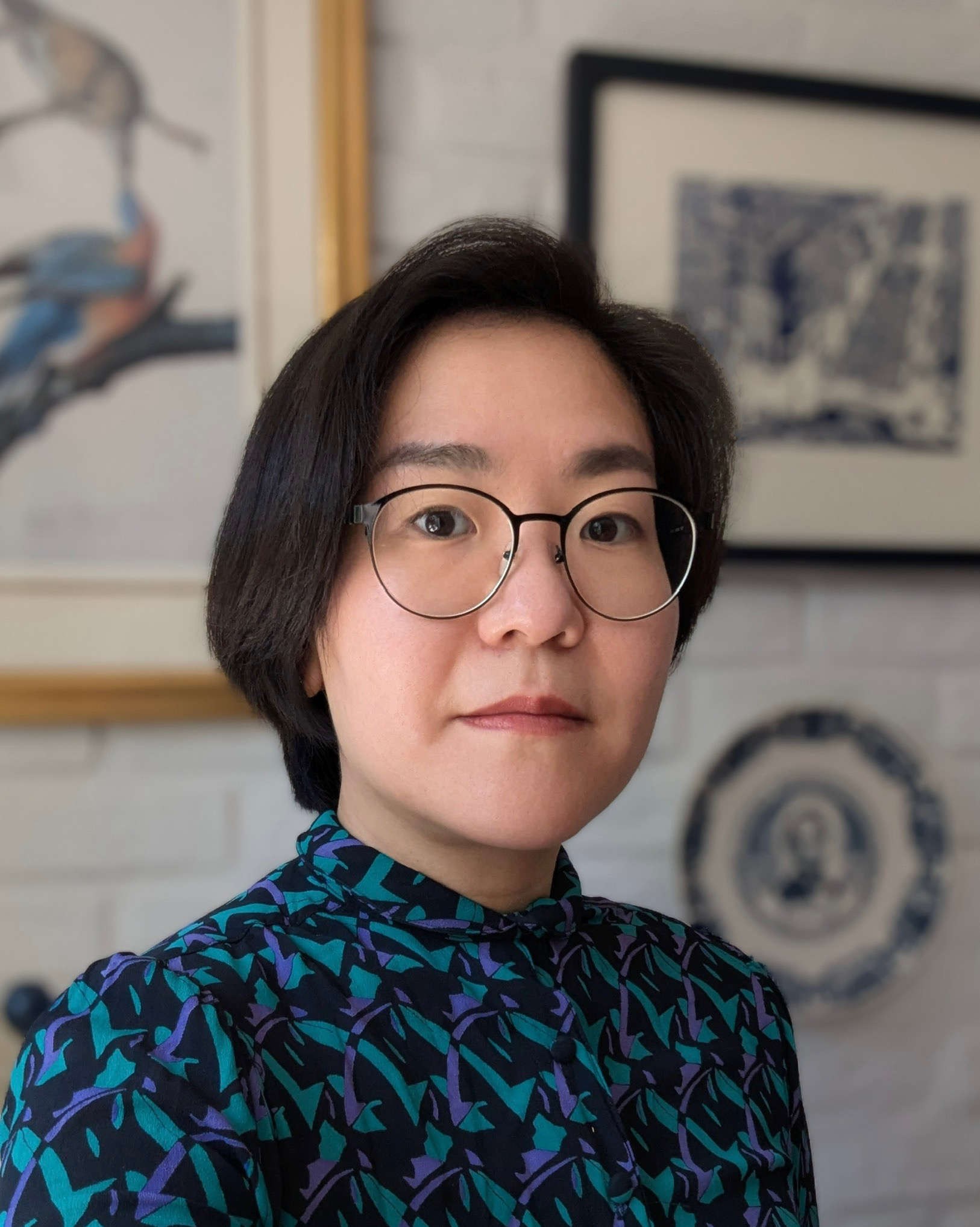
Jiyoung Han
Jiyoung Han was born in Seoul, Korea, and grew up in the American Midwest. She has lived and worked in four continents but now calls San Francisco home. When not writing, she conducts research in climate change and human decision-making. Honey in the Wound is her debut novel.
Product Details
- Publisher: Avid Reader Press/Simon & Schuster (March 2, 2027)
- Length: 320 pages
- ISBN13: 9781668202173
Browse Related Books
Raves and Reviews
“Poignant . . . Han blends folklore and magical realism with Korean history in her remarkable debut, a family saga spanning the 20th century. . . . Han brilliantly immerses readers in her birth country’s history and offers a testament to women’s strength in the face of brutality. It’s a knockout.” —Publishers Weekly (starred review)
“Honey in the Wound alchemizes 90 years of Korean history into an extraordinary multigenerational epic. . . . Tempering the horrors with magical realism—Geum-Ja’s avenging reappearances as a tiger, Young-Ja’s food infused with emotions, Rinako’s truth-revealing dreams—Han’s exceptional storytelling bears spectacular witness to history.” —Shelf Awareness (starred review)
“Honey in the Wound is unspeakable history given the power of myth and fable. Every word is truer than truth.” —Anton Hur, author of Toward Eternity
“This fantastical multigenerational saga highlights the Korean women who fought back against Japanese imperialism in the 1930s and beyond. . . . It’s a gorgeous story full of richly drawn characters and a thread of magic.” —BookRiot
“In this family, the women are magic. . . . [They] subvert expectations, finding ways to reclaim their voices, even when they are repressed and it’s not easy to be heard. Watching each character find a source of strength and fight for her sense of self is remarkable. The magical elements of the story don’t distract from the historical detail, but are instead presented as inherent to the women’s lives, part of the fabric of their existence and resistance. Han’s prose and imagery are sharp throughout the novel, giving a clear sense of time and place, and making the characters come alive in their trauma, joy, sorrow and connection. Honey in the Wound is a moving demonstration of the way that individual acts of resistance can preserve memories and stories that challenge the legacies of empire and colonization.” —BookPage
“Honey can be a salve or a sweetener but, as Han illustrates so vividly, not all wounds can be healed by the oft-employed Korean folk remedy. . . . Han has incorporated extensive research into a revelatory work of harrowing fiction. . . . [Han] validates the hidden powers of ‘powerless’ women.” —Kirkus Reviews
“How does memory travel through time, bridging generations through its different forms? Riveting and poignant, Han’s debut explores how memory transforms into secrets, dreams, and testimonies that bond people across distance and time. . . . Powerfully bridges the individual with the collective.” —Booklist
“Han’s writing is lush and moving, and the work is both inventive and deeply researched—sometimes reading as fable, other times as historical account or ancestral narrative.” —Electric Literature
“Honey in the Wound by Jiyoung Han weaves a story of broken silences in the wake of brutality and the connections that give voice to those silences. Magical moments live in the tears that grow into grass and a tiger that can rescue, but not save, the fate of her human family. And in the way mothers attend to each other while their dead children’s ghosts cry out. And in the transformation of gifts into love, resistance, and freedom.” —Debutiful
“In Han’s courageous debut, magic is a form of resistance which, like hope, bolsters the human spirit. Within seemingly ordinary people, there are extraordinary powers. This isn’t just a story, it’s a record of the brutality of invasion, occupation, and war. Honey in the Wound is a book to remember, and Han is an author to watch.” —Eve J. Chung, USA Today bestselling author of The Daughters of Shandong
“With heartbreaking passion, Honey in the Wound refuses to turn away from the dark underbelly of history, putting words to those who are forgotten and who survive despite. Jiyoung Han’s prose is lush and fiercely inventive, wresting immense beauty and hope from great despair. This is a startling and unforgettable debut.” —Janika Oza, author of A History of Burning
“A spellbinding epic that captures the resilience and spirit of Jiyoung Han’s unforgettably drawn characters. I’ll be thinking about this powerful debut for many years to come.” —Jung Yun, author of Shelter and O Beautiful
“A fierce and mythic family saga, Honey in the Wound moves with the urgency of anti-colonial resistance and the grace of folklore. Even as history bears down, its most magical moments rise from the sorrow, fury, and enduring love of ordinary lives. Refusing to let the ghosts of the Japanese empire fall silent, the novel honors the truth still burning in the wound.” —Silvia Park, author of Luminous
“A rich sweeping novel that brings together magical realism and the brutalities of the Pacific War. An incredible multi-generational story with unforgettable characters. Make time for it.” —Emma Nanami Strenner, author of My Other Heart
“Honey in the Wound is a spellbinding debut, both a lyrical fable and unflinching testimony. Jiyoung Han deftly weaves magical realism into a devastating account of the Japanese Imperial Army's brutality in the early 20th century, granting her characters—and voices like them silenced throughout history—power and agency. The resulting work leaves one shaken. Absolutely unforgettable.” —Karissa Chen, USA Today bestselling author of Homeseeking
“This novel is a testimony of, and a testament to, the indestructible spirit of women. It forces you to hear and see, to bear witness, to make sure nothing like comfort women ever happens again. Terrific writing. Enchanting in every way!” —Chikodili Emelumadu, author of Dazzling
Resources and Downloads
High Resolution Images
-
Book Cover Image (jpg): Honey in the Wound
Trade Paperback 9781668202173
-
Author Photo (jpg): Jiyoung Han Jiyoung Han(0.1 MB)
Any use of an author photo must include its respective photo credit