Plus, receive recommendations and exclusive offers on all of your favorite books and authors from Simon & Schuster.
Table of Contents
About The Book
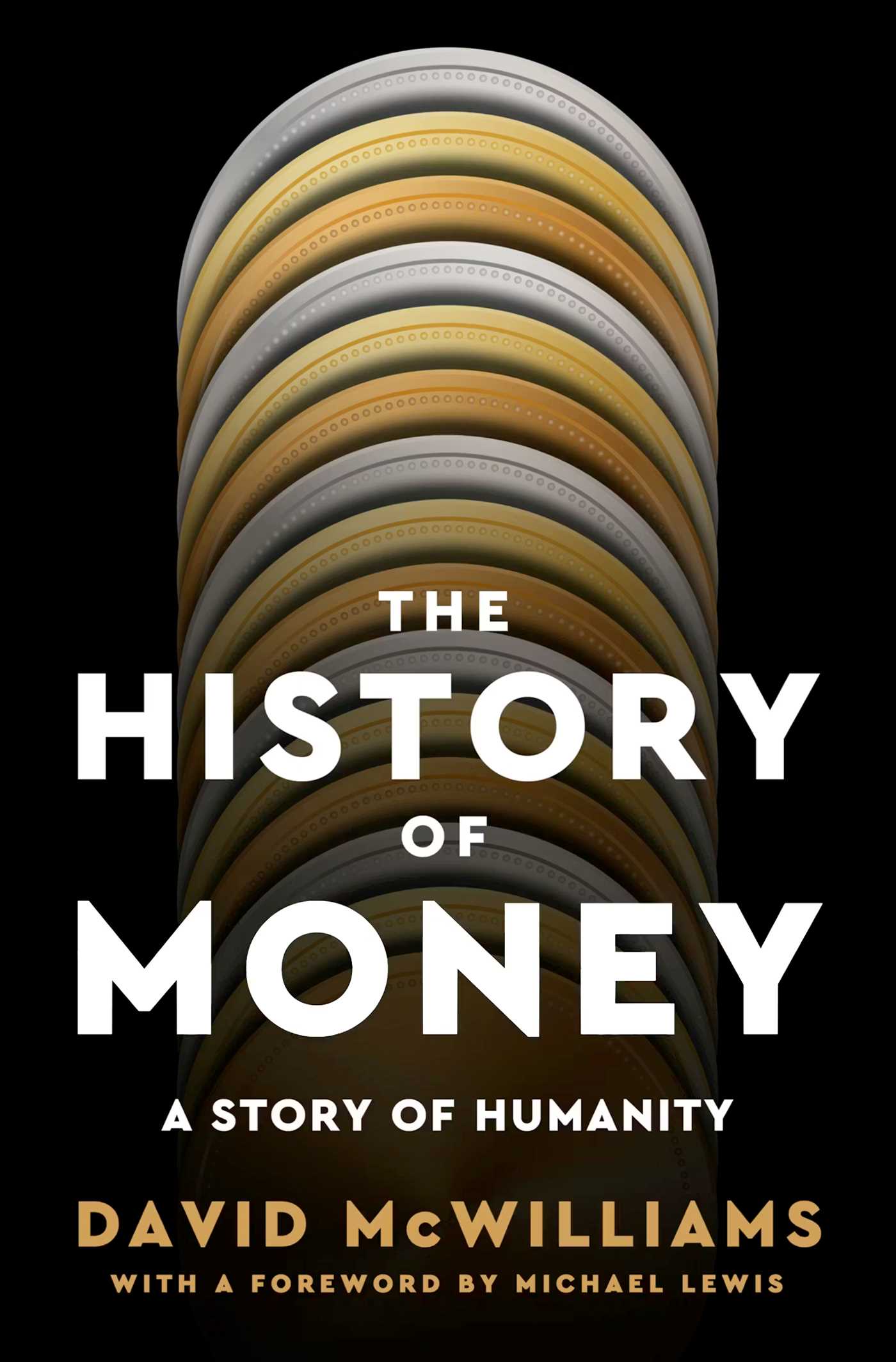
In this groundbreaking book, renowned global economist David McWilliams unlocks the mysteries and the awesome power of money: what it is, how it works, and why it matters.
The story of money is the story of our desires, our genius, and our downfalls. Money is power—and power beguiles. Nothing we’ve invented as a species has defined our own evolution so thoroughly and changed the direction of our planet’s history so dramatically. Money has shaped the very essence of what it means to be human. We can’t hope to understand ourselves without it. And yet despite money’s primacy, most of us don’t truly understand it. As economist David McWilliams states, money is everything. “Money defines the relationship between worker and employer, buyer and seller, merchant and producer. But not only that: it also defines the bond between the governed and the governor, the state and the citizen. Money unlocks pleasure, puts a price on desire, art and creativity. It motivates us to strive, achieve, invent and take risks. Money also brings out humanity’s darker side, invoking greed, envy, hatred, violence and, of course, colonialism.” Money isn’t just paper or coins or virtual currency. Money is humanity.
Leading economics expert, David McWilliams answers these questions and more in Money, an epic, breathlessly entertaining journey across the world through the present and the past, from the birthplace of money in ancient Babylon to the beginning of trade along the silk road to China, from Marrakech markets to Wall Street and the dawn of cryptocurrency. By tracking its history, McWilliams uncovers our relationship with money, transforming our perspective on its impact on the world right now. McWilliams is no dusty economist; he is a communicator at the highest level, a highly telegenic and marketable expert who is as comfortable in front of a large audience talking about his favourite subject as he is appearing on podcasts, social media, and even in stand-up comedy. He’s been called Ireland’s most important economist and is ranked among the leading economists working today.
The story of money is the story of earth’s most inventive, destructive, and dangerous animal: Homo sapiens. It is our story.
The story of money is the story of our desires, our genius, and our downfalls. Money is power—and power beguiles. Nothing we’ve invented as a species has defined our own evolution so thoroughly and changed the direction of our planet’s history so dramatically. Money has shaped the very essence of what it means to be human. We can’t hope to understand ourselves without it. And yet despite money’s primacy, most of us don’t truly understand it. As economist David McWilliams states, money is everything. “Money defines the relationship between worker and employer, buyer and seller, merchant and producer. But not only that: it also defines the bond between the governed and the governor, the state and the citizen. Money unlocks pleasure, puts a price on desire, art and creativity. It motivates us to strive, achieve, invent and take risks. Money also brings out humanity’s darker side, invoking greed, envy, hatred, violence and, of course, colonialism.” Money isn’t just paper or coins or virtual currency. Money is humanity.
Leading economics expert, David McWilliams answers these questions and more in Money, an epic, breathlessly entertaining journey across the world through the present and the past, from the birthplace of money in ancient Babylon to the beginning of trade along the silk road to China, from Marrakech markets to Wall Street and the dawn of cryptocurrency. By tracking its history, McWilliams uncovers our relationship with money, transforming our perspective on its impact on the world right now. McWilliams is no dusty economist; he is a communicator at the highest level, a highly telegenic and marketable expert who is as comfortable in front of a large audience talking about his favourite subject as he is appearing on podcasts, social media, and even in stand-up comedy. He’s been called Ireland’s most important economist and is ranked among the leading economists working today.
The story of money is the story of earth’s most inventive, destructive, and dangerous animal: Homo sapiens. It is our story.
Excerpt
Chapter 1: Money in the Beginning
In the Royal Belgian Institute of Natural Sciences in Brussels lies the Ishango Bone, which dates back to around 18,000 BCE. It was discovered on the banks of the Congo in 1950, roughly a century after European colonists first became excited about the commercial possibilities opened up by the then largely uncharted river. Running through Central Africa, the Congo River was and still is the life blood of the region. It has acted as a trading superhighway for millennia.
The Ishango Bone is a baboon’s femur with a series of notches cut into it. Archaeologists are divided over the artefact’s purpose, but it is speculated that each notch indicates an amount owed by someone to someone else and that together they signify a trade or a set of credits and debits. Indentations in the bone may have been indicators that the trades were paid and therefore cancelled or that they were outstanding.1 If the Ishango Bone was indeed a commercial tallystick, its notches also represent the first known example of value, a highly sophisticated concept. Valuing is an exercise in abstract thinking, not least because what I value and the price I am willing to pay for something might be completely different to what you value and what you would be willing to pay for the same item.
To get over this, could our African ancestors have developed a rudimentary form of trade for which they needed accounting? As the human story begins in Africa, it should not surprise us if the story of money begins there too. Amid the conjecture, what we do know is that these Africans were counting. The Ishango Bone is an extremely early recording technology, and if these ancestors were counting in order to trade, it was human beings who were likely to have been the base currency. Slavery was money’s original sin.
In the standard account of the history of our species, humans roamed, settled and roamed again, before settling down around 5000 BCE in small communities that would come to be largely organised around money. But the Ishango Bone theory of early commerce suggests that our African ancestors may have been thinking about money much earlier than that. The people who notched the Ishango Bone were hunter-gatherers on the cusp of a new world. Central to their old Stone Age society was the technology that scared Zeus: fire.
Archaeologists, anthropologists, biologists and ancient historians have emphasised how much of our domestication as a species was dependent on fire. James C. Scott, the American anthropologist, goes further, calling us a fire-adjusted or ‘pyrophyte’ species.2 Our bodies changed as we adjusted to fire, our environment was changed by fire, and the animals we hunted and lived with were also altered by fire. Although still nomadic, the range of our hunting and gathering became tighter as we used fire to ensure that more and more nutrients were available with ever less effort.3
Humans have been using fire for over 400,000 years. Fire allowed us to settle in various camps throughout the seasons. We might have an image of the hunter-gatherer roaming aimlessly, foraging randomly, with little control over their environment, entirely at the whim of nature. It’s more reasonable to think of the hunter-gatherers as having an organisational system – you could call it an early economy. Not an economy with currencies, taxes and the like, but an economy in the sense of a social structure, with hierarchies that the tribe understood.
In the economy of the nomads, most of the earth was covered in thick, almost impenetrable forest. By rearranging this landscape, they could make daily life easier. Those hunter-gatherers observed that natural wildfires cleared huge swathes of forest, revealing the hiding places and nests of animals they could eat. They’d have noticed how, after the burning, vegetation changed quickly with fast-growing grasses replacing the dense woodland.4
The evolutionary impact of fire is hard to overstate. Fire meant we could cook. Food is energy, and increasing the variety of food you can eat means more energy. Before fire, humans had subsisted on raw animal and vegetable matter. Fire gave us a diet that was much easier to digest: cooking does much of the chewing and digestion for us, delivering more calories with less effort. Cooking also took on a social dimension as eating around the hearth anchored the tribe. We can visualise our ancestors gathering around the fire, cooking, chewing, chatting, warming themselves, flirting, exchanging gossip, gazing at the stars, imagining the universe and telling stories.
It’s not hard to envision the people who made the cave paintings 17,000 years ago at Lascaux, in modern-day France – which depict horses, deer and other local wild animals – conceiving the images together round the fireside. Fire was a time-saving technology: it opened up space to involve ourselves in abstract notions such as painting, self-expression, imagination and art.
Around 12,000 to 9000 BCE, farming emerged in the Fertile Crescent, Central America and China.5 There is no evidence that these peoples learned from each other; each civilisation must have figured out farming in response to some greater elementary force. That greater force was global warming.
During the Ice Age, not only was the planet much colder, with ice sheets covering much of what we call the northern hemisphere today, but, crucially, it was much drier. In Ireland, we often associate the cold with the wet but if it is really cold, there is far less evaporation, fewer clouds and less rain. Our world in the Ice Age was cold and dry, meaning it was difficult for plants to grow. In this type of climate, farming isn’t an option: it’s too risky to depend on any one piece of land to produce the energy you need.
As the temperature rose and the ice caps melted, we experienced a sudden profusion of life. The world got warmer and wetter, and people started to live around places where they could make food grow most intensively. This didn’t happen overnight; it probably took thousands of years, with hunter-gatherers foraging and hunting, while doing a little side-hustle in farming. Part-time farming was likely the norm for millennia, until we got better at it. Remember, the name of the game is energy. How much energy can we derive from farming, how intensively can we cultivate this energy and how stable can we make this source of energy? Bit by bit, grains became a more stable source of energy.
Humans living in tiny villages, with hunter-gatherers still roaming around, looked for crops that would give nutritional value as well as being simple to grow, quick to harvest and easy to store. Grains did the trick. Grains grew easily, offered high yields, were cultivated quickly and could be harvested within months of being sown. Evolution had also been kind to them: they were self-pollinating. These attributes of grain were essential in persuading nomadic hunters to settle down. Given the increased fertility of the warmer planet in general, the emergence of farming, and the domestication of animals for easy protein, we would have expected the human population to have grown rapidly. But this did not happen.
The first few thousand years of settling down were an epidemiological holocaust for humanity. When we began to swap roaming for farming, animal diseases such as flu, measles, smallpox, typhus and plagues of all sorts ripped through the first farmers. Pathogens jumped from recently domesticated animals to hapless humans, whose immune system had never encountered these microscopic invaders. In the first few thousand years of domestication, from around 10,000 BCE to around 5000 BCE, the cow and the pig constituted as much of a threat to us as we did to them.
Demographers of the ancient world put the planet’s human population at around 4 million in 10,000 BCE. Five thousand years later, that population had only increased to 5 million, the growth slowed by devastating pandemics. The nomadic immune system, which the farmer inherited, was unprepared. It took many generations of evolution to build immunity.
By around 5000 BCE, evolution was doing its thing – passing on survival codes, allowing the immune system to identify invaders and the population to become more resistant to an increasing number of recognised pathogens. Around then, the human population appears to have taken off. By the time Jesus was kicking the moneylenders out of the temple, the population was roughly 100 million people, a twentyfold increase in only 5,000 years.
As we settled, our communities became larger and more complicated, yet some of our hunter-gatherer traits stayed with us. One such trait is what anthropologists call social capacity. British anthropologist Robin Dunbar, when trying to understand why various primates had differently sized brains, wondered whether the size of the primate’s social group correlated with its brain size.6 It turns out brain size does correlate with group size: the neocortex, the part of our brain that deals with complex thinking and reasoning, grows in primates relative to the number of fellow primates they are likely to live with. Brains evolve to handle the number of social contacts we are going to have. Humans, foraging for the vast majority of our existence in small bands of nomads, have brains that evolved to deal with small groups. The arrival of agriculture and domesticity meant that, quite suddenly in evolutionary terms, over only a few thousand years, we were living in much larger communities. The human brain needed tools – or technologies – to make sense of this new complexity.
We tend to think of technology in terms of physical technology, like a hammer or a car, but there are also social technologies. Social technologies help humans work more efficiently in large groups, and include language, law and religion. These social tools, which emerged with urbanisation, co-evolved, organising collective human energy around common goals governed by clear sets of rules. Money is also a social technology, a coping mechanism that humans invented to deal with this abrupt shift in the way we lived.
For the hunter-gatherers, nature’s challenges of food and shelter were the problems of small groups. The problems of domestication, on the other hand, were the problems of large groups, or what we might call organisational challenges. Health, wealth, distribution, dealing with strangers, trading with outsiders and coping with many people living cheek by jowl – these are complicated conundrums.
Once fuelled by grain, we were on a road that begins to look familiar to the modern observer. It isn’t an accident that human civilisations occurred within the latitudes suited to growing cereals, from the Fertile Crescent to the central Chinese plains to Meso-America. As the world’s population expanded from 5 million to 100 million in the last five millennia BCE, those places where populations grew most spectacularly required social technologies to cope. These are the places we see the first evidence of money, along with its close companions: writing and organised religion.
Grain had a number of characteristics that changed humans and human organisation profoundly. It could be grown, harvested and then stored, thus generating a surplus of energy that could be doled out over time. We reap what we sow. Crucially, with a grain surplus, the community could construct a system of value based around an easy-to-understand unit of measurement – a quantity of grain. A specific amount of grain corresponded to something else such as a day’s work for a labourer, establishing a relationship between the price of food and the price of everything else.
Early money was grain-based; grain gave money a universal value. In Sumer (in present-day south-central Iraq), for instance, one shekel was equivalent to a bushel of barley.7 The shekel could be counted and traded easily. The granary, one of the most important institutions in any ancient city, regulated the supply of grain and thereby the supply of money, much like a modern-day central bank. The more grain, the better the harvest, the more money in circulation. With a base money tied to, and given intrinsic value by, a commodity like grain, debits and credits, assets and debts – the rudiments of balance sheets – could easily be assessed. The grain economies created surpluses that could then be taxed by the state, siphoning off a cut for the rulers and their bureaucrats. The greater the grain surplus, the more productive a society’s agriculture, and the more complex the society. A society that can more than feed itself from its agricultural output becomes more sophisticated. It can sustain priests, soldiers, traders, merchants and scribes as well as the aristocracy, royal family and various other hangers-on.
Grain-based money propelled humankind from a world determined by the natural technology of fire towards one driven by a human technology, money. The Promethean baton was being passed. This would not happen overnight, but the direction of travel was mapped out.
1 MONEY IN THE BEGINNING
A Stone Age blockchain?
In the Royal Belgian Institute of Natural Sciences in Brussels lies the Ishango Bone, which dates back to around 18,000 BCE. It was discovered on the banks of the Congo in 1950, roughly a century after European colonists first became excited about the commercial possibilities opened up by the then largely uncharted river. Running through Central Africa, the Congo River was and still is the life blood of the region. It has acted as a trading superhighway for millennia.
The Ishango Bone is a baboon’s femur with a series of notches cut into it. Archaeologists are divided over the artefact’s purpose, but it is speculated that each notch indicates an amount owed by someone to someone else and that together they signify a trade or a set of credits and debits. Indentations in the bone may have been indicators that the trades were paid and therefore cancelled or that they were outstanding.1 If the Ishango Bone was indeed a commercial tallystick, its notches also represent the first known example of value, a highly sophisticated concept. Valuing is an exercise in abstract thinking, not least because what I value and the price I am willing to pay for something might be completely different to what you value and what you would be willing to pay for the same item.
To get over this, could our African ancestors have developed a rudimentary form of trade for which they needed accounting? As the human story begins in Africa, it should not surprise us if the story of money begins there too. Amid the conjecture, what we do know is that these Africans were counting. The Ishango Bone is an extremely early recording technology, and if these ancestors were counting in order to trade, it was human beings who were likely to have been the base currency. Slavery was money’s original sin.
In the standard account of the history of our species, humans roamed, settled and roamed again, before settling down around 5000 BCE in small communities that would come to be largely organised around money. But the Ishango Bone theory of early commerce suggests that our African ancestors may have been thinking about money much earlier than that. The people who notched the Ishango Bone were hunter-gatherers on the cusp of a new world. Central to their old Stone Age society was the technology that scared Zeus: fire.
Eve’s kitchen
Archaeologists, anthropologists, biologists and ancient historians have emphasised how much of our domestication as a species was dependent on fire. James C. Scott, the American anthropologist, goes further, calling us a fire-adjusted or ‘pyrophyte’ species.2 Our bodies changed as we adjusted to fire, our environment was changed by fire, and the animals we hunted and lived with were also altered by fire. Although still nomadic, the range of our hunting and gathering became tighter as we used fire to ensure that more and more nutrients were available with ever less effort.3
Humans have been using fire for over 400,000 years. Fire allowed us to settle in various camps throughout the seasons. We might have an image of the hunter-gatherer roaming aimlessly, foraging randomly, with little control over their environment, entirely at the whim of nature. It’s more reasonable to think of the hunter-gatherers as having an organisational system – you could call it an early economy. Not an economy with currencies, taxes and the like, but an economy in the sense of a social structure, with hierarchies that the tribe understood.
In the economy of the nomads, most of the earth was covered in thick, almost impenetrable forest. By rearranging this landscape, they could make daily life easier. Those hunter-gatherers observed that natural wildfires cleared huge swathes of forest, revealing the hiding places and nests of animals they could eat. They’d have noticed how, after the burning, vegetation changed quickly with fast-growing grasses replacing the dense woodland.4
The evolutionary impact of fire is hard to overstate. Fire meant we could cook. Food is energy, and increasing the variety of food you can eat means more energy. Before fire, humans had subsisted on raw animal and vegetable matter. Fire gave us a diet that was much easier to digest: cooking does much of the chewing and digestion for us, delivering more calories with less effort. Cooking also took on a social dimension as eating around the hearth anchored the tribe. We can visualise our ancestors gathering around the fire, cooking, chewing, chatting, warming themselves, flirting, exchanging gossip, gazing at the stars, imagining the universe and telling stories.
It’s not hard to envision the people who made the cave paintings 17,000 years ago at Lascaux, in modern-day France – which depict horses, deer and other local wild animals – conceiving the images together round the fireside. Fire was a time-saving technology: it opened up space to involve ourselves in abstract notions such as painting, self-expression, imagination and art.
Population explosion
Around 12,000 to 9000 BCE, farming emerged in the Fertile Crescent, Central America and China.5 There is no evidence that these peoples learned from each other; each civilisation must have figured out farming in response to some greater elementary force. That greater force was global warming.
During the Ice Age, not only was the planet much colder, with ice sheets covering much of what we call the northern hemisphere today, but, crucially, it was much drier. In Ireland, we often associate the cold with the wet but if it is really cold, there is far less evaporation, fewer clouds and less rain. Our world in the Ice Age was cold and dry, meaning it was difficult for plants to grow. In this type of climate, farming isn’t an option: it’s too risky to depend on any one piece of land to produce the energy you need.
As the temperature rose and the ice caps melted, we experienced a sudden profusion of life. The world got warmer and wetter, and people started to live around places where they could make food grow most intensively. This didn’t happen overnight; it probably took thousands of years, with hunter-gatherers foraging and hunting, while doing a little side-hustle in farming. Part-time farming was likely the norm for millennia, until we got better at it. Remember, the name of the game is energy. How much energy can we derive from farming, how intensively can we cultivate this energy and how stable can we make this source of energy? Bit by bit, grains became a more stable source of energy.
Humans living in tiny villages, with hunter-gatherers still roaming around, looked for crops that would give nutritional value as well as being simple to grow, quick to harvest and easy to store. Grains did the trick. Grains grew easily, offered high yields, were cultivated quickly and could be harvested within months of being sown. Evolution had also been kind to them: they were self-pollinating. These attributes of grain were essential in persuading nomadic hunters to settle down. Given the increased fertility of the warmer planet in general, the emergence of farming, and the domestication of animals for easy protein, we would have expected the human population to have grown rapidly. But this did not happen.
The first few thousand years of settling down were an epidemiological holocaust for humanity. When we began to swap roaming for farming, animal diseases such as flu, measles, smallpox, typhus and plagues of all sorts ripped through the first farmers. Pathogens jumped from recently domesticated animals to hapless humans, whose immune system had never encountered these microscopic invaders. In the first few thousand years of domestication, from around 10,000 BCE to around 5000 BCE, the cow and the pig constituted as much of a threat to us as we did to them.
Demographers of the ancient world put the planet’s human population at around 4 million in 10,000 BCE. Five thousand years later, that population had only increased to 5 million, the growth slowed by devastating pandemics. The nomadic immune system, which the farmer inherited, was unprepared. It took many generations of evolution to build immunity.
By around 5000 BCE, evolution was doing its thing – passing on survival codes, allowing the immune system to identify invaders and the population to become more resistant to an increasing number of recognised pathogens. Around then, the human population appears to have taken off. By the time Jesus was kicking the moneylenders out of the temple, the population was roughly 100 million people, a twentyfold increase in only 5,000 years.
Coping mechanisms
As we settled, our communities became larger and more complicated, yet some of our hunter-gatherer traits stayed with us. One such trait is what anthropologists call social capacity. British anthropologist Robin Dunbar, when trying to understand why various primates had differently sized brains, wondered whether the size of the primate’s social group correlated with its brain size.6 It turns out brain size does correlate with group size: the neocortex, the part of our brain that deals with complex thinking and reasoning, grows in primates relative to the number of fellow primates they are likely to live with. Brains evolve to handle the number of social contacts we are going to have. Humans, foraging for the vast majority of our existence in small bands of nomads, have brains that evolved to deal with small groups. The arrival of agriculture and domesticity meant that, quite suddenly in evolutionary terms, over only a few thousand years, we were living in much larger communities. The human brain needed tools – or technologies – to make sense of this new complexity.
We tend to think of technology in terms of physical technology, like a hammer or a car, but there are also social technologies. Social technologies help humans work more efficiently in large groups, and include language, law and religion. These social tools, which emerged with urbanisation, co-evolved, organising collective human energy around common goals governed by clear sets of rules. Money is also a social technology, a coping mechanism that humans invented to deal with this abrupt shift in the way we lived.
For the hunter-gatherers, nature’s challenges of food and shelter were the problems of small groups. The problems of domestication, on the other hand, were the problems of large groups, or what we might call organisational challenges. Health, wealth, distribution, dealing with strangers, trading with outsiders and coping with many people living cheek by jowl – these are complicated conundrums.
Once fuelled by grain, we were on a road that begins to look familiar to the modern observer. It isn’t an accident that human civilisations occurred within the latitudes suited to growing cereals, from the Fertile Crescent to the central Chinese plains to Meso-America. As the world’s population expanded from 5 million to 100 million in the last five millennia BCE, those places where populations grew most spectacularly required social technologies to cope. These are the places we see the first evidence of money, along with its close companions: writing and organised religion.
Grain had a number of characteristics that changed humans and human organisation profoundly. It could be grown, harvested and then stored, thus generating a surplus of energy that could be doled out over time. We reap what we sow. Crucially, with a grain surplus, the community could construct a system of value based around an easy-to-understand unit of measurement – a quantity of grain. A specific amount of grain corresponded to something else such as a day’s work for a labourer, establishing a relationship between the price of food and the price of everything else.
Early money was grain-based; grain gave money a universal value. In Sumer (in present-day south-central Iraq), for instance, one shekel was equivalent to a bushel of barley.7 The shekel could be counted and traded easily. The granary, one of the most important institutions in any ancient city, regulated the supply of grain and thereby the supply of money, much like a modern-day central bank. The more grain, the better the harvest, the more money in circulation. With a base money tied to, and given intrinsic value by, a commodity like grain, debits and credits, assets and debts – the rudiments of balance sheets – could easily be assessed. The grain economies created surpluses that could then be taxed by the state, siphoning off a cut for the rulers and their bureaucrats. The greater the grain surplus, the more productive a society’s agriculture, and the more complex the society. A society that can more than feed itself from its agricultural output becomes more sophisticated. It can sustain priests, soldiers, traders, merchants and scribes as well as the aristocracy, royal family and various other hangers-on.
Grain-based money propelled humankind from a world determined by the natural technology of fire towards one driven by a human technology, money. The Promethean baton was being passed. This would not happen overnight, but the direction of travel was mapped out.
Product Details
- Publisher: Simon & Schuster (November 10, 2026)
- Length: 416 pages
- ISBN13: 9781982152970
Browse Related Books
Raves and Reviews
“Religion, technology, power, and the rise and fall of entire empires are tied up with economics and commerce in McWilliams’ excellent whistle-stop tour of the way money has shaped world history. … McWilliams is a clever and irreverent guide with a knack for turning economic concepts into easy conversation.”
— Kirkus
“At a moment of political earthquake for the actual Emerald City of New York, when we’re all Venmoing and Zelleing and Apple-paying as though living in a video game, The History of Money just hits different. Like an arrow into the ticking heart of capitalism and its discontents.”
— The New York Times
“Religion, technology, power, and the rise and fall of entire empires are tied up with economics and commerce in McWilliams’ excellent whistle-stop tour of the way money has shaped world history. … McWilliams is a clever and irreverent guide with a knack for turning economic concepts into easy conversation.”
— Kirkus
“The author carries his readers from antiquity to medieval times to Renaissance Florence to the Age of Revolutions (American and French) to the 19th century and on to the present day and beyond. … For Mr. McWilliams, next to nothing is irrelevant to the story of man and money.”
— The Wall Street Journal
“McWilliams has a great knack for bringing a complex economics story to life. He is also funny. In economics, that’s a rare and persuasive combination.”
— The Irish Times
“A gifted and often courageous polemicist.”
— Irish Independent
Resources and Downloads
High Resolution Images
-
Book Cover Image (jpg): The History of Money
Trade Paperback 9781982152970