
Plus, receive recommendations and exclusive offers on all of your favorite books and authors from Simon & Schuster.
Table of Contents
About The Book
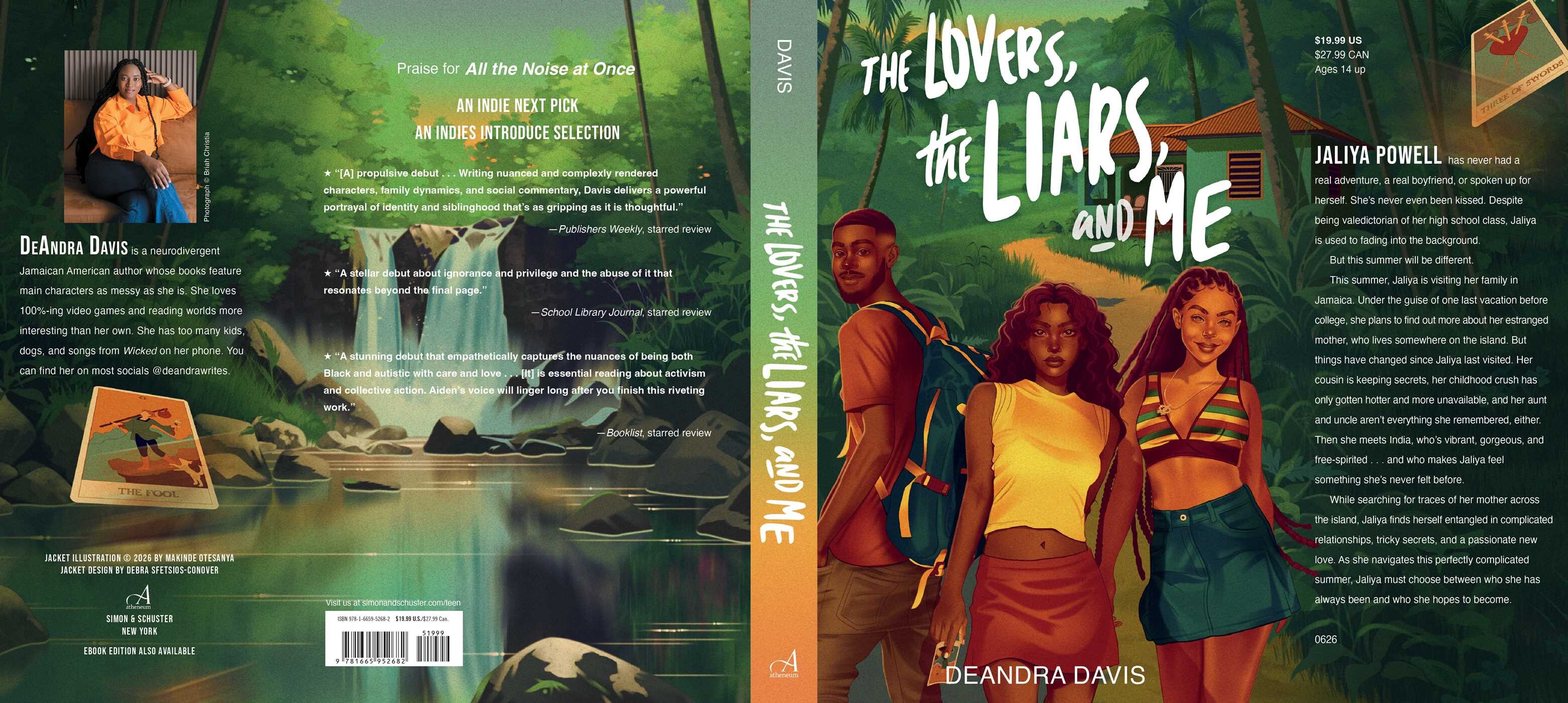
A teen travels to Jamaica hoping to answer questions about her absent mother, only to discover more about her identity than she could have ever expected—and find herself caught up in an unexpected love triangle—in this dazzling young adult coming-of-age novel by award-winning author DeAndra Davis.
Jaliya Powell has never had a real adventure, a real boyfriend, or spoken up for herself. She’s never even been kissed. Despite being valedictorian of her high school class, Jaliya is used to fading into the background.
But this summer will be different.
This summer, Jaliya is visiting her uncle and his family in Jamaica. Under the guise of one last vacation before college, she plans to find out more about her estranged mother, whose absence has remained an unspoken mystery. But things have changed in the seven years since Jaliya last visited. Her cousin has his own life and is reluctant to let Jaliya in, her childhood crush has only gotten hotter and more unavailable, and her aunt and uncle aren’t everything she remembered, either. Then she meets India, who’s vibrant, gorgeous, and free-spirited. And who makes Jaliya feel something she’s never felt before.
While searching for traces of her mother across the island, Jaliya finds herself entangled in complicated relationships, tricky secrets, and a passionate new love. As she navigates this perfectly complicated summer, Jaliya must choose between who she has always been or who she hopes to become.
Jaliya Powell has never had a real adventure, a real boyfriend, or spoken up for herself. She’s never even been kissed. Despite being valedictorian of her high school class, Jaliya is used to fading into the background.
But this summer will be different.
This summer, Jaliya is visiting her uncle and his family in Jamaica. Under the guise of one last vacation before college, she plans to find out more about her estranged mother, whose absence has remained an unspoken mystery. But things have changed in the seven years since Jaliya last visited. Her cousin has his own life and is reluctant to let Jaliya in, her childhood crush has only gotten hotter and more unavailable, and her aunt and uncle aren’t everything she remembered, either. Then she meets India, who’s vibrant, gorgeous, and free-spirited. And who makes Jaliya feel something she’s never felt before.
While searching for traces of her mother across the island, Jaliya finds herself entangled in complicated relationships, tricky secrets, and a passionate new love. As she navigates this perfectly complicated summer, Jaliya must choose between who she has always been or who she hopes to become.
Reading Group Guide
Get a FREE ebook by joining our mailing list today! Plus, receive recommendations for your next Book Club read.
By clicking 'Sign me up', I consent to Simon & Schuster sending me email offers and updates, including offers for a free eBook. I understand I can unsubscribe at any time. Any offer for an eBook may be subject to exclusions, terms, conditions, and registration with our fulfillment partners. We collect and use your information in accordance with our Privacy Policy. Free ebook offer available to NEW CA subscribers only. Offer redeemable at Simon & Schuster's ebook fulfillment partner. Must redeem within 90 days. See the full terms and conditions.
Reading Group Guide
The Lovers, the Liars, and Me
By DeAndra Davis
About the Book
Jaliya Powell has spent most of her life playing it safe. When her mother left years ago, Jaliya quietly folded that loss into herself and kept moving. She graduated high school with admission offers from some of the country’s best universities, but she chose a school close to home in Miami, reasoning that if she stumbled, she could always find her way back to her dad. She has one close friend, has never been in a relationship, and rarely speaks up for herself. In almost every way, Jaliya has built her life around staying small and staying close.
Then an anonymous letter arrives, and Jaliya becomes convinced it is from her mother. Without telling her father the real reason, she agrees to visit Jamaica for the first time in over seven years. What she finds when she gets there is complicated. Her uncle’s house feels different, the island feels different, and Jaliya feels like a stranger in a place that is supposed to be home. Her cousin Shevaughn is inexplicably cold, and Andre, her childhood crush, is somehow both reserved and flirty in ways that confuse her, especially given that he has a girlfriend. But she also finds Dion, a familiar face from childhood, and India, a new friend with a sharp mind and an open heart, who together pull Jaliya into the kind of summer she never planned for.
Over the course of that summer, Jaliya wrestles with complicated romantic feelings, long-buried family secrets, and questions of cultural belonging. Her search for her mother does not end the way she hoped, but it leads her toward the understanding that shrinking herself was never actually the safe choice, and that a full life requires showing up for it, even when things are hard.
Discussion Questions
1. The novel uses tarot card names to structure its chapters. What do the tarot cards’ traditional meanings reveal about the themes or turning points in the story? What effect does this framing device have on how you read Jaliya’s journey?
2. Jaliya struggles with thinking of herself as a tourist. It makes her feel like her claim to Jamaica is somehow less legitimate than her friends’. Her friend India pushes back, arguing that there is no single, correct way to be Jamaican. How do we decide we belong to a culture? Is it a birthplace, language, memory, family? Do you agree with India?
3. Passing a Starbucks on the way to her uncle’s house, Jaliya can’t quite name how she feels. There’s something unsettling about the intrusion of the familiar in a place that was supposed to feel like an escape from that world. What does this moment say about capitalism and Western expansion? Have you ever arrived somewhere meaningful and found it altered by outside forces in a way that complicated how you felt about it?
4. Jaliya moves fluidly between American English and patois, adjusting her register naturally depending on who she’s with. What does code-switching signal about power, belonging, and identity? What does it mean for Jaliya specifically, someone navigating multiple worlds at once?
5. Every time Jaliya feels anxious, she pulls at her fingers. Why do you think the author chose to make Jaliya’s inner life visible through this repeated physical detail? What does it add to our understanding of her?
6. Jaliya’s cousin Shevaughn tells her that being gay in Jamaica is treated as a stain on the family, connecting it to the country’s high density of churches. Jaliya sits with this and with her own privilege: as a bisexual woman, she can leave Jamaica and be fully herself in a way he cannot. What does this conversation emphasize about how location shapes queer experience? What does it mean that Jaliya and her cousin share an identity but face vastly different consequences for it?
7. India tells Jaliya that there are two different kinds of family: the one you’re born into, and the one you choose. What makes someone family? Is it obligation, love, history, or choice? Who has functioned as chosen family for Jaliya, and who has played that role in your own life?
8. Jaliya uses the phrase “blood is thicker than water,” meaning family loyalty comes first. India states that the original phrase means the opposite: the bonds we choose run deeper than the ones we’re born into. (Chapter 25) How does learning India’s interpretation change how you understand the phrase?
9. Jaliya spends much of the novel searching for the mother who left her. But the text quietly asks readers to notice that she has been mothered all along by her father, teachers, friends’ mothers, and her auntie Mary. Othermothering, rooted in Black feminist and womanist traditions, names this shared labor of nurturing that extends beyond biological motherhood. Who has mothered Jaliya across the novel? What is the novel ultimately saying about what motherhood is?
10. In the record shop, Jaliya pins her tarot cards among a wall of strangers’ Polaroids, pairing each card with the photo that seems to fit it. She reflects that her mother can live on there, and so can she. A palimpsest is a surface where old writing has been partially erased and written over, but traces of what came before remain visible. In what ways is this wall at the store a palimpsest? In what ways is Jaliya herself one?
11. Jaliya and her best friend, Ketta, are inseparable at the start of the novel. Jaliya leans on Ketta in ways that suggest she doesn’t yet fully trust herself. But once Jaliya arrives in Jamaica, Ketta largely disappears from the story. What do you make of this shift? Is it a sign of Jaliya’s growth, a failure of friendship, or both? Explain your reasoning.
12. In her author’s note, the author identifies how compounding factors of identity including nationality, ethnicity, gender, sexuality, and religion are central to the book. Choose two or three characters and trace how their overlapping identities shape what they’re able to do, say, or survive. Where do you see power shifting based on who someone is?
13. At one point, Jaliya recognizes that she has been measuring her own worth against the people around her, making everyone else the standard for whether she matters. Where does this habit come from for Jaliya? What would it take to stop? Have you ever found yourself doing something similar? If so, how do you break away from this behavior or thought process?
14. Jaliya describes her father as someone whose natural warmth and positivity sometimes clashes with where she is emotionally. There are moments when she wants to stay in her grief rather than be pulled out of it. Is it ever necessary to protect a painful feeling rather than let someone lift you out of it? How do we honor where we are emotionally when the people who love us want to pull us somewhere else?
15. Jaliya’s cousin Shevaughn tells her that it’s easier for girls to be gay because their sexuality is often fetishized and treated as spectacle, while boys face a different and often more dangerous kind of hatred. Is being fetishized a form of safety? What’s the difference between being tolerated and being accepted? Consider Jaliya’s and Shevaughn’s differing yet connected experiences. What does each one’s experience reveal about the other’s??
16. Throughout her time in Jamaica, Jaliya is repeatedly marked as an outsider. She is whispered about at church, overcharged at the post office, and told to step back at the market so her Americanness doesn’t cost her friends a fair price. What does the novel suggest about how Americans are seen when they return to countries their families came from? How is Jaliya’s experience of being othered different from the typical story about American travelers abroad?
17. Near a breakthrough in her search, Jaliya decides not to tell her uncle what she’s doing. She reflects that involving adults always seems to bring her sense of agency to a halt. When adults try to help, what can they unintentionally take away? Is there a meaningful difference between intervening and supporting?
18. India observes that churches are holy, but that they always feel a little haunted to her. What do you think she means? What does the novel show us about what the church gives its characters and what it has cost them?
19. When Jaliya’s uncle confronts her, her cousin doesn’t intervene. He explains later that defending her would have put him at risk. Jaliya faces her uncle alone and tells him directly that there is nothing wrong with her and that she accepts herself even if he cannot. What does it cost Shevaughn to stay silent, and was he right to? How do you read Jaliya’s speech to her uncle: as disrespect, as courage, or as both? Explain your reasoning.
20. Near the end of the novel, Jaliya arrives at the decision that she will not argue with people who are committed to misunderstanding her. What does it take to reach that place, to stop trying to explain yourself to people who have already decided who you are? How has Jaliya changed from the person we met at the beginning of the book?
Extension Activities
1. Before or after reading, have students research the history and symbolism behind the colors of the Jamaican flag. Ask them to consider how those symbols connect to the novel’s themes of identity, pride, and belonging, and to think about what it means that Jamaica’s flag contains none of the colors most commonly associated with national flags around the world (red, white, blue). This can open into a broader conversation about how nations construct and communicate identity through symbols, and what those symbols include or leave out.
2. Using a physical or digital map, trace all the places Jaliya visits: Montego Bay, Fern Gully, Kingston, Ocho Rios, and any others mentioned in the text. For each location, have students note what happened there and what it meant to Jaliya. Ask students to consider what the geography of the novel tells us about her journey.
3. The novel moves across generations of Jamaican music, from Beres Hammond, Garnett Silk, Bob Marley and the Wailers, Dennis Brown, Gregory Isaacs, and Half Pint to Dexta Daps, Jada Kingdom, Aidonia, Teejay, and Shenseea. Have students listen to at least one track from two different artists, one from an earlier era and one contemporary. Ask them to reflect on what they notice about how the music sounds, what it’s about, and what it evokes, and to consider what the author might be saying by letting these generations share the same space in the novel.
4. Marcus Garvey, born in Jamaica, became one of the most influential Black political thinkers of the twentieth century. Have students research his life and ideas, particularly Pan-Africanism and the concept of Black self-determination, and connect what they find to the novel’s themes of identity, pride, and belonging.
5. Othermothering, rooted in Black feminist and womanist traditions, names the shared labor of nurturing that extends beyond biological motherhood. After discussing the concept with students, ask them to create an othermother map in which they place themselves at the center and branch out to name the people who have nurtured or shaped them, noting one specific thing each person gave them. Leave space for reflection on who surprised them and what it feels like to see that network laid out.
6. In the record shop scene, Jaliya creates a kind of living archive by pairing her tarot cards with strangers’ photos and letting different stories speak to each other across time. Ask students to bring in five to eight images, whether photos, clippings, or drawings, that represent different moments or people that have shaped them. Have them arrange the images together and annotate each with a word, phrase, or line from a song, poem, or the novel, then share one pairing that surprised them in the process.
Guide written by Stephanie R. Toliver, an assistant professor of Literacy and Secondary Humanities at the University of Colorado, Boulder. Her scholarship centers the freedom dreams of Black youth and honors the historical legacy that Black imaginations have had and will have on activism and social change.
This guide has been provided by Simon & Schuster for classroom, library, and reading group use. It may be reproduced in its entirety or excerpted for these purposes. For more Simon & Schuster guides and classroom materials, please visit simonandschuster.net.
The Lovers, the Liars, and Me
By DeAndra Davis
About the Book
Jaliya Powell has spent most of her life playing it safe. When her mother left years ago, Jaliya quietly folded that loss into herself and kept moving. She graduated high school with admission offers from some of the country’s best universities, but she chose a school close to home in Miami, reasoning that if she stumbled, she could always find her way back to her dad. She has one close friend, has never been in a relationship, and rarely speaks up for herself. In almost every way, Jaliya has built her life around staying small and staying close.
Then an anonymous letter arrives, and Jaliya becomes convinced it is from her mother. Without telling her father the real reason, she agrees to visit Jamaica for the first time in over seven years. What she finds when she gets there is complicated. Her uncle’s house feels different, the island feels different, and Jaliya feels like a stranger in a place that is supposed to be home. Her cousin Shevaughn is inexplicably cold, and Andre, her childhood crush, is somehow both reserved and flirty in ways that confuse her, especially given that he has a girlfriend. But she also finds Dion, a familiar face from childhood, and India, a new friend with a sharp mind and an open heart, who together pull Jaliya into the kind of summer she never planned for.
Over the course of that summer, Jaliya wrestles with complicated romantic feelings, long-buried family secrets, and questions of cultural belonging. Her search for her mother does not end the way she hoped, but it leads her toward the understanding that shrinking herself was never actually the safe choice, and that a full life requires showing up for it, even when things are hard.
Discussion Questions
1. The novel uses tarot card names to structure its chapters. What do the tarot cards’ traditional meanings reveal about the themes or turning points in the story? What effect does this framing device have on how you read Jaliya’s journey?
2. Jaliya struggles with thinking of herself as a tourist. It makes her feel like her claim to Jamaica is somehow less legitimate than her friends’. Her friend India pushes back, arguing that there is no single, correct way to be Jamaican. How do we decide we belong to a culture? Is it a birthplace, language, memory, family? Do you agree with India?
3. Passing a Starbucks on the way to her uncle’s house, Jaliya can’t quite name how she feels. There’s something unsettling about the intrusion of the familiar in a place that was supposed to feel like an escape from that world. What does this moment say about capitalism and Western expansion? Have you ever arrived somewhere meaningful and found it altered by outside forces in a way that complicated how you felt about it?
4. Jaliya moves fluidly between American English and patois, adjusting her register naturally depending on who she’s with. What does code-switching signal about power, belonging, and identity? What does it mean for Jaliya specifically, someone navigating multiple worlds at once?
5. Every time Jaliya feels anxious, she pulls at her fingers. Why do you think the author chose to make Jaliya’s inner life visible through this repeated physical detail? What does it add to our understanding of her?
6. Jaliya’s cousin Shevaughn tells her that being gay in Jamaica is treated as a stain on the family, connecting it to the country’s high density of churches. Jaliya sits with this and with her own privilege: as a bisexual woman, she can leave Jamaica and be fully herself in a way he cannot. What does this conversation emphasize about how location shapes queer experience? What does it mean that Jaliya and her cousin share an identity but face vastly different consequences for it?
7. India tells Jaliya that there are two different kinds of family: the one you’re born into, and the one you choose. What makes someone family? Is it obligation, love, history, or choice? Who has functioned as chosen family for Jaliya, and who has played that role in your own life?
8. Jaliya uses the phrase “blood is thicker than water,” meaning family loyalty comes first. India states that the original phrase means the opposite: the bonds we choose run deeper than the ones we’re born into. (Chapter 25) How does learning India’s interpretation change how you understand the phrase?
9. Jaliya spends much of the novel searching for the mother who left her. But the text quietly asks readers to notice that she has been mothered all along by her father, teachers, friends’ mothers, and her auntie Mary. Othermothering, rooted in Black feminist and womanist traditions, names this shared labor of nurturing that extends beyond biological motherhood. Who has mothered Jaliya across the novel? What is the novel ultimately saying about what motherhood is?
10. In the record shop, Jaliya pins her tarot cards among a wall of strangers’ Polaroids, pairing each card with the photo that seems to fit it. She reflects that her mother can live on there, and so can she. A palimpsest is a surface where old writing has been partially erased and written over, but traces of what came before remain visible. In what ways is this wall at the store a palimpsest? In what ways is Jaliya herself one?
11. Jaliya and her best friend, Ketta, are inseparable at the start of the novel. Jaliya leans on Ketta in ways that suggest she doesn’t yet fully trust herself. But once Jaliya arrives in Jamaica, Ketta largely disappears from the story. What do you make of this shift? Is it a sign of Jaliya’s growth, a failure of friendship, or both? Explain your reasoning.
12. In her author’s note, the author identifies how compounding factors of identity including nationality, ethnicity, gender, sexuality, and religion are central to the book. Choose two or three characters and trace how their overlapping identities shape what they’re able to do, say, or survive. Where do you see power shifting based on who someone is?
13. At one point, Jaliya recognizes that she has been measuring her own worth against the people around her, making everyone else the standard for whether she matters. Where does this habit come from for Jaliya? What would it take to stop? Have you ever found yourself doing something similar? If so, how do you break away from this behavior or thought process?
14. Jaliya describes her father as someone whose natural warmth and positivity sometimes clashes with where she is emotionally. There are moments when she wants to stay in her grief rather than be pulled out of it. Is it ever necessary to protect a painful feeling rather than let someone lift you out of it? How do we honor where we are emotionally when the people who love us want to pull us somewhere else?
15. Jaliya’s cousin Shevaughn tells her that it’s easier for girls to be gay because their sexuality is often fetishized and treated as spectacle, while boys face a different and often more dangerous kind of hatred. Is being fetishized a form of safety? What’s the difference between being tolerated and being accepted? Consider Jaliya’s and Shevaughn’s differing yet connected experiences. What does each one’s experience reveal about the other’s??
16. Throughout her time in Jamaica, Jaliya is repeatedly marked as an outsider. She is whispered about at church, overcharged at the post office, and told to step back at the market so her Americanness doesn’t cost her friends a fair price. What does the novel suggest about how Americans are seen when they return to countries their families came from? How is Jaliya’s experience of being othered different from the typical story about American travelers abroad?
17. Near a breakthrough in her search, Jaliya decides not to tell her uncle what she’s doing. She reflects that involving adults always seems to bring her sense of agency to a halt. When adults try to help, what can they unintentionally take away? Is there a meaningful difference between intervening and supporting?
18. India observes that churches are holy, but that they always feel a little haunted to her. What do you think she means? What does the novel show us about what the church gives its characters and what it has cost them?
19. When Jaliya’s uncle confronts her, her cousin doesn’t intervene. He explains later that defending her would have put him at risk. Jaliya faces her uncle alone and tells him directly that there is nothing wrong with her and that she accepts herself even if he cannot. What does it cost Shevaughn to stay silent, and was he right to? How do you read Jaliya’s speech to her uncle: as disrespect, as courage, or as both? Explain your reasoning.
20. Near the end of the novel, Jaliya arrives at the decision that she will not argue with people who are committed to misunderstanding her. What does it take to reach that place, to stop trying to explain yourself to people who have already decided who you are? How has Jaliya changed from the person we met at the beginning of the book?
Extension Activities
1. Before or after reading, have students research the history and symbolism behind the colors of the Jamaican flag. Ask them to consider how those symbols connect to the novel’s themes of identity, pride, and belonging, and to think about what it means that Jamaica’s flag contains none of the colors most commonly associated with national flags around the world (red, white, blue). This can open into a broader conversation about how nations construct and communicate identity through symbols, and what those symbols include or leave out.
2. Using a physical or digital map, trace all the places Jaliya visits: Montego Bay, Fern Gully, Kingston, Ocho Rios, and any others mentioned in the text. For each location, have students note what happened there and what it meant to Jaliya. Ask students to consider what the geography of the novel tells us about her journey.
3. The novel moves across generations of Jamaican music, from Beres Hammond, Garnett Silk, Bob Marley and the Wailers, Dennis Brown, Gregory Isaacs, and Half Pint to Dexta Daps, Jada Kingdom, Aidonia, Teejay, and Shenseea. Have students listen to at least one track from two different artists, one from an earlier era and one contemporary. Ask them to reflect on what they notice about how the music sounds, what it’s about, and what it evokes, and to consider what the author might be saying by letting these generations share the same space in the novel.
4. Marcus Garvey, born in Jamaica, became one of the most influential Black political thinkers of the twentieth century. Have students research his life and ideas, particularly Pan-Africanism and the concept of Black self-determination, and connect what they find to the novel’s themes of identity, pride, and belonging.
5. Othermothering, rooted in Black feminist and womanist traditions, names the shared labor of nurturing that extends beyond biological motherhood. After discussing the concept with students, ask them to create an othermother map in which they place themselves at the center and branch out to name the people who have nurtured or shaped them, noting one specific thing each person gave them. Leave space for reflection on who surprised them and what it feels like to see that network laid out.
6. In the record shop scene, Jaliya creates a kind of living archive by pairing her tarot cards with strangers’ photos and letting different stories speak to each other across time. Ask students to bring in five to eight images, whether photos, clippings, or drawings, that represent different moments or people that have shaped them. Have them arrange the images together and annotate each with a word, phrase, or line from a song, poem, or the novel, then share one pairing that surprised them in the process.
Guide written by Stephanie R. Toliver, an assistant professor of Literacy and Secondary Humanities at the University of Colorado, Boulder. Her scholarship centers the freedom dreams of Black youth and honors the historical legacy that Black imaginations have had and will have on activism and social change.
This guide has been provided by Simon & Schuster for classroom, library, and reading group use. It may be reproduced in its entirety or excerpted for these purposes. For more Simon & Schuster guides and classroom materials, please visit simonandschuster.net.
About The Author
Photograph (c) Briah Christia
DeAndra Davis is New York–born and Florida-bred. She’s a hopeless musical theater nerd (Wicked is definitely her favorite), a perpetual student and teacher, and always trailed by a kid or a dog because she has way too many of both. She has an opinion for everything, an argument ready, and a hug for everyone, and she thinks you should, too. She is the author of All the Noise at Once, winner of the William C. Morris Award for best young adult debut book, and The Lovers, the Liars, and Me. DeAndra can be found on most socials @DeAndraWrites.
Product Details
- Publisher: Atheneum Books for Young Readers (June 23, 2026)
- Length: 416 pages
- ISBN13: 9781665952705
- Ages: 14 - 99
Browse Related Books
Raves and Reviews
"This lyrically written novel is centered around nuanced and deeply lovable characters, and Jaliya is a protagonist who readers will want to grow and change with as she figures out her own path. This story offers no simple answers about the gripping and complicated grief of estrangement, while handling the emotional experience of the characters with care. Fans of Elizabeth Acevedo and Ibi Zoboi will find a lot to love in this tender work, and it will likely become an important read for many teens."
– Booklist, starred review
"Part mystery, part love triangle, and a whole journey of self-discovery."
– Kirkus Reviews
"Rhythmic language renders Jaliya’s candid first-person narration as she perceptively confronts questions of sexuality and cultural identity. The evenly paced narrative provides ample room for readers to empathize and connect with the easy-to-root-for characters, making for a satisfying and introspective offering."
– Publishers Weekly
"Davis enchants in this coming-of-age novel about a teen girl discovering her roots and herself...A lovely coming-of-age novel of a teen who finds herself while looking for family that will resonate with fans of Ann Liang, Ebony LaDelle, and Lyla Lee."
– School Library Journal
Resources and Downloads
High Resolution Images
-
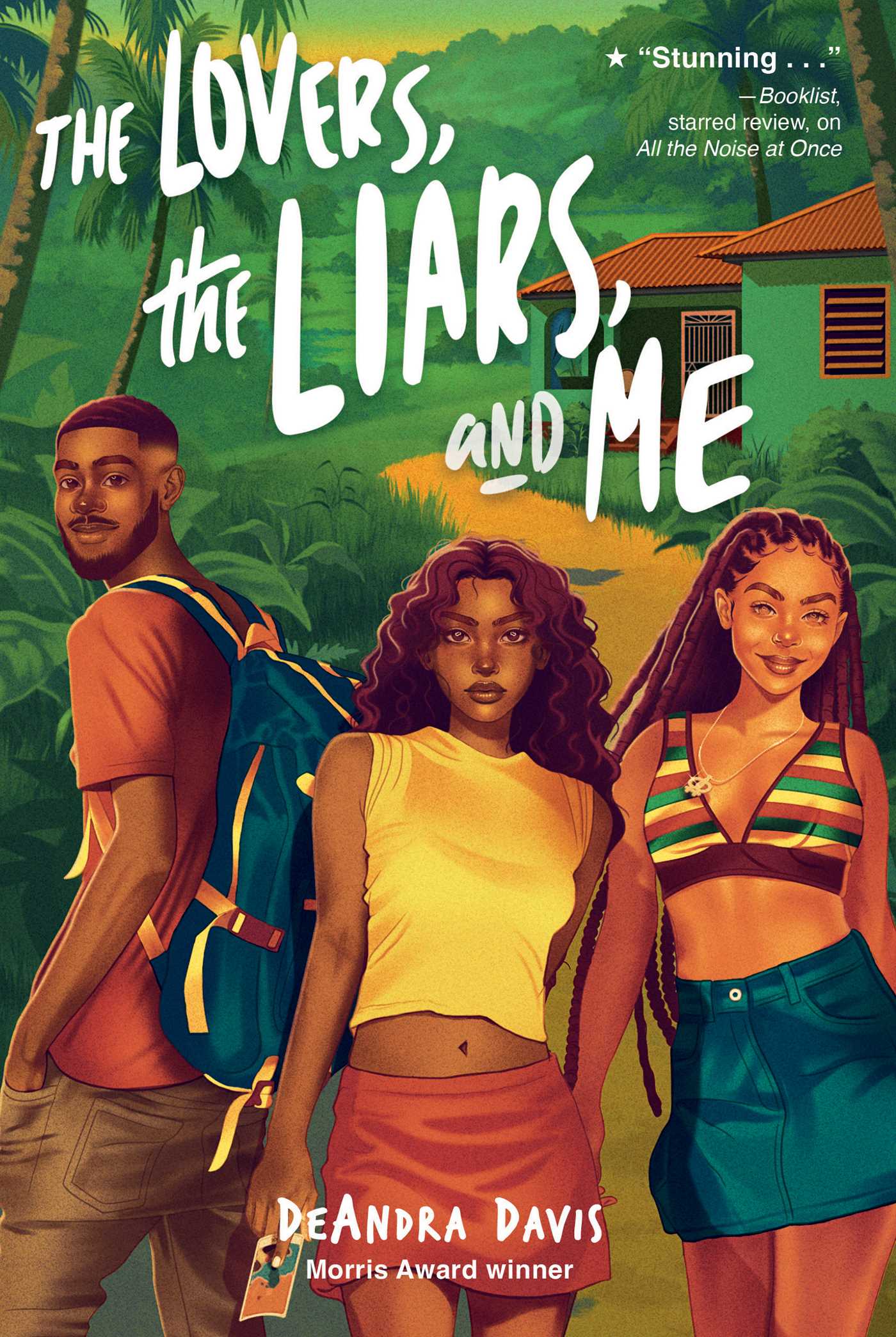
Book Cover Image (jpg): The Lovers, the Liars, and Me
eBook 9781665952705
-
Author Photo (jpg): DeAndra Davis Photograph (c) Briah Christia(0.1 MB)
Any use of an author photo must include its respective photo credit