
Plus, receive recommendations and exclusive offers on all of your favorite books and authors from Simon & Schuster.
0:00 /
Table of Contents
Listen To An Excerpt
0:00 /
About The Book
For fans of Laura Dave and Rebecca Makkai, a “gripping, engaging novel” (Vogue) that maps the extremes to which a family will go in order to protect their own.
No one appears more surprised than Hailey Gelman when she comes under suspicion for the murder of her soon-to-be ex-husband Jonah. Hailey—nicknamed Sunshine by her mother for her bright outlook and ever-present smile—has always tried to do what is expected of her and is regarded as the family peacemaker. But is anyone, including Hailey, who she has always seemed to be?
The months leading up to Jonah’s death have been fraught, including a bitter separation and a messy custody battle over their young daughter, Maya. When Hailey files a motion to relocate to Florida so she can be near her family, Jonah retaliates and the divorce begins to spiral dangerously out of control.
Sherry, Hailey’s mother, will stop at almost nothing to keep Jonah from getting what he wants. Nate, Hailey’s impetuous and protective older brother, has tried to keep his distance, but he can’t stand to see his little sister suffer. And then there’s Solomon, the patriarch, who is keeping a secret that threatens the stability and security Sherry has worked so hard to maintain. Soon, they are forced to reckon with who they are as individuals and as a family, and just how far they will go for each other.
Inspired by a true story, We Would Never is “an intellectual mystery—part whodunit, part whydunit, and heavy on the complexities of family dynamics, asking: How far would you go to protect those you love?” (The Boston Globe).
No one appears more surprised than Hailey Gelman when she comes under suspicion for the murder of her soon-to-be ex-husband Jonah. Hailey—nicknamed Sunshine by her mother for her bright outlook and ever-present smile—has always tried to do what is expected of her and is regarded as the family peacemaker. But is anyone, including Hailey, who she has always seemed to be?
The months leading up to Jonah’s death have been fraught, including a bitter separation and a messy custody battle over their young daughter, Maya. When Hailey files a motion to relocate to Florida so she can be near her family, Jonah retaliates and the divorce begins to spiral dangerously out of control.
Sherry, Hailey’s mother, will stop at almost nothing to keep Jonah from getting what he wants. Nate, Hailey’s impetuous and protective older brother, has tried to keep his distance, but he can’t stand to see his little sister suffer. And then there’s Solomon, the patriarch, who is keeping a secret that threatens the stability and security Sherry has worked so hard to maintain. Soon, they are forced to reckon with who they are as individuals and as a family, and just how far they will go for each other.
Inspired by a true story, We Would Never is “an intellectual mystery—part whodunit, part whydunit, and heavy on the complexities of family dynamics, asking: How far would you go to protect those you love?” (The Boston Globe).
Reading Group Guide
Get a FREE audiobook by joining our mailing list today! Plus, receive recommendations for your next Book Club read.
By clicking 'Sign me up', I consent to Simon & Schuster sending me email offers and updates, including offers for a free eBook. I understand I can unsubscribe at any time. Any offer for an eBook may be subject to exclusions, terms, conditions, and registration with our fulfillment partners. We collect and use your information in accordance with our Privacy Policy. Free ebook offer available to NEW CA subscribers only. Offer redeemable at Simon & Schuster's ebook fulfillment partner. Must redeem within 90 days. See the full terms and conditions.
Introduction
Hailey Gelman is known for her lovely disposition. Raised in sunny Palm Beach, she is a beacon of light to her brother, parents, and daughter. However, no one is more shocked than Hailey to learn she has been accused of murdering her soon-to-be-ex-husband Jonah. Jonah’s murder arrives on the heels of an acrimonious divorce and Hailey turns to her devoted family for help. Hailey soon comes to learn that while her closeknit, upstanding family might be her best defense, they—and their secrets—are also her most damning liability. Inspired by a true story, We Would Never explores extremes to which a family will go in order to protect their own.
Topics & Questions for Discussion
1. How does the first scene of the book, set in Maine in 2019, work as an effective frame for the story that follows?
2. Early in his career, Solomon has an academic discovery stolen from him. How does this intellectual theft inform his sense of justice?
3. What do you think of Sherry and Nate’s plan to initially pay off Jonah?
4. Discuss the moment on page 126 when Nate jokingly suggests murdering Jonah. How did you react to this suggestion initially? Does your reaction to this idea change over the course of the novel?
5. We learn why Adam decides he never wants to see his mother again (page 162). Do you think Adam’s anger toward Sherry is justified?
6. How do Sherry and Solomon approach parenting differently? Do you think one is more appropriate than the other?
7. Both Hailey and Sherry use exercise to cope with their anger. Do you ever use exercise to deal with your emotions?
8. How does Nate’s relationship with Tara affect his decision about how to deal with Jonah?
9. The concept of love is often used to justify characters actions. Are there limits to what you would do to protect the people you love?
10. Sherry becomes focused on getting Hailey to move to West Palm Beach. How much do you think this has to do with watching out for her daughter and how much is it about her own self-interest?
11. With Jonah out of the picture, the Marcuses’ were supposed to be closer than ever. How does this plan backfire?
12. Discuss the revelation at the end of the book. At any point did you suspect who was actually responsible for Jonah’s murder?
13. Why do you think Solomon decided to tell Adam the truth? Why do you think Adam told Hailey?
14. Where do you think the Marcus family goes from here?
Enhance Your Book Club
1. Research the psychology behind birth order. How do you think each sibling does or does not exhibit the characteristics associated with their birth order?
2. Hailey frequently mentions writing in her journal as a way to figure out her feelings. Do you keep a journal? How does writing help you sort through difficult problems in your life?
3. Research the Dan Markel case that inspired the novel. Discuss the ways in which the case is similar to the Marcus story and the ways in which it is different.
A Conversation with Tova Mirvis
When you began writing the book, did you know how it would end?
I didn’t! I assumed I would stick to what I thought had happened in the true-crime story that inspired the book. But a novel is different than a real story, with different demands, and as I began to depart from the true-crime story in various ways, my thoughts about the possibilities for the ending began to change too. I was very surprised by the ending—it wasn’t what I had envisioned at the outset (and I have to credit my husband for helping me think of the plot twist at the end!). Not knowing the ending can be a nerve-wracking way to write, but it injects an element of suspense into the writing process that creates momentum for the writer as well as for the reader. Once I worked out the ending, I spent a lot of time going back and laying the groundwork for it so that it felt like that was where we were going all along. I hope readers were as surprised by the ending as I was!
What was your writing process for this book? Did it differ at all from the process of writing your previous books?
In every book I’ve written, I always start with a burning question that I really want an answer to. In this book, I needed to understand how a seemingly ordinary family could so lose their moral compass as to be able to engineer a murder; I needed to understand how a divorce could escalate so badly that people were willing to kill a man. That question becomes my guide through the book—when I feel lost, I return in my mind to that original question. But overall, I have a very loose process. In the beginning I write any piece of a book I can come up with, scenes or descriptions or conversations, not necessarily in order. In the beginning, I let myself play and explore. I eventually make outlines and try to map things out but I have learned that I have to be willing to live with disorder for a very long time. And then, usually a few years into the process, I start to see the structure and the narrative arcs, and the novel comes into more of an ordered state. That’s my favorite part—when I can finally see its shape clearly but I am still creating and inventing. And I spend years revising, rethinking, undoing, redoing, pushing myself, listening to feedback. I have learned that you can take apart all the pieces of a book and it doesn’t fall apart—it makes a book richer and more layered in the end.
Is there one character you found the most interesting to write?
Nate came easiest to me—and I’m not really sure why, since I don’t think I am like him at all. But even early on, I could hear his voice in my head as I wrote and enjoyed exploring his conflicted sense of who he is. And I loved writing about Adam who has a quiet loneliness that intrigued me. And as a (relatively new) dog person, I liked exploring the sense of companionship he feels with the dogs that he didn’t feel with his own family. To write all the characters, I wrote page and pages of notes and description and really tried to feel them, deeply, viscerally. I wanted to live inside their heads and hearts. Even as they began plotting the murder, I still wanted to locate their humanity. I thought a lot about how we might all claim we would never do something, but I’m not sure we always know what we might be capable of, in situations we can’t yet imagine. Under what set of circumstances might someone commit an act they once believed was impossible? What combination of anger and loyalty and fear might enable someone to lose their moral compass? That doesn’t mean I excuse or condone the actions that my characters take but I wanted to understand.
Did you have to do any research for this book?
I did a very eclectic kind of research. I read a lot about the actual case that inspired the book, as well as other true crime cases, particularly spousal murders. (I printed out a lot of these news articles and sometimes they would accumulate on the family printer; when my kids went to print their homework, they would see all these articles about awful murders and say, “Oh, this must be Mom’s!”) I researched dermatology to create the office setting and learned about various skin diseases as well as cosmetic dermatology. I also spent a lot of time researching dogs—when I started writing, I didn’t have a dog and worried about how I could really write about dogs without having one. During the pandemic, my kids begged for a dog and we ended up getting one which enabled me to do a lot of hands-on research. Even then, I read a lot about dog training and spent a lot of time googling videos of dogs giving birth so I could describe that birth scene well.
Why do you think divorce is such a ripe ground for a good story?
Divorce is not fun to go through but it is definitely fertile ground for a novel. In a divorce, people can be at their worst. So much that feels certain about your life comes undone—it is so destabilizing and so unmooring to have to fight for what you believed was yours—not just money and physical objects but custody of children, relationships with friends. Even a sense of who you are and the story you tell about your life is suddenly up for grabs. In this vulnerable, volatile time, there is great possibility for emotional drama—we get to see who characters are in their most raw, unleashed state. And there is a great sense of disorder from which action and plot can spring. So much of writing fiction is about creating a sense of escalation and causation; in order to have plot and momentum, you need to push characters one step and then one step more. In a divorce, all of those elements are readily at play.
While the divorce between Hailey and Jonah is the driving relationship of the story, We Would Never is largely a story about a mother’s relationships with her children. What drew you to write about these particular relationships, and did your perception of a family evolve while writing these characters?
As I was writing, I felt that yes, this is a book about a murder but really, this is a book about a family and its complicated and evolving dynamics. From early on, I was very interested in the question of what a mother might do when she fears she is losing her children—how a mother who has put everything into raising her children might feel as they get older, and for a variety of reasons, begins to feel that they are slipping away. I thought a lot about the prospect of the empty nest, and how, for a character like Sherry who has tried so hard to cling to her children, this can feel enormously destabilizing. I think that on some level this is where the idea for the dog thread of the book came from—we talk about what animals will do to protect their young, but what will people do? What will a family do when it feels like one of their own is in danger? I was especially interested in the phrase “we would do anything for each other.” Is this a testament to familial love—or something darker? Is it possible to love your children too much? My own wrestling with these questions did evolve as I wrote the book—part of what I love about being a novelist is that you get to turn and turn a question to look at it from all sides, all perspectives. There is no one answer, no prescribed way to feel, and that opens up a lot of space to explore complicated, sometimes uncomfortable truths.
How does the setting—sunny, warm West Palm Beach—contrast the darkness of the story? What did you hope to explore with that juxtaposition?
The true crime story that inspired the book was set in Florida, and while I changed many things in writing the novel, Florida did not feel like a location I could give up. I live in the Boston area, but spend time in Florida because my husband works there several days a week. I have come to love the natural beauty of Florida, the tropical flowers always in bloom and the lush greenery which became important in creating the visual setting for the book. I loved writing the descriptions of Sherry’s swimming pool as her oasis and the garden that becomes overgrown as the events begin to escalate. I pictured the encroaching plants and vines as a way to think about family enmeshment and entrapment. I am fascinated by the way Florida holds two extremes—it is both so manicured and so wild all at once, filled with gorgeous gardens and alligator-infested swamps. It is so sunny yet so beset with terrifying storms. I felt like my characters veered between two extremes as well—on the one hand, a loving close-knit family and on the other hand, a family roiled by conflict and seemingly able to commit a murder.
Have you spent time in all the other locations you write about? Why did you decide to include them in your novel?
I chose rural Maine because it felt like an opposite to West Palm Beach. I haven’t spent that much time in Maine but have spent time in similar rural parts of New England that I drew upon in creating that setting, especially the physical landscape and the weather. I wanted to alternate between the stifling humidity of South Florida, with its swampy sense of entanglement, and the cold pristineness and quiet loneliness of Maine that Adam chooses as antidote to how he was raised.
New York City make a brief appearance in the novel, which is where I went to college and then lived for seven years after. Leaving New York City for the Boston suburbs was hard for me, and I gave some of those feelings to Hailey. As for Binghamton (where the murder takes place), there was an element of randomness in choosing that locale. A few years back, I was supposed to give a book talk at SUNY Binghamton. I was at the airport when I got a call saying that there had been a murder on campus and the event was canceled. Sometimes details lodge in your mind, and then, one day, they make their way onto the page.
As a writer, you’ve written across themes, topics, and genres. As a reader, what types of stories are you drawn to?
As different as each of my books are, there’s a thread that links them all and it’s the same thing that I’m interested in as a reader. I love writing and reading books that delve deep into people’s inner lives. I want to read and write books that go beyond the surface of what people say about themselves to all the messy, conflicted parts below. I love stories that deal in emotional complexity, that illuminate the bubbling stew of desire and shame and love and fear that makes us human, that take us beyond our own lives and deep into the messy experiences of others.
Hailey Gelman is known for her lovely disposition. Raised in sunny Palm Beach, she is a beacon of light to her brother, parents, and daughter. However, no one is more shocked than Hailey to learn she has been accused of murdering her soon-to-be-ex-husband Jonah. Jonah’s murder arrives on the heels of an acrimonious divorce and Hailey turns to her devoted family for help. Hailey soon comes to learn that while her closeknit, upstanding family might be her best defense, they—and their secrets—are also her most damning liability. Inspired by a true story, We Would Never explores extremes to which a family will go in order to protect their own.
Topics & Questions for Discussion
1. How does the first scene of the book, set in Maine in 2019, work as an effective frame for the story that follows?
2. Early in his career, Solomon has an academic discovery stolen from him. How does this intellectual theft inform his sense of justice?
3. What do you think of Sherry and Nate’s plan to initially pay off Jonah?
4. Discuss the moment on page 126 when Nate jokingly suggests murdering Jonah. How did you react to this suggestion initially? Does your reaction to this idea change over the course of the novel?
5. We learn why Adam decides he never wants to see his mother again (page 162). Do you think Adam’s anger toward Sherry is justified?
6. How do Sherry and Solomon approach parenting differently? Do you think one is more appropriate than the other?
7. Both Hailey and Sherry use exercise to cope with their anger. Do you ever use exercise to deal with your emotions?
8. How does Nate’s relationship with Tara affect his decision about how to deal with Jonah?
9. The concept of love is often used to justify characters actions. Are there limits to what you would do to protect the people you love?
10. Sherry becomes focused on getting Hailey to move to West Palm Beach. How much do you think this has to do with watching out for her daughter and how much is it about her own self-interest?
11. With Jonah out of the picture, the Marcuses’ were supposed to be closer than ever. How does this plan backfire?
12. Discuss the revelation at the end of the book. At any point did you suspect who was actually responsible for Jonah’s murder?
13. Why do you think Solomon decided to tell Adam the truth? Why do you think Adam told Hailey?
14. Where do you think the Marcus family goes from here?
Enhance Your Book Club
1. Research the psychology behind birth order. How do you think each sibling does or does not exhibit the characteristics associated with their birth order?
2. Hailey frequently mentions writing in her journal as a way to figure out her feelings. Do you keep a journal? How does writing help you sort through difficult problems in your life?
3. Research the Dan Markel case that inspired the novel. Discuss the ways in which the case is similar to the Marcus story and the ways in which it is different.
A Conversation with Tova Mirvis
When you began writing the book, did you know how it would end?
I didn’t! I assumed I would stick to what I thought had happened in the true-crime story that inspired the book. But a novel is different than a real story, with different demands, and as I began to depart from the true-crime story in various ways, my thoughts about the possibilities for the ending began to change too. I was very surprised by the ending—it wasn’t what I had envisioned at the outset (and I have to credit my husband for helping me think of the plot twist at the end!). Not knowing the ending can be a nerve-wracking way to write, but it injects an element of suspense into the writing process that creates momentum for the writer as well as for the reader. Once I worked out the ending, I spent a lot of time going back and laying the groundwork for it so that it felt like that was where we were going all along. I hope readers were as surprised by the ending as I was!
What was your writing process for this book? Did it differ at all from the process of writing your previous books?
In every book I’ve written, I always start with a burning question that I really want an answer to. In this book, I needed to understand how a seemingly ordinary family could so lose their moral compass as to be able to engineer a murder; I needed to understand how a divorce could escalate so badly that people were willing to kill a man. That question becomes my guide through the book—when I feel lost, I return in my mind to that original question. But overall, I have a very loose process. In the beginning I write any piece of a book I can come up with, scenes or descriptions or conversations, not necessarily in order. In the beginning, I let myself play and explore. I eventually make outlines and try to map things out but I have learned that I have to be willing to live with disorder for a very long time. And then, usually a few years into the process, I start to see the structure and the narrative arcs, and the novel comes into more of an ordered state. That’s my favorite part—when I can finally see its shape clearly but I am still creating and inventing. And I spend years revising, rethinking, undoing, redoing, pushing myself, listening to feedback. I have learned that you can take apart all the pieces of a book and it doesn’t fall apart—it makes a book richer and more layered in the end.
Is there one character you found the most interesting to write?
Nate came easiest to me—and I’m not really sure why, since I don’t think I am like him at all. But even early on, I could hear his voice in my head as I wrote and enjoyed exploring his conflicted sense of who he is. And I loved writing about Adam who has a quiet loneliness that intrigued me. And as a (relatively new) dog person, I liked exploring the sense of companionship he feels with the dogs that he didn’t feel with his own family. To write all the characters, I wrote page and pages of notes and description and really tried to feel them, deeply, viscerally. I wanted to live inside their heads and hearts. Even as they began plotting the murder, I still wanted to locate their humanity. I thought a lot about how we might all claim we would never do something, but I’m not sure we always know what we might be capable of, in situations we can’t yet imagine. Under what set of circumstances might someone commit an act they once believed was impossible? What combination of anger and loyalty and fear might enable someone to lose their moral compass? That doesn’t mean I excuse or condone the actions that my characters take but I wanted to understand.
Did you have to do any research for this book?
I did a very eclectic kind of research. I read a lot about the actual case that inspired the book, as well as other true crime cases, particularly spousal murders. (I printed out a lot of these news articles and sometimes they would accumulate on the family printer; when my kids went to print their homework, they would see all these articles about awful murders and say, “Oh, this must be Mom’s!”) I researched dermatology to create the office setting and learned about various skin diseases as well as cosmetic dermatology. I also spent a lot of time researching dogs—when I started writing, I didn’t have a dog and worried about how I could really write about dogs without having one. During the pandemic, my kids begged for a dog and we ended up getting one which enabled me to do a lot of hands-on research. Even then, I read a lot about dog training and spent a lot of time googling videos of dogs giving birth so I could describe that birth scene well.
Why do you think divorce is such a ripe ground for a good story?
Divorce is not fun to go through but it is definitely fertile ground for a novel. In a divorce, people can be at their worst. So much that feels certain about your life comes undone—it is so destabilizing and so unmooring to have to fight for what you believed was yours—not just money and physical objects but custody of children, relationships with friends. Even a sense of who you are and the story you tell about your life is suddenly up for grabs. In this vulnerable, volatile time, there is great possibility for emotional drama—we get to see who characters are in their most raw, unleashed state. And there is a great sense of disorder from which action and plot can spring. So much of writing fiction is about creating a sense of escalation and causation; in order to have plot and momentum, you need to push characters one step and then one step more. In a divorce, all of those elements are readily at play.
While the divorce between Hailey and Jonah is the driving relationship of the story, We Would Never is largely a story about a mother’s relationships with her children. What drew you to write about these particular relationships, and did your perception of a family evolve while writing these characters?
As I was writing, I felt that yes, this is a book about a murder but really, this is a book about a family and its complicated and evolving dynamics. From early on, I was very interested in the question of what a mother might do when she fears she is losing her children—how a mother who has put everything into raising her children might feel as they get older, and for a variety of reasons, begins to feel that they are slipping away. I thought a lot about the prospect of the empty nest, and how, for a character like Sherry who has tried so hard to cling to her children, this can feel enormously destabilizing. I think that on some level this is where the idea for the dog thread of the book came from—we talk about what animals will do to protect their young, but what will people do? What will a family do when it feels like one of their own is in danger? I was especially interested in the phrase “we would do anything for each other.” Is this a testament to familial love—or something darker? Is it possible to love your children too much? My own wrestling with these questions did evolve as I wrote the book—part of what I love about being a novelist is that you get to turn and turn a question to look at it from all sides, all perspectives. There is no one answer, no prescribed way to feel, and that opens up a lot of space to explore complicated, sometimes uncomfortable truths.
How does the setting—sunny, warm West Palm Beach—contrast the darkness of the story? What did you hope to explore with that juxtaposition?
The true crime story that inspired the book was set in Florida, and while I changed many things in writing the novel, Florida did not feel like a location I could give up. I live in the Boston area, but spend time in Florida because my husband works there several days a week. I have come to love the natural beauty of Florida, the tropical flowers always in bloom and the lush greenery which became important in creating the visual setting for the book. I loved writing the descriptions of Sherry’s swimming pool as her oasis and the garden that becomes overgrown as the events begin to escalate. I pictured the encroaching plants and vines as a way to think about family enmeshment and entrapment. I am fascinated by the way Florida holds two extremes—it is both so manicured and so wild all at once, filled with gorgeous gardens and alligator-infested swamps. It is so sunny yet so beset with terrifying storms. I felt like my characters veered between two extremes as well—on the one hand, a loving close-knit family and on the other hand, a family roiled by conflict and seemingly able to commit a murder.
Have you spent time in all the other locations you write about? Why did you decide to include them in your novel?
I chose rural Maine because it felt like an opposite to West Palm Beach. I haven’t spent that much time in Maine but have spent time in similar rural parts of New England that I drew upon in creating that setting, especially the physical landscape and the weather. I wanted to alternate between the stifling humidity of South Florida, with its swampy sense of entanglement, and the cold pristineness and quiet loneliness of Maine that Adam chooses as antidote to how he was raised.
New York City make a brief appearance in the novel, which is where I went to college and then lived for seven years after. Leaving New York City for the Boston suburbs was hard for me, and I gave some of those feelings to Hailey. As for Binghamton (where the murder takes place), there was an element of randomness in choosing that locale. A few years back, I was supposed to give a book talk at SUNY Binghamton. I was at the airport when I got a call saying that there had been a murder on campus and the event was canceled. Sometimes details lodge in your mind, and then, one day, they make their way onto the page.
As a writer, you’ve written across themes, topics, and genres. As a reader, what types of stories are you drawn to?
As different as each of my books are, there’s a thread that links them all and it’s the same thing that I’m interested in as a reader. I love writing and reading books that delve deep into people’s inner lives. I want to read and write books that go beyond the surface of what people say about themselves to all the messy, conflicted parts below. I love stories that deal in emotional complexity, that illuminate the bubbling stew of desire and shame and love and fear that makes us human, that take us beyond our own lives and deep into the messy experiences of others.
About The Author
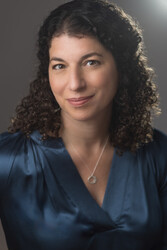
Photograph by Sharona Jacobs
Tova Mirvis is the author of the memoir The Book of Separation as well as four novels: We Would Never, Visible City, The Outside World, and The Ladies Auxiliary, which was a national bestseller. Her essays have appeared in numerous publications including The New York Times, The Boston Globe, and Real Simple, and her fiction has been broadcast on NPR. She lives in Newton, Massachusetts, with her family. You can connect with her on her website, TovaMirvis.com.
About The Reader
Product Details
- Publisher: Simon & Schuster Audio (February 11, 2025)
- Runtime: 11 hours and 38 minutes
- ISBN13: 9781668110393
Browse Related Books
Resources and Downloads
High Resolution Images
-
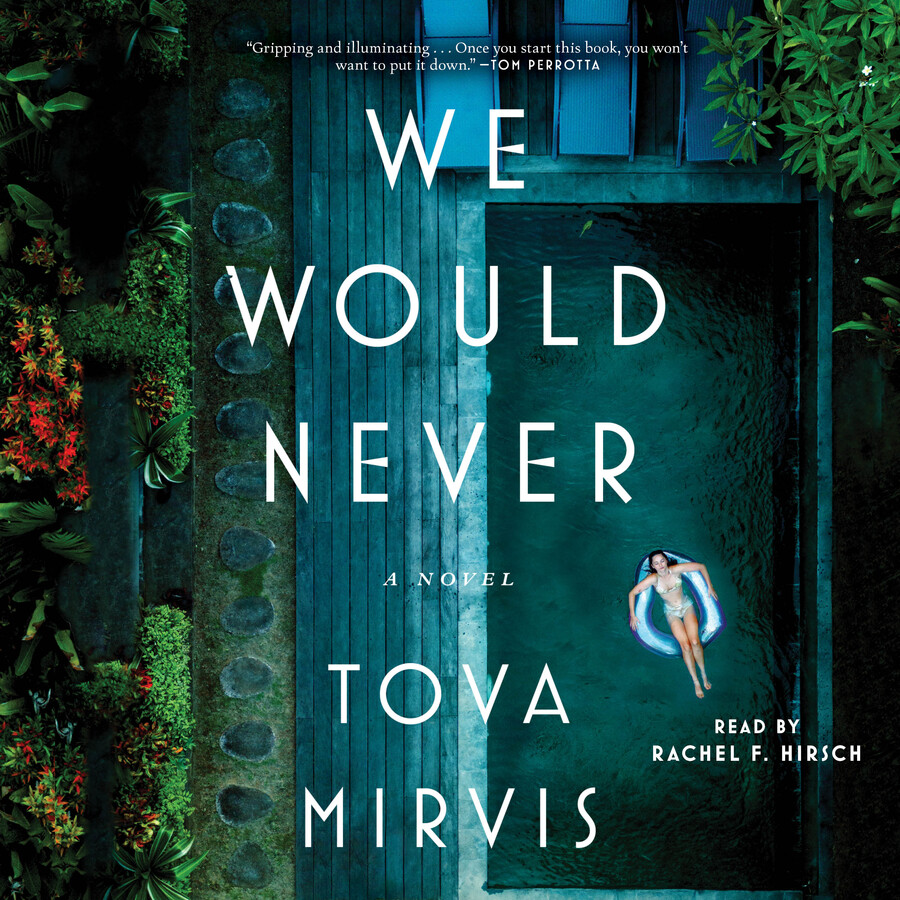
Book Cover Image (jpg): We Would Never
Unabridged Audio Download 9781668110393
-
Author Photo (jpg): Tova Mirvis Photograph by Sharona Jacobs(0.1 MB)
Any use of an author photo must include its respective photo credit