
Plus, receive recommendations and exclusive offers on all of your favorite books and authors from Simon & Schuster.
0:00 /
Table of Contents
About The Book
“Deliciously twisty….A heady mix of dark academia, spiraling stakes, and tangled loyalties.” —Ruth Ware, New York Times bestselling author
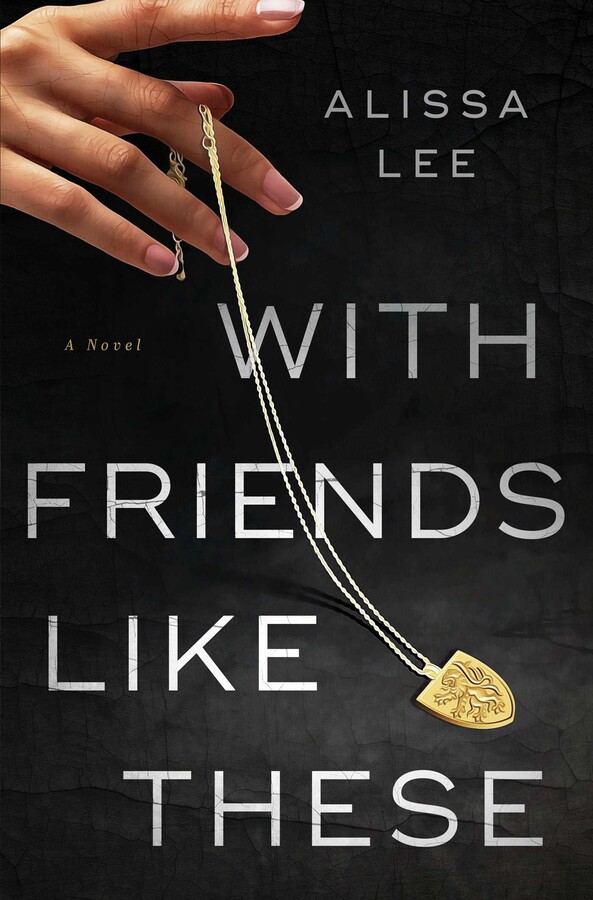
A group of Harvard alums have played a secret game for decades but as the stakes rise, deadly consequences emerge from old lies. An unputdownable debut thriller for readers of the suspenseful novels of Julia Bartz and Katy Hays.
Harvard promised them everything.
At eighteen years old, six young women had ambitious futures ahead: bright careers, love affairs, an education that would open doors for the rest of their lives. Sara’s college roommates were the family she never had: Bee the political hopeful, Dina the academic prodigy, Allie the family girl, Wesley the hard-partying heiress, and Claudine the Southern belle—the closest thing Sara had ever known to a sister. But their senior year, Claudine died, and everything changed.
Twenty years later, the five college roommates still indulge in a secret tradition they’ve kept alive since their campus days: the Circus, a harmless assassin-style game played across the private rooms and secret alleys of New York City. The game is the glue that keeps them close and a nod to the sixth roommate they lost too young, but this time around Sara keeps catching inexplicable glimpses of Claudine. She wants out of the Circus until she discovers a small fortune awaits the winner of this final round and agrees out of loyalty and desperation to play one last time. As the Circus unfolds, Sara suspects the others aren’t playing by the rules. When the game heats up and the roommates start pointing fingers, she discovers that even her closest friends have been keeping secrets that now threaten to destroy them all.
A group of Harvard alums have played a secret game for decades but as the stakes rise, deadly consequences emerge from old lies. An unputdownable debut thriller for readers of the suspenseful novels of Julia Bartz and Katy Hays.
Harvard promised them everything.
At eighteen years old, six young women had ambitious futures ahead: bright careers, love affairs, an education that would open doors for the rest of their lives. Sara’s college roommates were the family she never had: Bee the political hopeful, Dina the academic prodigy, Allie the family girl, Wesley the hard-partying heiress, and Claudine the Southern belle—the closest thing Sara had ever known to a sister. But their senior year, Claudine died, and everything changed.
Twenty years later, the five college roommates still indulge in a secret tradition they’ve kept alive since their campus days: the Circus, a harmless assassin-style game played across the private rooms and secret alleys of New York City. The game is the glue that keeps them close and a nod to the sixth roommate they lost too young, but this time around Sara keeps catching inexplicable glimpses of Claudine. She wants out of the Circus until she discovers a small fortune awaits the winner of this final round and agrees out of loyalty and desperation to play one last time. As the Circus unfolds, Sara suspects the others aren’t playing by the rules. When the game heats up and the roommates start pointing fingers, she discovers that even her closest friends have been keeping secrets that now threaten to destroy them all.
Excerpt
Chapter 1 1
NOTHING interesting ever happens in January, which is why January makes sense for killing. I can’t remember now who came up with that haunting sentiment—most likely it was Wesley, whom I can still picture teetering barefoot on the back of the threadbare sofa in our fifth-floor common room, practicing her Latin oration with such campy enthusiasm we would be rolling on the floor—but memory’s funny that way. The line between what’s real and what we want to be real becomes more porous with age. The truth is that any of us could’ve said it—that was how my college roommates Allie, Bee, Dina, Wesley, Claudine, and I saw the world back then, when January in Cambridge was cold and dead, two weeks of reading period and long days spent pretending not to care that our worth was so easily summed up in a handful of letter grades.
I always assumed the eccentric Harvard tradition we carried with us after graduation would peter out in the years that followed, a casualty of frenetic schedules, geography, or common sense. None of us imagined we’d drag it with us for two decades, across states and countries, through marriages, births, and deaths—especially when we grew into jobs, families, and reputations that couldn’t be put on hold for a game. But it makes a certain sense now. We made a pact on the eve of graduation to live unconditionally, and the Circus, as we affectionately called it, was how we made good on that promise. It made us feel powerful in ways our everyday lives didn’t. It was a secret that reminded us of who we were and the history we shared. And it was the tether that helped us find our way back to one another year after year, when the rough seas of circumstance might have otherwise scattered us apart.
In the three years since that last round of the Circus, I’ve come to view life as a series of tiny, seemingly unimportant decisions. The catch is that you never really know, even in hindsight, which ones matter in the end. Don’t get me wrong—I still beat myself up over the choices we made and rummage through memories of that time in a desperate search for a single fatal decision. On sunnier days, I think it could’ve been greed or just bad luck that sank us. But I suspect our fundamental misstep was simple: we were told at an early age we were special, and somewhere along the way we began to believe it.
The place to start, I suppose, is the night of Fabby’s gallery opening, which was the first indication that something was very wrong. It was a week before Christmas and I was intent on arriving early as a show of gratitude to Fabby, an older photographer who had been good to me. She had thrown me part-time work as one of her assistants and insisted I keep shooting, even though my photo series on women in invisible jobs was going nowhere. I was always grateful to have Coulter by my side at these arty parties, as he called them—he was a clever conversationalist, equally at ease with celebrities and art history students—but he still hadn’t come home and wasn’t answering my texts when we were due to leave. He was inundated at work after his front-of-house manager quit three weeks before; the stress had driven him to smoking again. But his prolonged funk was understandable, really. Neither of us imagined he would take over his family’s restaurant when his uncle passed or that his detour from travel writing would stretch into a six-year odyssey.
Thirty minutes later, I found myself clopping down Tenth Ave-nue in too-tall heels, a cold drizzle undoing my hasty blow-dry. I had just turned onto the side street where the gallery lived when I welled up with dread at the prospect of facing a den of art-world insiders alone.
Under the thin protection of a restaurant awning, I yanked off my gloves to text my college roommate Dina, imploring her to save me. She taught at Harvard four days a week and spent her weekends in Manhattan. I figured she would be riding the train back to the city after wrapping up her classes for the week, and the promise of free champagne wouldn’t hurt. I was about to slip my phone back in my hip pocket when a cab shot out of nowhere, honking obnoxiously at a man crossing diagonally up ahead.
That’s when I saw her.
A woman stood beneath the steel-pipe scaffolding across the street. Her figure was slight, her gray belted coat almost baggy. Blond hair tumbled past her shoulders. I sensed a skittishness—like a doe that would dart away the second I moved—but there was something familiar in the way she was standing. The hand in her pocket, the sharp bend at her elbow, the dropped hip. She was staring at me like she knew me.
I stood perfectly still. As a photographer in a city where the wildlife is temperamental, I had my phone ready, but I managed only one shot before she bolted toward Tenth, leaving me dumbfounded on the sidewalk.
When my fog dissipated, I zoomed in on the hazy image.
It was Claudine, the roommate who shattered our lives all those years ago.
The light in her eyes was undimmed by the years that had faded the rest of us. Incredibly, she looked the same as she had the day I first met her in the freshman dining hall. Tiny—barely size two, which made her easy to underestimate—but one of the most remarkable people I’d ever known. A free spirit, an artist, and a romantic for whom ancient Greek legends were as real as whatever was on the news that day. The perfect foil for the rest of us, who were too concerned with where we were headed and how fast we could get there. How many times would we be walking somewhere, only to discover Claudine had disappeared? We’d turn back to find her crouching down, entranced by a daffodil or a chubby-cheeked squirrel, or craning up to take in a night sky crammed with stars, and all we could do was stop and marvel beside her.
She still haunted my dreams, a queen parading around the Winthrop House courtyard on the shoulders of two senior boys, her flaxen hair glinting in the winter sun and her face lit up with a beatific smile.
I should’ve been thrilled to see her, but the sight of Claudine that night on the street was both electrifying and unnerving. My imagination had to be acting up; the stress of my uncertain livelihood and the strain of a mortgage Coulter and I could barely cover were catching up with me. Or perhaps it was the guilt that still plagued me over what happened all those years ago.
I remember thinking of the Fitzgerald quote Dina liked to throw around: the test of intelligence is the ability to hold two opposing ideas in your head and still function, or something like that, but the thought only added to my alarm. The woman I had seen was my college roommate Claudine. I was sure of it. And yet that was impossible because I also knew with absolute certainty—for I was with her on that terrible day twenty-three years ago—that Claudine was dead.
NOTHING interesting ever happens in January, which is why January makes sense for killing. I can’t remember now who came up with that haunting sentiment—most likely it was Wesley, whom I can still picture teetering barefoot on the back of the threadbare sofa in our fifth-floor common room, practicing her Latin oration with such campy enthusiasm we would be rolling on the floor—but memory’s funny that way. The line between what’s real and what we want to be real becomes more porous with age. The truth is that any of us could’ve said it—that was how my college roommates Allie, Bee, Dina, Wesley, Claudine, and I saw the world back then, when January in Cambridge was cold and dead, two weeks of reading period and long days spent pretending not to care that our worth was so easily summed up in a handful of letter grades.
I always assumed the eccentric Harvard tradition we carried with us after graduation would peter out in the years that followed, a casualty of frenetic schedules, geography, or common sense. None of us imagined we’d drag it with us for two decades, across states and countries, through marriages, births, and deaths—especially when we grew into jobs, families, and reputations that couldn’t be put on hold for a game. But it makes a certain sense now. We made a pact on the eve of graduation to live unconditionally, and the Circus, as we affectionately called it, was how we made good on that promise. It made us feel powerful in ways our everyday lives didn’t. It was a secret that reminded us of who we were and the history we shared. And it was the tether that helped us find our way back to one another year after year, when the rough seas of circumstance might have otherwise scattered us apart.
In the three years since that last round of the Circus, I’ve come to view life as a series of tiny, seemingly unimportant decisions. The catch is that you never really know, even in hindsight, which ones matter in the end. Don’t get me wrong—I still beat myself up over the choices we made and rummage through memories of that time in a desperate search for a single fatal decision. On sunnier days, I think it could’ve been greed or just bad luck that sank us. But I suspect our fundamental misstep was simple: we were told at an early age we were special, and somewhere along the way we began to believe it.
The place to start, I suppose, is the night of Fabby’s gallery opening, which was the first indication that something was very wrong. It was a week before Christmas and I was intent on arriving early as a show of gratitude to Fabby, an older photographer who had been good to me. She had thrown me part-time work as one of her assistants and insisted I keep shooting, even though my photo series on women in invisible jobs was going nowhere. I was always grateful to have Coulter by my side at these arty parties, as he called them—he was a clever conversationalist, equally at ease with celebrities and art history students—but he still hadn’t come home and wasn’t answering my texts when we were due to leave. He was inundated at work after his front-of-house manager quit three weeks before; the stress had driven him to smoking again. But his prolonged funk was understandable, really. Neither of us imagined he would take over his family’s restaurant when his uncle passed or that his detour from travel writing would stretch into a six-year odyssey.
Thirty minutes later, I found myself clopping down Tenth Ave-nue in too-tall heels, a cold drizzle undoing my hasty blow-dry. I had just turned onto the side street where the gallery lived when I welled up with dread at the prospect of facing a den of art-world insiders alone.
Under the thin protection of a restaurant awning, I yanked off my gloves to text my college roommate Dina, imploring her to save me. She taught at Harvard four days a week and spent her weekends in Manhattan. I figured she would be riding the train back to the city after wrapping up her classes for the week, and the promise of free champagne wouldn’t hurt. I was about to slip my phone back in my hip pocket when a cab shot out of nowhere, honking obnoxiously at a man crossing diagonally up ahead.
That’s when I saw her.
A woman stood beneath the steel-pipe scaffolding across the street. Her figure was slight, her gray belted coat almost baggy. Blond hair tumbled past her shoulders. I sensed a skittishness—like a doe that would dart away the second I moved—but there was something familiar in the way she was standing. The hand in her pocket, the sharp bend at her elbow, the dropped hip. She was staring at me like she knew me.
I stood perfectly still. As a photographer in a city where the wildlife is temperamental, I had my phone ready, but I managed only one shot before she bolted toward Tenth, leaving me dumbfounded on the sidewalk.
When my fog dissipated, I zoomed in on the hazy image.
It was Claudine, the roommate who shattered our lives all those years ago.
The light in her eyes was undimmed by the years that had faded the rest of us. Incredibly, she looked the same as she had the day I first met her in the freshman dining hall. Tiny—barely size two, which made her easy to underestimate—but one of the most remarkable people I’d ever known. A free spirit, an artist, and a romantic for whom ancient Greek legends were as real as whatever was on the news that day. The perfect foil for the rest of us, who were too concerned with where we were headed and how fast we could get there. How many times would we be walking somewhere, only to discover Claudine had disappeared? We’d turn back to find her crouching down, entranced by a daffodil or a chubby-cheeked squirrel, or craning up to take in a night sky crammed with stars, and all we could do was stop and marvel beside her.
She still haunted my dreams, a queen parading around the Winthrop House courtyard on the shoulders of two senior boys, her flaxen hair glinting in the winter sun and her face lit up with a beatific smile.
I should’ve been thrilled to see her, but the sight of Claudine that night on the street was both electrifying and unnerving. My imagination had to be acting up; the stress of my uncertain livelihood and the strain of a mortgage Coulter and I could barely cover were catching up with me. Or perhaps it was the guilt that still plagued me over what happened all those years ago.
I remember thinking of the Fitzgerald quote Dina liked to throw around: the test of intelligence is the ability to hold two opposing ideas in your head and still function, or something like that, but the thought only added to my alarm. The woman I had seen was my college roommate Claudine. I was sure of it. And yet that was impossible because I also knew with absolute certainty—for I was with her on that terrible day twenty-three years ago—that Claudine was dead.
About The Author
Wendy Yalom
Alissa Lee is a writer and former tech lawyer. A graduate of Harvard College and Harvard Law School, she’s fiercely proud of her New Jersey roots, but now lives in the San Francisco Bay area with her family. She does her best work in local libraries and is a longtime board member of the San Francisco Public Library.
Product Details
- Publisher: Atria/Emily Bestler Books (November 4, 2025)
- Length: 240 pages
- ISBN13: 9781668094006
Browse Related Books
Raves and Reviews
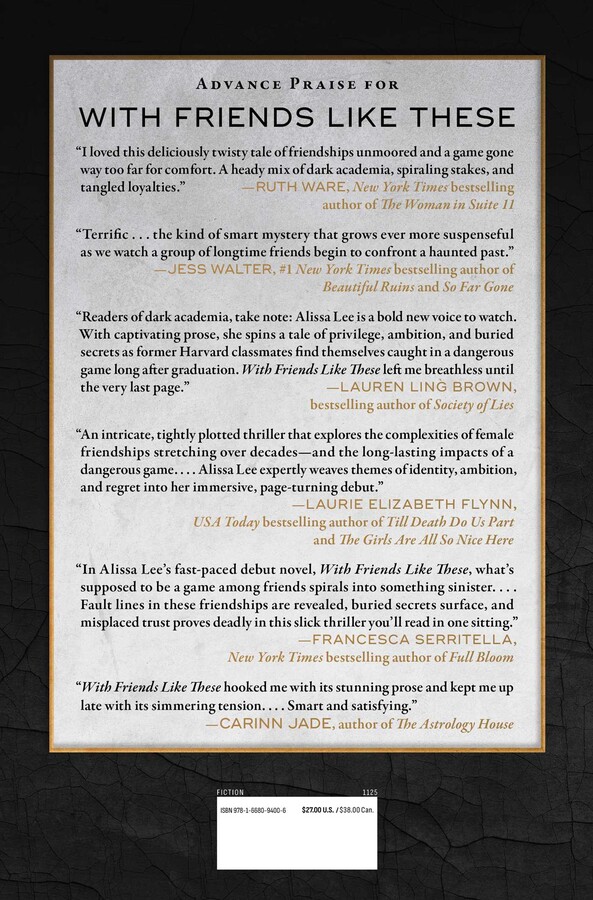
"I loved this deliciously twisty tale of friendships unmoored and a game gone way too far for comfort. A heady mix of dark academia, spiraling stakes, and tangled loyalties."
– Ruth Ware, New York Times bestselling author of THE WOMAN IN SUITE 11
"A terrific debut, the kind of smart mystery that grows ever more suspenseful as we watch a group of longtime friends begin to confront a haunted past."
– Jess Walter, #1 New York Times bestselling author of BEAUTIFUL RUINS and SO FAR GONE
"Readers of Dark Academia, take note: Alissa Lee is a bold new voice to watch. With captivating prose, she spins a tale of privilege, ambition, and buried secrets as former Harvard classmates find themselves caught in a dangerous game long after graduation. WITH FRIENDS LIKE THESE left me breathless until the very last page."
– Lauren Ling Brown, bestselling author of SOCIETY OF LIES
"An intricate, tightly plotted thriller that explores the complexities of female friendships stretching over decades—and the long-lasting impacts of a dangerous game. WITH FRIENDS LIKE THESE will enthrall fans of Dark Academia, but at its heart are the relationships that shapeshift with tragedy, time, and distance. Alissa Lee expertly weaves themes of identity, ambition, and regret into her immersive, page-turning debut."
– Laurie Elizabeth Flynn, USA Today bestselling author of TILL DEATH DO US PART and THE GIRLS ARE ALL SO NICE HERE
“In Alissa Lee’s fast-paced debut novel, WITH FRIENDS LIKE THESE, what’s supposed to be a game among friends spirals into something sinister when the stakes are raised by a million-dollar prize pot. Fault lines in these friendships are revealed, buried secrets surface, and misplaced trust proves deadly in this slick thriller you’ll read in one sitting.”
– Francesca Serritella, New York Times bestselling author of FULL BLOOM
"WITH FRIENDS LIKE THESE hooked me with its stunning prose and kept me up late with its simmering tension. . . . Smart and satisfying, I flew through this debut and can't wait to read more from this breakout author!"
– Carinn Jade, author of THE ASTROLOGY HOUSE
"Fast paced and tightly plotted, Lee’s novel explores the complexities of female friendships against a quietly unsettling backdrop of privilege and ambition. An immersive novel that delivers suspense with style and intelligence."
– Kirkus Reviews
"Readers will be clawing their way through this story to find out who is doing the blackmail and how it all ties together. Mystery is abundant and the characters’ paranoia will leak into readers’ psyches."
– Library Journal
"In this inventively plotted debut thriller, Harvard friends haunted by the death of a roommate turn their secret game into a tradition extending well (and worrisomely) beyond graduation."
– Shelf Awareness, "Best Books This Week"
"A suspenseful, twisty, fun novel that’s a circus—somewhat literally. 'Circus' is what Lee’s assortment of characters call their longtime elimination-style “killing” game, and it looks like it’s leading to real murder. . . . Read it with the lights on."
– Local News Matters Bay Area, "Must Read Book Roundup"
Resources and Downloads
High Resolution Images
-
Book Cover Image (jpg): With Friends Like These
Hardcover 9781668094006
-
Author Photo (jpg): Alissa Lee Wendy Yalom(0.1 MB)
Any use of an author photo must include its respective photo credit