

Plus, receive recommendations and exclusive offers on all of your favorite books and authors from Simon & Schuster.
0:00 /
Table of Contents
About The Book
From the New York Times bestselling author of House of Eve—a 2023 Reese’s Book Club Pick!
*A Best Book of the Year by NPR and Christian Science Monitor*
Called “wholly engrossing” by New York Times bestselling author Kathleen Grissom, this “fully immersive” (Lisa Wingate, #1 bestselling author of Before We Were Yours) story follows an enslaved woman forced to barter love and freedom while living in the most infamous slave jail in Virginia.
Born on a plantation in Charles City, Virginia, Pheby Delores Brown has lived a relatively sheltered life. Shielded by her mother’s position as the estate’s medicine woman and cherished by the Master’s sister, she is set apart from the others on the plantation, belonging to neither world.
She’d been promised freedom on her eighteenth birthday, but instead of the idyllic life she imagined with her true love, Essex Henry, Pheby is forced to leave the only home she has ever known. She unexpectedly finds herself thrust into the bowels of slavery at the infamous Devil’s Half Acre, a jail in Richmond, Virginia, where the enslaved are broken, tortured, and sold every day. There, Pheby is exposed not just to her Jailer’s cruelty but also to his contradictions. To survive, Pheby will have to outwit him, and she soon faces the ultimate sacrifice.
*A Best Book of the Year by NPR and Christian Science Monitor*
Called “wholly engrossing” by New York Times bestselling author Kathleen Grissom, this “fully immersive” (Lisa Wingate, #1 bestselling author of Before We Were Yours) story follows an enslaved woman forced to barter love and freedom while living in the most infamous slave jail in Virginia.
Born on a plantation in Charles City, Virginia, Pheby Delores Brown has lived a relatively sheltered life. Shielded by her mother’s position as the estate’s medicine woman and cherished by the Master’s sister, she is set apart from the others on the plantation, belonging to neither world.
She’d been promised freedom on her eighteenth birthday, but instead of the idyllic life she imagined with her true love, Essex Henry, Pheby is forced to leave the only home she has ever known. She unexpectedly finds herself thrust into the bowels of slavery at the infamous Devil’s Half Acre, a jail in Richmond, Virginia, where the enslaved are broken, tortured, and sold every day. There, Pheby is exposed not just to her Jailer’s cruelty but also to his contradictions. To survive, Pheby will have to outwit him, and she soon faces the ultimate sacrifice.
Reading Group Guide
Get a FREE ebook by joining our mailing list today! Plus, receive recommendations for your next Book Club read.
By clicking 'Sign me up', I consent to Simon & Schuster sending me email offers and updates, including offers for a free eBook. I understand I can unsubscribe at any time. Any offer for an eBook may be subject to exclusions, terms, conditions, and registration with our fulfillment partners. We collect and use your information in accordance with our Privacy Policy. Free ebook offer available to NEW CA subscribers only. Offer redeemable at Simon & Schuster's ebook fulfillment partner. Must redeem within 90 days. See the full terms and conditions.
When Pheby is moved to work in the house for Missus Delphina, she has a moment where she sits in Missus Delphina’s chair and uses her hairbrush. She looks in the mirror and muses “with a little rouge and a proper gown, I could fit in like a member of the family.” Why would Pheby want to fit in like a member of the family? In what ways did this scene foreshadow what would happen to Pheby in adulthood?
Why do you think Miss Sally took an interest in Pheby? In what ways do you think that her influence affected Pheby’s personality and outlook on her future predicaments?
When Pheby is serving dinner to Master Jacob and Missus Delphina, she is instructed to stand against the wall and pretend not to listen. She says, “Mama always said the way to keep peace with white folks was to be available and invisible at the same time.” How does this resonate with modern times and what are the current socio-political implications of this?
Though Missus Delphina is aware that Pheby is Master Jacob’s daughter, she seems to take her wrath out on Pheby rather than her mother Ruth. Why do you think this is?
In the novel, children are portrayed oftentimes as either a source of joy for a family, a blessing, or a source of sorrow and tragedy. There are many scenes of mothers losing children in a myriad of ways. Discuss the sacrifices enslaved mothers had to make during this time in history.
Compare and contrast Pheby and Essex’s treatments as a man and woman within the institution of slavery. In what way were their different modes of survival different based on their genders?
What was it about Pheby that made the Jailer choose her? Even when he fathered children with other enslaved women, why do you think he chose to keep Pheby as the mistress of the jail?
Many times, Pheby wants Monroe to speak “properly” like her. Monroe is afraid to do so in case he is punished for it. She says to him: “People will judge you on the way that you speak.” To which Monroe responds: “Silver-head man did not like me speaking like white folk...told me to watch my uppity ways.” Discuss speaking styles such as improper or proper ways of speaking and what it means for Monroe and Pheby’s survival. In what ways does the way we talk or how we use language define us?
Pheby is anything but a damsel in distress. Where do you think her strength and resilience comes from? How do you think she endures her life with the Jailer in the parts of her story we don’t get to know?
Pheby describes the Jailer as looking at her with love in his eyes. Historians of slavery, particularly black feminist historians, have fiercely contested narratives (both fiction and nonfiction) that encourages such an interpretation, insisting that there could be no love between master and enslaved. Most see these “romantic” relationships as simply rape. What are your thoughts on their relationship? Could the Jailer, as Pheby’s oppressor, actually love her?
What were the dangers of Pheby’s daughters passing as white women in post-bellum society? Why do you think Birdie chose to stay with her mother and to not pass for white? Compare and contrast Birdie and Hester’s childhood and personalities and why they chose their own separate paths.
Why do you think Miss Sally took an interest in Pheby? In what ways do you think that her influence affected Pheby’s personality and outlook on her future predicaments?
When Pheby is serving dinner to Master Jacob and Missus Delphina, she is instructed to stand against the wall and pretend not to listen. She says, “Mama always said the way to keep peace with white folks was to be available and invisible at the same time.” How does this resonate with modern times and what are the current socio-political implications of this?
Though Missus Delphina is aware that Pheby is Master Jacob’s daughter, she seems to take her wrath out on Pheby rather than her mother Ruth. Why do you think this is?
In the novel, children are portrayed oftentimes as either a source of joy for a family, a blessing, or a source of sorrow and tragedy. There are many scenes of mothers losing children in a myriad of ways. Discuss the sacrifices enslaved mothers had to make during this time in history.
Compare and contrast Pheby and Essex’s treatments as a man and woman within the institution of slavery. In what way were their different modes of survival different based on their genders?
What was it about Pheby that made the Jailer choose her? Even when he fathered children with other enslaved women, why do you think he chose to keep Pheby as the mistress of the jail?
Many times, Pheby wants Monroe to speak “properly” like her. Monroe is afraid to do so in case he is punished for it. She says to him: “People will judge you on the way that you speak.” To which Monroe responds: “Silver-head man did not like me speaking like white folk...told me to watch my uppity ways.” Discuss speaking styles such as improper or proper ways of speaking and what it means for Monroe and Pheby’s survival. In what ways does the way we talk or how we use language define us?
Pheby is anything but a damsel in distress. Where do you think her strength and resilience comes from? How do you think she endures her life with the Jailer in the parts of her story we don’t get to know?
Pheby describes the Jailer as looking at her with love in his eyes. Historians of slavery, particularly black feminist historians, have fiercely contested narratives (both fiction and nonfiction) that encourages such an interpretation, insisting that there could be no love between master and enslaved. Most see these “romantic” relationships as simply rape. What are your thoughts on their relationship? Could the Jailer, as Pheby’s oppressor, actually love her?
What were the dangers of Pheby’s daughters passing as white women in post-bellum society? Why do you think Birdie chose to stay with her mother and to not pass for white? Compare and contrast Birdie and Hester’s childhood and personalities and why they chose their own separate paths.
About The Author
RhodesPhotoLLC
Sadeqa Johnson is the New York Times bestselling author of five novels. Her most recent novel, The House of Eve, was an instant New York Times bestseller, Reese’s Book Club selection, NAACP Image Award nominee, and Goodreads Choice award finalist. Her previous novel, Yellow Wife, was the Library of Virginia’s Literary People’s Choice Award winner, Goodreads Choice Award finalist, Hurston/Wright Foundation Legacy finalist, and a BCALA Literary Award honoree. Originally from Philadelphia, Sadeqa currently lives near Richmond, Virginia. For more information, go to Sadeqa.net.
Product Details
- Publisher: 37 Ink (January 12, 2021)
- Length: 288 pages
- ISBN13: 9781982149123
Browse Related Books
Raves and Reviews
“A fully immersive, intricately crafted story inspired by the pages of history. In Pheby, Sadeqa Johnson has created a woman whose struggle to survive and to protect the ones she loves will have readers turning the pages as fast as their fingers can fly. Simply enthralling.”--Lisa Wingate, #1 New York Times Bestselling Author of Before We Were Yours and The Book of Lost Friends.
"Seldom do I get to enjoy a novel so wholly engrossing, so exquisitely researched, so timely. Sadeqa Johnson has brought a fresh telling to a story we think we already know, making it beautifully relatable and human. Riveting and suspenseful, I highly recommend this novel."--Kathleen Grissom New York Times Bestselling author of Glory Over Everything and The Kitchen House
"Johnson is unsparing in her depiction of the physical, psychological, and spiritual damages wrought by slavery and realistic in her portrayal of the heroism of Pheby and others in resisting it — they cannot change the world, but they do what they can, and sometimes that’s extraordinary... [an] ultimately moving story anchored by a complex narrator." --Kirkus, Starred Review
"This well-researched and intensely moving [novel]...is perfect for fans of historical fiction with strong female characters such as The Kitchen House by Kathleen Grissom and Wench by Dolen Perkins-Valdez. Book clubs looking for #OwnVoices authors will be powerfully impressed by this story of a lesser-known aspect of the history of slavery in the American South." --Library Journal, Starred Review
"A challenging read but beautifully told... Yellow Wife doesn't pull any punches in telling its story about this painful period in American history. However, with a central character who is more than up to the task, this thought-provoking, well-paced tale brims with heart and intelligence."--NPR
"Johnson achieves a powerful, unflinching account of determination in the face of oppression."--Publishers Weekly
"[A]n absorbing story. A deeply researched and truly transfixing narrative told with heart, soul and skill — one that will no doubt grip the reader as much as it did the author."--Toronto Star
"As Americans continue to deal with issues of race today, “Yellow Wife” is the perfect book to help the country see, in part, how it got here."--Christian Science Monitor
Awards and Honors
- BCALA Literary Award Honor
Resources and Downloads
High Resolution Images
-
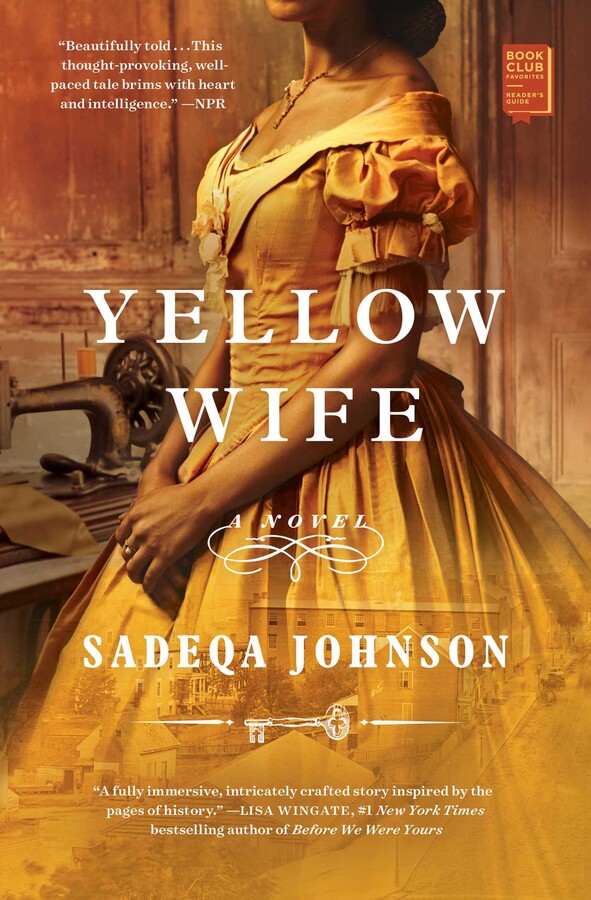
Book Cover Image (jpg): Yellow Wife
eBook 9781982149123
-
Author Photo (jpg): Sadeqa Johnson RhodesPhotoLLC(0.1 MB)
Any use of an author photo must include its respective photo credit