Plus, receive recommendations and exclusive offers on all of your favorite books and authors from Simon & Schuster.
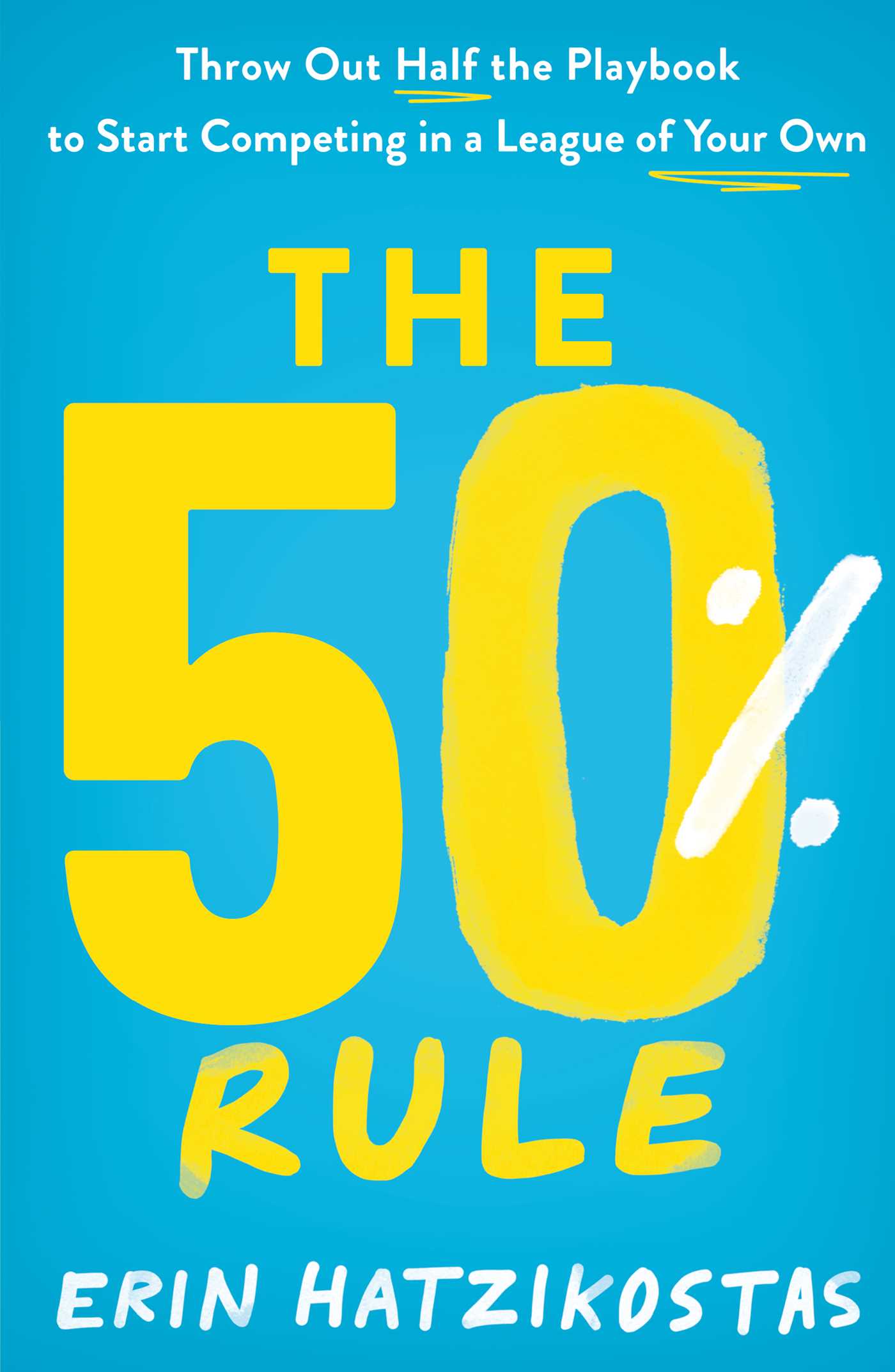
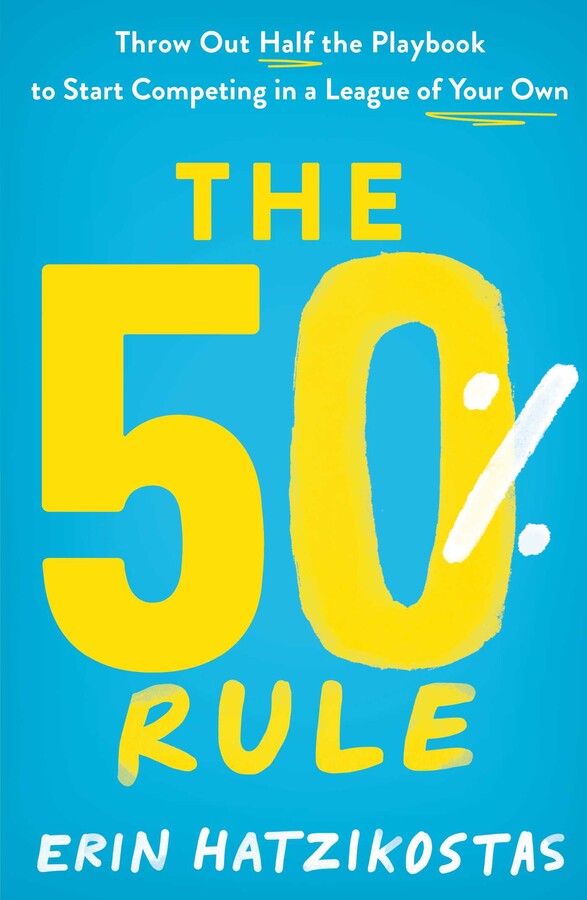
The 50% Rule
Throw Out Half the Playbook to Start Competing in a League of Your Own
Published by Urano Publishing
Distributed by Simon & Schuster
Table of Contents
About The Book
"I started to see that The 50% Rule was the thread, and best-kept secret, that connects some of the most successful people, products, and companies in the world." -Erin Hatzikostas
Discover the power of half with this innovative new approach to authenticity and success.
In The 50% Rule, award-winning author and former CEO Erin Hatzikostas unveils the creative shortcut that has helped her and so many others go from underdog status to unmatched success in career and daily life. The 50% Rule is a simple compromise: Do things half-normal, half-you--and work half as hard--for amazing results that are grounded in your authentic strengths.
In a guide that weaves together actionable advice, compelling research, and dynamic storytelling (with a sprinkle of salty language), you'll learn how to stop 100%ing your problems and start approaching them with the ease of 50%. The 50% Rule is your loving kick in the pants to:
Whether you're applying The 50% Rule to the novel you're writing, the product you're launching, or even how you dress, Hatzikostas shows you how The Rule will liberate you from life's mini hurdles and launch you to new heights.
Discover the power of half with this innovative new approach to authenticity and success.
In The 50% Rule, award-winning author and former CEO Erin Hatzikostas unveils the creative shortcut that has helped her and so many others go from underdog status to unmatched success in career and daily life. The 50% Rule is a simple compromise: Do things half-normal, half-you--and work half as hard--for amazing results that are grounded in your authentic strengths.
In a guide that weaves together actionable advice, compelling research, and dynamic storytelling (with a sprinkle of salty language), you'll learn how to stop 100%ing your problems and start approaching them with the ease of 50%. The 50% Rule is your loving kick in the pants to:
- Mix old ideas with new ones and embrace all your weirdness to achieve innovation that feels true to you.
- Do away with binary thinking for problem-solving that addresses your needs and others'.
- Take what you need and nothing else from your friends, coworkers, and family's advice.
- Go off the beaten path and have adventures to find unexpected solutions to personal, business, and creative challenges.
Whether you're applying The 50% Rule to the novel you're writing, the product you're launching, or even how you dress, Hatzikostas shows you how The Rule will liberate you from life's mini hurdles and launch you to new heights.
Excerpt
Chapter 6
WELCOME IN YOUR WEAKNESSES AND YOUR WEIRD
I ran the hurdles in high school for our track and field team. As a five-foot, not-quite-three-inch-tall human, this was a bit ludicrous. My vertical limitation definitely made it more challenging to get over each metal tower of terror. In addition to being short, I wasn't the fastest runner on the team. And Lord knows I'm about the least flexible human on the planet.
But, despite these limitations, I had a great track "career." I certainly wasn't an all-state runner, but I won several races throughout my years in track. I even held my high school's 300-meter hurdles record for a while.
People often asked me why I ran the hurdles, and I never had a good answer. Until about a year ago. I realized that running the hurdles was part of my Personal Pattern (PP). That is, I chose the hurdles because fewer people ran the hurdles than other races. It was one of the more unusual track races.
When I dug deep into the truth behind this, I realized it was a rationale that's been on repeat for me for much of my life: that it's easier to fumble through the unusual than to compete in the usual.
It's easier to fumble through the unusual than to compete in the usual.
I don't know when or why it started, but throughout my life, my PP has manifested in several ways. A few examples:
? I selected my undergraduate college based on where most people in my high school weren't going.
? Out of approximately 35,000 other students, I was the only person in my graduating class with my degree-a statistics major from the business college.
? My lucky number is thirteen.
? I joined a division of our larger company at a time when it wasn't necessarily the "cool" place to work (and eventually became its CEO).
? I only like dancing when or where I'm not supposed to dance. Think: no-go on the discothèque and hell-yes at a team meeting.
? And credit goes to the Universe on this one: I married a man who gave me a last name that makes me the ONLY Erin Hatzikostas in the world. Or at least on the Internet.
Now that I'm a more self-reflective human, I realize that this PP says more about me than just "being deviant." I recognize that constantly having a radar to look past the usual and appreciate the unusual has allowed me to safeguard myself from those nasty Comparison Cramps and Copying Calluses (see page 000 for a refresher) that so easily sneak up when I'm Sleeprunning through work and life.
The 50% Rule is the compass on my radar. And it can be yours, too. Using The 50% Rule as your guide, you inherently upend the usual to embrace the unusual. You no longer sit in a world where grinding it out is the key to success because YOU'RE NOT COPYING WHAT ANYONE ELSE IS DOING. You're running your own race, jumping your own hurdles, dancing where fewer seasoned dancers dance.
Look at what everyone else is doing, then refuse to do more than half of it the same way.
When Alfred was growing up, he was your classic nerd. After entering kindergarten a year early and then skipping second grade, he was set up perfectly for all the stereotypes and bullying one would expect a nerdy adolescent to get during his school years. To add to his nerd pedigree, one day, when Alfred was seven, his parents bought accordion lessons from a door-to-door salesperson, putting arguably the most uncool instrument into the hands of the already-oddest duck in school.
While Alfred didn't resist learning the accordion, he also loved pop music. He would listen to more traditional radio songs only after his parents fell asleep (his mom wasn't a big fan of the language and suggestive things that come with pop music). His favorite song to play (publicly) on the accordion was "Goodbye Yellow Brick Road" by Elton John. But his nerdiness also secretly drew him to a radio show called The Dr. Demento Radio Show, which highlighted unusual artists. Dr. Demento was the first person to give Alfred permission to not do "usual."
When Alfred was in college, he started to 50% Rule music. He was a DJ at his university and often searched for unusual music. Not too long into his time as a DJ, he quickly took on a nickname: Weird Al.
As you probably know, Weird Al and his iconic music parodies went on to make him famous. He brought something new, not just to odd stations like The Dr. Demento Radio Show, but to the mainstream, and he became one of the most successful music artists ever. In fact, he became more famous than some of the artists he parodied!
Weird Al perfectly executed The 50% Rule. He blended pop music with nerdy humor to create something fresh and new. And in a twist of 50% Rule irony, only about half the songs he made were parodies. The other half were 100% original.
It's easy to suppress your weaknesses and weirdnesses while sleeprunning on that treadmill. You get caught up in the "exceed to succeed" game. Instead, you should play the "stand out to succeed" game.
Stop outplaying others and start out-uniquing others.
My friend Shelley Brown is a global keynote speaker and author of Weird Girl Adventures from A to Z. Through her work, she asks, "What if weird wasn't weird?" and argues that our "weird" actually brings us all together.
What if your weird wasn't weird but rather the thing that helps you stand out? The thing that connects you with others? What if your weirdness is the foundation for bringing something new into the world that others crave? Ask yourself these questions, and maybe write down your answers!
? What quirk of yours have you always been a bit embarrassed by?
? What is something you see that others don't?
? What do you love doing that most people hate to do?
? What are you known for?
? What are two highly juxtaposed things you're good at?
? Where do you think people are yearning for something fresh and new?
When you get soft serve ice cream, what do you order? If you're like most people, it's not vanilla, and it's not chocolate. You order a twist. You prefer a little of this and a little of that. Because despite chocolate being the best-tasting thing on the face of this Earth, it just feels a little one-note, doesn't it? Why would you get that when you can get two things swirled into one?
Another friend of mine, Christina Glickman (author of Xtra: The Art of Being), is a fashionista. Her style rivals models' seen in fancy magazines. In fact, in 2022, she attended Paris Fashion Week, and a photo was taken of her on the street that was later featured in both Elle and Harper's Bazaar.
Whenever I pick her brain on fashion, her number-one suggestion is to purposefully not be "matchy-matchy." She loves wearing a pink top and red pants. She highly encourages an Adidas tracksuit to be split up-pairing the jacket with a fancier shirt or pairing the bottoms with a dressier jacket. When I gave my first keynote on The 50% Rule, I took her advice and sported black Adidas track bottoms with a formal leather jacket. Boom.
In many ways, The 50% Rule helps us stop being so matchy-matchy. 'Cause matchy-matchy kind of sucks. It's boring. It's predictable. And it only turns out awesome if your matchiness is better than everyone else's matchiness. Which is soooo hard to do.
Instead, like Christina does with her fashion, collect unique things and keep some staples in your closet. Mix your black Adidas tracksuit jacket with your green silk top. Dress up your basic white t-shirt with a fancy tie around your neck. Do this with more than just your outfits. Do this with your meetings. Do this with your job. Do this with your career. Do this with your next project. Do this with your business marketing. Stop being matchy-matchy!
You're already a master mixologist in so many ways. So why can't you do that in your professional life? Why does your profession have to be defined the way everyone else defines it? Why can't your weird passions collide? Who says your weaknesses and weirdnesses can't be the things that bring you, your career, and/or your business onto the workplace Top 40 charts?
And as you keep taking one more step towards out-uniquing others, just keep your Polka Face and do a little yodel to yourself.
WELCOME IN YOUR WEAKNESSES AND YOUR WEIRD
I ran the hurdles in high school for our track and field team. As a five-foot, not-quite-three-inch-tall human, this was a bit ludicrous. My vertical limitation definitely made it more challenging to get over each metal tower of terror. In addition to being short, I wasn't the fastest runner on the team. And Lord knows I'm about the least flexible human on the planet.
But, despite these limitations, I had a great track "career." I certainly wasn't an all-state runner, but I won several races throughout my years in track. I even held my high school's 300-meter hurdles record for a while.
People often asked me why I ran the hurdles, and I never had a good answer. Until about a year ago. I realized that running the hurdles was part of my Personal Pattern (PP). That is, I chose the hurdles because fewer people ran the hurdles than other races. It was one of the more unusual track races.
When I dug deep into the truth behind this, I realized it was a rationale that's been on repeat for me for much of my life: that it's easier to fumble through the unusual than to compete in the usual.
It's easier to fumble through the unusual than to compete in the usual.
I don't know when or why it started, but throughout my life, my PP has manifested in several ways. A few examples:
? I selected my undergraduate college based on where most people in my high school weren't going.
? Out of approximately 35,000 other students, I was the only person in my graduating class with my degree-a statistics major from the business college.
? My lucky number is thirteen.
? I joined a division of our larger company at a time when it wasn't necessarily the "cool" place to work (and eventually became its CEO).
? I only like dancing when or where I'm not supposed to dance. Think: no-go on the discothèque and hell-yes at a team meeting.
? And credit goes to the Universe on this one: I married a man who gave me a last name that makes me the ONLY Erin Hatzikostas in the world. Or at least on the Internet.
Now that I'm a more self-reflective human, I realize that this PP says more about me than just "being deviant." I recognize that constantly having a radar to look past the usual and appreciate the unusual has allowed me to safeguard myself from those nasty Comparison Cramps and Copying Calluses (see page 000 for a refresher) that so easily sneak up when I'm Sleeprunning through work and life.
The 50% Rule is the compass on my radar. And it can be yours, too. Using The 50% Rule as your guide, you inherently upend the usual to embrace the unusual. You no longer sit in a world where grinding it out is the key to success because YOU'RE NOT COPYING WHAT ANYONE ELSE IS DOING. You're running your own race, jumping your own hurdles, dancing where fewer seasoned dancers dance.
Look at what everyone else is doing, then refuse to do more than half of it the same way.
When Alfred was growing up, he was your classic nerd. After entering kindergarten a year early and then skipping second grade, he was set up perfectly for all the stereotypes and bullying one would expect a nerdy adolescent to get during his school years. To add to his nerd pedigree, one day, when Alfred was seven, his parents bought accordion lessons from a door-to-door salesperson, putting arguably the most uncool instrument into the hands of the already-oddest duck in school.
While Alfred didn't resist learning the accordion, he also loved pop music. He would listen to more traditional radio songs only after his parents fell asleep (his mom wasn't a big fan of the language and suggestive things that come with pop music). His favorite song to play (publicly) on the accordion was "Goodbye Yellow Brick Road" by Elton John. But his nerdiness also secretly drew him to a radio show called The Dr. Demento Radio Show, which highlighted unusual artists. Dr. Demento was the first person to give Alfred permission to not do "usual."
When Alfred was in college, he started to 50% Rule music. He was a DJ at his university and often searched for unusual music. Not too long into his time as a DJ, he quickly took on a nickname: Weird Al.
As you probably know, Weird Al and his iconic music parodies went on to make him famous. He brought something new, not just to odd stations like The Dr. Demento Radio Show, but to the mainstream, and he became one of the most successful music artists ever. In fact, he became more famous than some of the artists he parodied!
Weird Al perfectly executed The 50% Rule. He blended pop music with nerdy humor to create something fresh and new. And in a twist of 50% Rule irony, only about half the songs he made were parodies. The other half were 100% original.
It's easy to suppress your weaknesses and weirdnesses while sleeprunning on that treadmill. You get caught up in the "exceed to succeed" game. Instead, you should play the "stand out to succeed" game.
Stop outplaying others and start out-uniquing others.
My friend Shelley Brown is a global keynote speaker and author of Weird Girl Adventures from A to Z. Through her work, she asks, "What if weird wasn't weird?" and argues that our "weird" actually brings us all together.
What if your weird wasn't weird but rather the thing that helps you stand out? The thing that connects you with others? What if your weirdness is the foundation for bringing something new into the world that others crave? Ask yourself these questions, and maybe write down your answers!
? What quirk of yours have you always been a bit embarrassed by?
? What is something you see that others don't?
? What do you love doing that most people hate to do?
? What are you known for?
? What are two highly juxtaposed things you're good at?
? Where do you think people are yearning for something fresh and new?
When you get soft serve ice cream, what do you order? If you're like most people, it's not vanilla, and it's not chocolate. You order a twist. You prefer a little of this and a little of that. Because despite chocolate being the best-tasting thing on the face of this Earth, it just feels a little one-note, doesn't it? Why would you get that when you can get two things swirled into one?
Another friend of mine, Christina Glickman (author of Xtra: The Art of Being), is a fashionista. Her style rivals models' seen in fancy magazines. In fact, in 2022, she attended Paris Fashion Week, and a photo was taken of her on the street that was later featured in both Elle and Harper's Bazaar.
Whenever I pick her brain on fashion, her number-one suggestion is to purposefully not be "matchy-matchy." She loves wearing a pink top and red pants. She highly encourages an Adidas tracksuit to be split up-pairing the jacket with a fancier shirt or pairing the bottoms with a dressier jacket. When I gave my first keynote on The 50% Rule, I took her advice and sported black Adidas track bottoms with a formal leather jacket. Boom.
In many ways, The 50% Rule helps us stop being so matchy-matchy. 'Cause matchy-matchy kind of sucks. It's boring. It's predictable. And it only turns out awesome if your matchiness is better than everyone else's matchiness. Which is soooo hard to do.
Instead, like Christina does with her fashion, collect unique things and keep some staples in your closet. Mix your black Adidas tracksuit jacket with your green silk top. Dress up your basic white t-shirt with a fancy tie around your neck. Do this with more than just your outfits. Do this with your meetings. Do this with your job. Do this with your career. Do this with your next project. Do this with your business marketing. Stop being matchy-matchy!
You're already a master mixologist in so many ways. So why can't you do that in your professional life? Why does your profession have to be defined the way everyone else defines it? Why can't your weird passions collide? Who says your weaknesses and weirdnesses can't be the things that bring you, your career, and/or your business onto the workplace Top 40 charts?
And as you keep taking one more step towards out-uniquing others, just keep your Polka Face and do a little yodel to yourself.
Product Details
- Publisher: Urano Publishing (October 1, 2024)
- Length: 288 pages
- ISBN13: 9781953027443
Browse Related Books
Resources and Downloads
High Resolution Images
-
Book Cover Image (jpg): The 50% Rule
Trade Paperback 9781953027443