
Plus, receive recommendations and exclusive offers on all of your favorite books and authors from Simon & Schuster.
Published by Bear & Company
Distributed by Simon & Schuster
Table of Contents
About The Book
• Explores ancient Mesopotamian astrology, which originated with those who created Göbekli Tepe, and details the system’s eighteen zodiac signs
• Shares the author’s decades-long research to decipher the meanings and characteristics behind each of the original eighteen signs
• Shows how the original zodiac can enrich and expand our understanding of astrology, personal relationships, and our sense of self and destiny
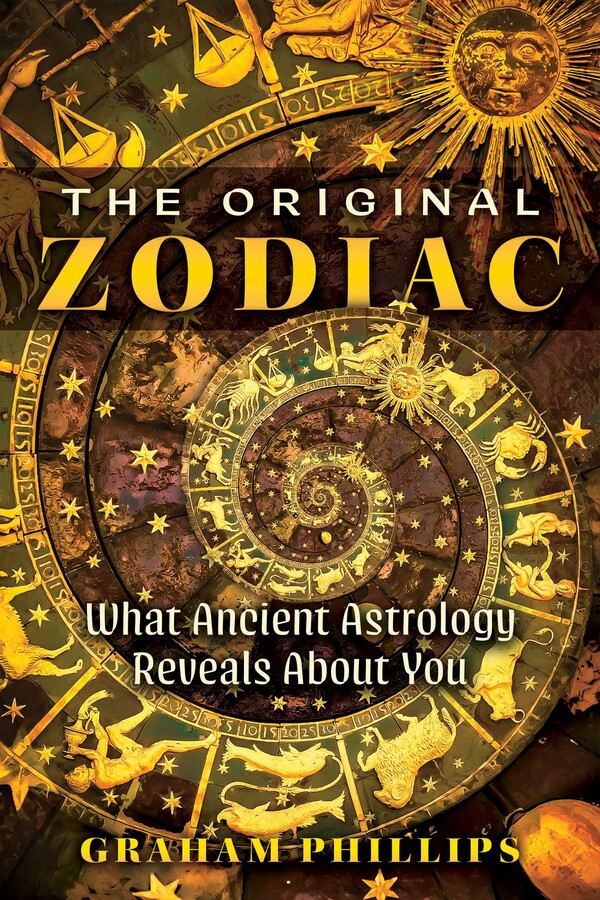
Today the zodiac is divided into twelve signs through which the sun appears to travel in a year. A person’s sign can influence their personality, physical characteristics, and fate. However, in ancient Mesopotamia, the first zodiac was divided into eighteen signs—different from the Western and Vedic systems in use today. The Original Zodiac reveals, for the first time in more than 4,000 years, this earliest known system of astrology.
The original Mesopotamian zodiac offered very different birth signs, including the Serpent, Swan, Crane, Horse, Wolf, and Eagle. This zodiac was recorded on a clay tablet that is now housed in the British Museum, cataloged as BM 86378, but there is no written record of how these signs were interpreted. Now, after decades of intensive research, Graham Phillips reveals the meanings of these mysterious signs and their relevance for our times.
To determine what traits might be shared by those born in each sign of the original zodiac, Phillips comprehensively surveyed hundreds of volunteers from diverse backgrounds. He measured each participant’s likes, dislikes, hobbies, habits, employment, health information, and other pertinent aspects of their lives and identities. Not intended to replace or challenge our traditional understanding of astrology, his findings offer an original system to enrich our current knowledge of the personality, character, and destiny of those born in each of its enigmatic signs.
• Shares the author’s decades-long research to decipher the meanings and characteristics behind each of the original eighteen signs
• Shows how the original zodiac can enrich and expand our understanding of astrology, personal relationships, and our sense of self and destiny
Today the zodiac is divided into twelve signs through which the sun appears to travel in a year. A person’s sign can influence their personality, physical characteristics, and fate. However, in ancient Mesopotamia, the first zodiac was divided into eighteen signs—different from the Western and Vedic systems in use today. The Original Zodiac reveals, for the first time in more than 4,000 years, this earliest known system of astrology.
The original Mesopotamian zodiac offered very different birth signs, including the Serpent, Swan, Crane, Horse, Wolf, and Eagle. This zodiac was recorded on a clay tablet that is now housed in the British Museum, cataloged as BM 86378, but there is no written record of how these signs were interpreted. Now, after decades of intensive research, Graham Phillips reveals the meanings of these mysterious signs and their relevance for our times.
To determine what traits might be shared by those born in each sign of the original zodiac, Phillips comprehensively surveyed hundreds of volunteers from diverse backgrounds. He measured each participant’s likes, dislikes, hobbies, habits, employment, health information, and other pertinent aspects of their lives and identities. Not intended to replace or challenge our traditional understanding of astrology, his findings offer an original system to enrich our current knowledge of the personality, character, and destiny of those born in each of its enigmatic signs.
Excerpt
The Greek Zodiac
The zodiac we know today was devised by the Greeks around 300 BCE. Each of its 12 signs shares a name with a stellar constellation. But how did they get their names? They are not recognizable in the pictorial sense. Who could claim, for example, that the Y-shaped arrangement of stars that form the Cancer constellation in any way resembles a crab or that the line of stars forming Aries remotely resembles a ram? The stars that fall in each sign could be joined by lines to make any conceivable shape. Indeed, throughout history, separate cultures have imagined the stars to form very different patterns in the sky. For example, the Egyptians regarded the stars of Taurus as a turtle,1 the Chinese saw Virgo as a horn,2 and the Mayans envisaged Aquarius as a bat.3 Well, it was for astrological rather than astronomical reasons.
The signs were chosen not for the constellation’s resemblance to what they were named after but for the symbolic qualities they represented. Ancient astrologers believed that birth dates shaped human characteristics, and the zodiac sector in which the sun was present at birth was deemed responsible. The sign was, therefore, named after a creature or mythical figure that best symbolized the character and personality traits of those born in the sign, and its stars eventually incorporated into the associated pictorial image. For example, someone born with the sun in Aries was not considered to have inherited ram-like qualities because the constellation looked anything like a ram; the ram was chosen as an image for the sign once ram-like qualities had been observed in people born at that time of year. Similarly, a person born during the sign of Leo was not thought to have inherited lionlike qualities from the constellation; the lion was chosen after lion-like qualities had been observed in people born when the sun was in that sector of the zodiac. The same applies to the signs symbolized by mythical figures rather than animals. Their attributes were similarly considered to epitomize those born in the sign named after them. Aquarius, the water carrier, was the romantic hero Ganymede; Virgo, the maiden, was Astraea, goddess of precision; Libra, the scales, was the symbol for Themis, the goddess of justice; Sagittarius, the archer, was the benevolent centaur Chiron; and Gemini, the twins, were the adventuring Argonauts Castor and Pollux.4
The Mesopotamian Zodiac
The ancient Greeks did not invent the zodiac concept; they were influenced by the Babylonians. Ancient Babylon was a thriving city-state in Mesopotamia, located near the Euphrates River in present-day Iraq. It emerged as a cultural and political powerhouse during the reign of Hammurabi (1792–1750 BCE), who is renowned for the Code of Hammurabi, one of the earliest written legal codes. Babylon became a hub of innovation, trade, and governance, blending Sumerian, Akkadian, and Semitic influences. The city reached its zenith under King Nebuchadnezzar II (605–562 BCE). His architectural achievements included the famed Hanging Gardens, one of the Seven Wonders of the Ancient World, and the magnificent Ishtar Gate. These symbolized Babylon’s wealth and architectural prowess. The ziggurat of Etemenanki, believed to inspire the biblical Tower of Babel, demonstrated their dedication to religion and astronomy. Babylon was a center of learning, contributing to advancements in mathematics, astronomy, and literature. It is home to the Epic of Gilgamesh, one of the oldest surviving literary works.5
The Babylonians had an earlier version of the 12-sign zodiac, which included signs of familiar creatures like a bull, crab, and lion and different animals such as a swallow, wolf, and swan. Indeed, all these earlier signs were named after animals, which is why they were collectively called the zodiac.6 Our modern word comes from the Greek zodiakós kýklos, meaning “cycle of animals.” Only later were five of the animals replaced with Hellenic symbolism that confusingly now bears the Latin names Aquarius, Virgo, Libra, Sagittarius, and Gemini.7
The history of the zodiac goes back further. Babylon had existed for two millennia before they adopted this 12-sign zodiac; their earlier astrologers employed a very different one with 18 signs. It is known from various fragmentary texts, but the oldest complete description survives on a clay tablet dating from 686 BCE found during excavations of the ancient city of Nineveh in Mosul, northern Iraq.8 Now in the British Museum and cataloged as BM 86378, the text references all the signs without directly revealing which stars they were associated with, except the first. It is referred to as the Star Cluster, identified as what is now called the Pleiades, or the Seven Sisters, a close grouping of stars in the constellation of Taurus, which they called the Spider.
This first sign began on the spring equinox and was followed by the others, each representing 20 degrees of the zodiac. The BM 86378 text reveals that they were symbolized by animals, some of this symbolism surviving until Greek times, with such signs as the Lion, the Scorpion, and the Bull. However, they were originally denoted by different stars, ascribed to other sectors in the zodiac band, and concerned different times of the year to the modern zodiac. The tablet alone does not clarify some of these, having names like The Great One, the god Pabilsaĝ, and the goddess Annunitum. Fortunately, they can be established by other surviving texts included in over 30,000 inscribed clay tablets found in 1851 during excavations of Nineveh by the English archeologist Austen Layard. Dating from the seventh century BCE, they include various astronomical texts from which the imagery of the early zodiac signs can be determined. Like the later 12-sign Babylonian zodiac, they were all represented by animals.9 They are, in order: Spider, Orox, Mouflon, Vulture, Gazelle, Serpent, Crayfish, Lion, Swan, Crane, Scorpion, Horse, Goat, Wolf, Fish, Swallow, Eagle, and Fox.
Astonishingly, the BM 86378 tablet also reveals that this 18-sign zodiac must have been devised well before the Babylonians. It all concerns a planetary phenomenon termed axial precession. Also called the precession of the equinoxes, axial precession is the slow and continuous change in the Earth’s rotational axis. Imagine a straight bar through the planet, sticking out into space on either side at the north and south poles. During axial precession, although the bar remains at an angle of approximately 23.5 away from upright, each end traces a complete circle through space roughly every 26,000 years. Accordingly, every 2,166 years, the sun appears to move back a sign.10
When the Greeks created their zodiac around 2300 years ago, between March 21 and April 19—what we now consider Aries—the sun was indeed in the zodiac segment dominated by the Aries constellation. However, today, between those dates, the sun is now in the zodiac sector dominated by the constellation Pisces. The same applies to every sign: they have all moved back one. What had been Taurus is now Aries, what was Gemini is now Taurus, what was Cancer is now Gemini, and so on.11 If you have doubts, check an online planetarium. Enter your date of birth and see which constellations the sun is in—it will be the one before your familiar sign. But if you swear by your birth sign, there’s no need to worry. As far as astrology is concerned, anyone born in the 30 days following the spring equinox is nevertheless born in the zodiac sector symbolized by the ram—precisely like in ancient Greece—it’s just that the sun is now in the 30-degree zodiac segment dominated by the Pisces constellation. The same goes for all the signs. (Remember, it’s the time of the year you were born that is thought to determine human characteristics and character traits, not the stars with which the sun aligns.) Which brings us back to the BM 86378 tablet.
As mentioned, the constellation referred to as the Star Cluster, the Spider, is identified as the Pleiades. Aries is the first sign of the Greek zodiac because it was created around 300 BCE when the sun was in the Aries constellation at the spring equinox. If the 18-sign zodiac was contrived when the sun was near the Pleiades constellation at the spring equinox, it had to have been devised millennia before the Babylonian civilization arose. Because of axial precession, the last time the sun was close to the Pleiades at that time of year was some 7,000 years ago.12 This means that for the Pleiades to have been the first sign, this 18-sign zodiac must have been compiled as long ago as 5000 BCE. This is over 2,000 years before the building of Stonehenge and the pyramids of Egypt, making it, by far, the oldest known zodiac devised anywhere in the world. (Again, you can check this with any online planetarium. Enter March 21, 5000 BCE, and you’ll see the sun next to the Pleiades.) Amazingly, this 18-sign zodiac may be even older.
The zodiac we know today was devised by the Greeks around 300 BCE. Each of its 12 signs shares a name with a stellar constellation. But how did they get their names? They are not recognizable in the pictorial sense. Who could claim, for example, that the Y-shaped arrangement of stars that form the Cancer constellation in any way resembles a crab or that the line of stars forming Aries remotely resembles a ram? The stars that fall in each sign could be joined by lines to make any conceivable shape. Indeed, throughout history, separate cultures have imagined the stars to form very different patterns in the sky. For example, the Egyptians regarded the stars of Taurus as a turtle,1 the Chinese saw Virgo as a horn,2 and the Mayans envisaged Aquarius as a bat.3 Well, it was for astrological rather than astronomical reasons.
The signs were chosen not for the constellation’s resemblance to what they were named after but for the symbolic qualities they represented. Ancient astrologers believed that birth dates shaped human characteristics, and the zodiac sector in which the sun was present at birth was deemed responsible. The sign was, therefore, named after a creature or mythical figure that best symbolized the character and personality traits of those born in the sign, and its stars eventually incorporated into the associated pictorial image. For example, someone born with the sun in Aries was not considered to have inherited ram-like qualities because the constellation looked anything like a ram; the ram was chosen as an image for the sign once ram-like qualities had been observed in people born at that time of year. Similarly, a person born during the sign of Leo was not thought to have inherited lionlike qualities from the constellation; the lion was chosen after lion-like qualities had been observed in people born when the sun was in that sector of the zodiac. The same applies to the signs symbolized by mythical figures rather than animals. Their attributes were similarly considered to epitomize those born in the sign named after them. Aquarius, the water carrier, was the romantic hero Ganymede; Virgo, the maiden, was Astraea, goddess of precision; Libra, the scales, was the symbol for Themis, the goddess of justice; Sagittarius, the archer, was the benevolent centaur Chiron; and Gemini, the twins, were the adventuring Argonauts Castor and Pollux.4
The Mesopotamian Zodiac
The ancient Greeks did not invent the zodiac concept; they were influenced by the Babylonians. Ancient Babylon was a thriving city-state in Mesopotamia, located near the Euphrates River in present-day Iraq. It emerged as a cultural and political powerhouse during the reign of Hammurabi (1792–1750 BCE), who is renowned for the Code of Hammurabi, one of the earliest written legal codes. Babylon became a hub of innovation, trade, and governance, blending Sumerian, Akkadian, and Semitic influences. The city reached its zenith under King Nebuchadnezzar II (605–562 BCE). His architectural achievements included the famed Hanging Gardens, one of the Seven Wonders of the Ancient World, and the magnificent Ishtar Gate. These symbolized Babylon’s wealth and architectural prowess. The ziggurat of Etemenanki, believed to inspire the biblical Tower of Babel, demonstrated their dedication to religion and astronomy. Babylon was a center of learning, contributing to advancements in mathematics, astronomy, and literature. It is home to the Epic of Gilgamesh, one of the oldest surviving literary works.5
The Babylonians had an earlier version of the 12-sign zodiac, which included signs of familiar creatures like a bull, crab, and lion and different animals such as a swallow, wolf, and swan. Indeed, all these earlier signs were named after animals, which is why they were collectively called the zodiac.6 Our modern word comes from the Greek zodiakós kýklos, meaning “cycle of animals.” Only later were five of the animals replaced with Hellenic symbolism that confusingly now bears the Latin names Aquarius, Virgo, Libra, Sagittarius, and Gemini.7
The history of the zodiac goes back further. Babylon had existed for two millennia before they adopted this 12-sign zodiac; their earlier astrologers employed a very different one with 18 signs. It is known from various fragmentary texts, but the oldest complete description survives on a clay tablet dating from 686 BCE found during excavations of the ancient city of Nineveh in Mosul, northern Iraq.8 Now in the British Museum and cataloged as BM 86378, the text references all the signs without directly revealing which stars they were associated with, except the first. It is referred to as the Star Cluster, identified as what is now called the Pleiades, or the Seven Sisters, a close grouping of stars in the constellation of Taurus, which they called the Spider.
This first sign began on the spring equinox and was followed by the others, each representing 20 degrees of the zodiac. The BM 86378 text reveals that they were symbolized by animals, some of this symbolism surviving until Greek times, with such signs as the Lion, the Scorpion, and the Bull. However, they were originally denoted by different stars, ascribed to other sectors in the zodiac band, and concerned different times of the year to the modern zodiac. The tablet alone does not clarify some of these, having names like The Great One, the god Pabilsaĝ, and the goddess Annunitum. Fortunately, they can be established by other surviving texts included in over 30,000 inscribed clay tablets found in 1851 during excavations of Nineveh by the English archeologist Austen Layard. Dating from the seventh century BCE, they include various astronomical texts from which the imagery of the early zodiac signs can be determined. Like the later 12-sign Babylonian zodiac, they were all represented by animals.9 They are, in order: Spider, Orox, Mouflon, Vulture, Gazelle, Serpent, Crayfish, Lion, Swan, Crane, Scorpion, Horse, Goat, Wolf, Fish, Swallow, Eagle, and Fox.
Astonishingly, the BM 86378 tablet also reveals that this 18-sign zodiac must have been devised well before the Babylonians. It all concerns a planetary phenomenon termed axial precession. Also called the precession of the equinoxes, axial precession is the slow and continuous change in the Earth’s rotational axis. Imagine a straight bar through the planet, sticking out into space on either side at the north and south poles. During axial precession, although the bar remains at an angle of approximately 23.5 away from upright, each end traces a complete circle through space roughly every 26,000 years. Accordingly, every 2,166 years, the sun appears to move back a sign.10
When the Greeks created their zodiac around 2300 years ago, between March 21 and April 19—what we now consider Aries—the sun was indeed in the zodiac segment dominated by the Aries constellation. However, today, between those dates, the sun is now in the zodiac sector dominated by the constellation Pisces. The same applies to every sign: they have all moved back one. What had been Taurus is now Aries, what was Gemini is now Taurus, what was Cancer is now Gemini, and so on.11 If you have doubts, check an online planetarium. Enter your date of birth and see which constellations the sun is in—it will be the one before your familiar sign. But if you swear by your birth sign, there’s no need to worry. As far as astrology is concerned, anyone born in the 30 days following the spring equinox is nevertheless born in the zodiac sector symbolized by the ram—precisely like in ancient Greece—it’s just that the sun is now in the 30-degree zodiac segment dominated by the Pisces constellation. The same goes for all the signs. (Remember, it’s the time of the year you were born that is thought to determine human characteristics and character traits, not the stars with which the sun aligns.) Which brings us back to the BM 86378 tablet.
As mentioned, the constellation referred to as the Star Cluster, the Spider, is identified as the Pleiades. Aries is the first sign of the Greek zodiac because it was created around 300 BCE when the sun was in the Aries constellation at the spring equinox. If the 18-sign zodiac was contrived when the sun was near the Pleiades constellation at the spring equinox, it had to have been devised millennia before the Babylonian civilization arose. Because of axial precession, the last time the sun was close to the Pleiades at that time of year was some 7,000 years ago.12 This means that for the Pleiades to have been the first sign, this 18-sign zodiac must have been compiled as long ago as 5000 BCE. This is over 2,000 years before the building of Stonehenge and the pyramids of Egypt, making it, by far, the oldest known zodiac devised anywhere in the world. (Again, you can check this with any online planetarium. Enter March 21, 5000 BCE, and you’ll see the sun next to the Pleiades.) Amazingly, this 18-sign zodiac may be even older.
Product Details
- Publisher: Bear & Company (October 28, 2025)
- Length: 208 pages
- ISBN13: 9781591435426
Browse Related Books
Raves and Reviews
“Graham Phillips brings current scientific evidence for astrology together with a rediscovery of the original zodiac in this fascinating and thought-provoking book. Relatable, accessible, and intriguing, it opens new windows into ancient wisdom that we today sorely need.”
– Lynn Picknett and Clive Prince, authors of When God Had a Wife
“Graham Phillips adds a whole new dimension to the world of Göbekli Tepe by showing that behind all the incredible carved art and animal reliefs lies a cohesive system that could well be the beginnings of astrology as we know it. This is an important addition to the ancient mysteries bookshelf.”
– Andrew Collins, author of Karahan Tepe and Göbekli Tepe
“This thoroughly researched book reveals, for the first time to the modern world, the earliest known form of astrology and its zodiac, with roots in the world’s oldest known temple complex, Göbekli Tepe. A groundbreaking work.”
– Deborah Benstead, author of The Inward Revolution
“For decades Graham Phillips has consistently produced remarkable, fresh insights into subjects of perennial interest such as the Ark of the Covenant and the Holy Grail. To give us something new on the zodiac and astrology that combines recent scientific research with ancient history is worthy of note. To make it compellingly readable makes it all the more so.”
– Paul Weston, author of Aleister Crowley and the Aeon of Horus and The Michael Line, the Qabalah and
“Having known Graham for more than 30 years, I can say he is one of the most conscientious and thorough researchers in the esoteric history world. If he says there are grounds to consider a new, groundbreaking theory or concept, you can take it to the bank. Graham Phillips is always ahead of the curve and has been for years! He is a true pioneer of esoteric history, research, and exploration.”
– Mark Ryan, author of Hold Fast and coauthor of The Greenwood Tarot and The Wildwood Tarot
“The Original Zodiac is a thought-provoking and ambitious work that will appeal to anyone interested in ancient history, mythology, and astrology. Phillips offers a compelling argument for re-examining the roots of the zodiac, combining meticulous research with an engaging narrative style. While some of his conclusions may be open to debate, the book succeeds in sparking curiosity and offering new perspectives on an ancient topic that continues to fascinate people today.”
– PJ Spur, Musing Mystical
Resources and Downloads
High Resolution Images
-
Book Cover Image (jpg): The Original Zodiac
eBook 9781591435426





